
Specialist LCD/OLED Supplier
|
|






wide-tempereature display panel
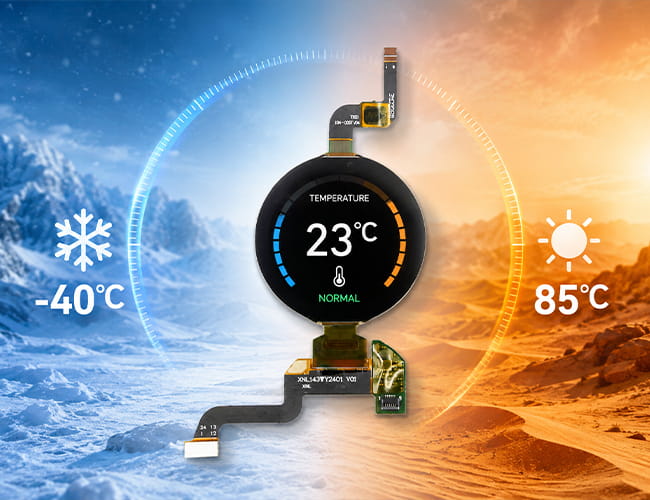
What is Wide Temperature Operation
For some products that need to be used in cold places, such as Russia, Canada, and Southern Europe, or for some military applications, the display panel must work well under - 40 degrees.Wide temperature display panels are designed for devices that need stable performance in cold, hot, outdoor, vehicle, industrial, or rugged environments. Compared with standard indoor displays, they are better suited for products that may face cold starts, direct sunlight, enclosure heat, long operating hours, or changing working conditions.
Panox Display provides wide temperature options across OLED, AMOLED, Micro OLED, Memory LCD, TFT-LCD, flexible AMOLED, mobile display, and industrial LCD products. These displays can be used in AR/VR optics, wearables, handheld instruments, automotive systems, outdoor terminals, and industrial control devices.
-
Size(inch)
- 0.39~1.0
- 1.0~1.9
- 2.0~2.9
- 3.0~3.9
- 4.0~4.9
- 5.0~5.9
- 6.0~6.9
- 7.0~7.9
- 8.0~9.9
- 10~20
-
Interface
- I2C
- SPI
- Parallal
- MCU
- CPU
- RGB
- MIPI
- LVDS
- eDP
- HDMI
-
Display Color
- Monochrome
- Double Color
- Full Color
-
Orientation
- Landscape
- Portrait
| Model | Size | Display Type | Resolution | Interface | Display Brand | Image | ||||||||||
|---|---|---|---|---|---|---|---|---|---|---|---|---|---|---|---|---|

0.39 inch micro OLED For AR
|
0.39 | Micro OLED | 1024x768 | I2C,RGB | PanoxDisplay |
|
||||||||||

0.39 inch Micro OLED For AR Type-c Board
|
0.39 | Micro OLED | 1920x1080 | MIPI | BOE |
|
||||||||||
/049microOLEDico.jpg)
0.49 inch Micro OLED Display 1920X1080 MIPI Interface
|
0.49 | Si-OLED, OLED | 1920(RGB)×1080, FHD 4391PPI | SPI,MIPI | BOE |
|
||||||||||

0.5 inch 1600x1200 Micro OLED 1000 cd luminance 120 Hz
|
0.5 | Micro OLED | 1600x1200 | I2C,MIPI | Panox Display |
|
||||||||||

0.5 inch micro OLED For AR
|
0.5 | Micro OLED | 1024x768 | LVDS | Sony |
|
||||||||||
0.68 inch Micro OLED 5000 Brightness Fast Response
|
0.68 inch | Micro OLED | 1920 × 1200 (WUXGA) | SPI,LVDS | Sony |
|
||||||||||

0.69 inch Graphic OLED Display SSD1306
|
0.69 | PMOLED | 96x16 | I2C,SPI | Visonox/Univision |
|
||||||||||
0.71 inch Micro OLED FHD For AR
|
0.71 | Micro OLED | 1920x1080 | LVDS | Sony |
|
||||||||||

0.71 inch Micro OLED For AR
|
0.71 | Micro OLED | 1920x1080 | I2C,MIPI | BOE |
|
||||||||||

0.71 inch Micro OLED 1920x1080 LVDS 3000 nits
|
0.71 | Silicone based Micro OLED | 1920(RGB)×1080, FHD 3078 PPI | LVDS | Sony |
|
||||||||||

0.95 inch OLED On-cell PACP TP For Wearable Bracelet
|
0.95 | AMOLED | 120(RGB)×240 | SPI,CPU,MIPI | BOE |
|
||||||||||

0.95 inch OLED On-cell PACP TP For Wearable Bracelet
|
0.95 | AMOLED | 120(RGB)×240 | SPI | Truly |
|
What Makes a Display Suitable for Wide Temperature Operation?
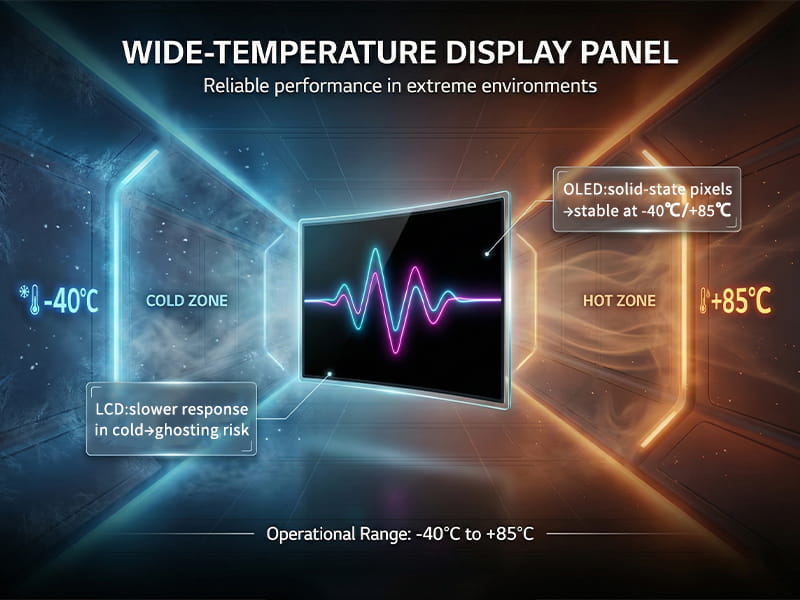
First, most LCDs have a residual shadow in low temperatures, thermotropic liquid crystals are liquid crystal phases that occur as a result of temperature changes. At low temperatures, it is crystalline, and at high temperatures, it becomes liquid, where the melting point (TM) and the clear point (TC) are indicated. Single molecules of liquid crystal have their own melting point and clearing point and exist as liquid crystals at intermediate temperatures. At present, the liquid crystal materials used for display are basically thermotropic liquid crystals. In the thermotropic liquid crystal, the liquid crystal is divided into three types according to the molecular arrangement structure: SMECTIC, NEMATIC, and CHOLESTERIC. Low temperature will cause the liquid crystal to become solid, and the response speed is reduced, resulting in residual shadow.
But OLED pixels are solid-state, so OLED can still work well under low temperatures such as - 40 degrees. BTW, some Memory LCD or Transflective LCD also can work well under -15 degrees.
A wide temperature display should remain usable when the surrounding environment becomes colder or hotter than normal room conditions. This includes stable image output, acceptable response speed, reliable interface communication, and consistent brightness or contrast.
For LCD products, low temperature may slow liquid crystal response and cause image delay or residual shadow. OLED and AMOLED displays are often suitable for compact low-temperature applications because their pixels are self-emissive. Memory LCD and transflective display options can also be useful for low-power outdoor devices.
Common Applications for Wide Temperature Displays
Wide temperature displays are commonly used in vehicle displays, industrial HMIs, handheld terminals, outdoor instruments, medical devices, smart watches, AR/VR viewers, electronic viewfinders, testing equipment, and public service machines.
Different applications need different display solutions. A vehicle console may require a high-brightness LCD with touch support, while an AR optical engine may need a compact Micro OLED. A wearable device may use a small AMOLED or flexible OLED, and a low-power outdoor meter may benefit from Memory LCD.
More About Wide Temperature Display Panels
What Is a Wide Temperature Display? A Practical Guide for Industrial LCD and OLED Selection
Why Is Wide Temperature Operation Important for OLED and LCD Display Products?
Wide Temperature Display Applications: Choosing the Right OLED and LCD Module for Real Product Environments
Customized Service
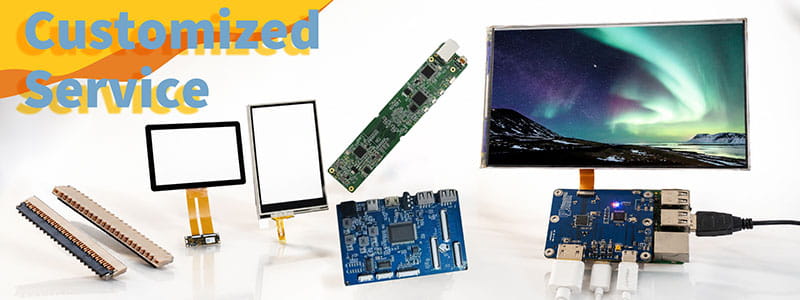
It`s just a beginning to get display panels from us, then clients need to solve cover glass/touch panel, driving board, connectors on PCB.Fortunately Panox Display provide complete display solutions.
Connectors
Panox Display provides free connectors for clients who purchase more than five products from us. Our product range includes connectors from Molex, Kyocera, AXE, AXG, JAE, Hiros, and more.
Cover Glass/Touch Panels
Panox Display provides a customized cover glass/touch panel service. We supply cover glass from Gorilla, AGC, and Panda, which all have excellent optical performance. We also supply driver ICs from Goodix and Focaltech.
Controller/Driver Boards
If your applications are directly connected to a PC, a cellphone, or Raspberry Pi, and you have enough space to insert a board to input video, Panox Display can provide customized Controller/Driver boards with input connections for VGA, HDMI, DVI, DP, Type-C video input, MIPI, RGB, LVDS, and eDP.
The functions of our boards include, but are not limited to, adjustment of brightness, sound output, touch interface, extra data transmission, and gyroscope.
Simple Instructions
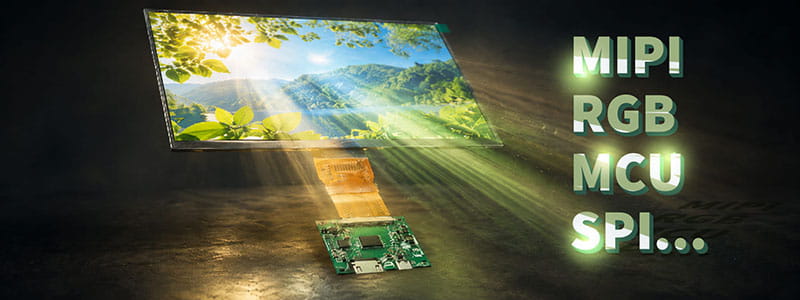
#MIPI# How to Bring Up a MIPI DSI Display: A Practical Guide for Embedded Display Integration.
#MIPI# D-PHY and C-PHY Physical Layer Guide for Display Interfaces.
#MIPI#DSI PCB Layout Guidelines for Reliable Display Interfaces
#SPI#MCU# LCD MCU Interface and SPI Interface Explained: 8080 Parallel vs Serial LCD Connections.
#MIPI# DSI PCB Layout Guidelines for Reliable Display Interfaces
#MIPI# vs #LVDS# Display Interface Differences and Selection Guide
#MIPI DSI# Interface Guide: Protocol, D-PHY, Linux Driver Bring-Up, and Debugging
#POS LCD#How to Build Main and Secondary Display Output for POS Terminals
If our display fit your application, subscrlbe for monthly Insights
Panox Display Professional OLED/LCD Supplier and Manufacturer
- 📍 Shenzhen
- 📞 Phone: 86 755 3396 6409
- 📠 Skype: panoxwesley

If it`s urgent, try to contact
Whatsapp: +86 18665870665
Skype: panoxwesley
QQ: 407417798