
Specialist LCD/OLED Supplier
|
|






qspi display panel
What Does “QSPI Display Panel” Mean?
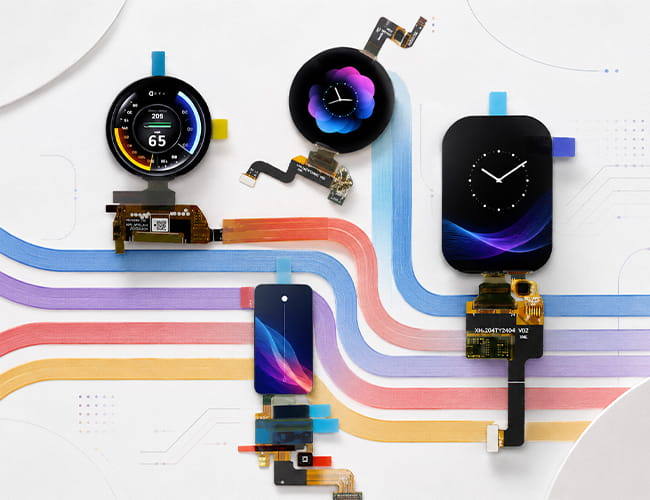
A QSPI display panel is a screen module that uses Quad Serial Peripheral Interface for display communication. Compared with classic SPI, QSPI uses four data lines instead of one, allowing pixel data to move faster while keeping the connection compact and MCU-friendly.
For small AMOLED and OLED modules, QSPI is often used to balance bandwidth, pin count, power efficiency, and development complexity. It is especially common in smartwatch-class displays, compact touch panels, round OLED screens, and embedded products that need a smooth graphical interface without a full MIPI DSI display system.
-
Size(inch)
- 0.39~1.0
- 1.0~1.9
- 2.0~2.9
- 3.0~3.9
- 4.0~4.9
- 5.0~5.9
- 6.0~6.9
- 7.0~7.9
- 8.0~9.9
- 10~20
-
Interface
- I2C
- SPI
- Parallal
- MCU
- CPU
- RGB
- MIPI
- LVDS
- eDP
- HDMI
-
Display Color
- Monochrome
- Double Color
- Full Color
-
Orientation
- Landscape
- Portrait
| Model | Size | Display Type | Resolution | Interface | Display Brand | Image | ||||||||||
|---|---|---|---|---|---|---|---|---|---|---|---|---|---|---|---|---|
/120qspi_round_ico.jpg)
1.2 inch Round OLED 390X390 Q-SPI 60Hz PCAP Touch Panel
|
1.2 | AM-OLED , OLED | 390x390 325 PPI | SPI,MIPI | EDO |
|
||||||||||
1.39 inch Round OLED 454x454 SPI 800 nits
|
1.39 inch | OLED , AM-OLED | 454x454 | SPI,MIPI | BOE |
|
||||||||||
/1_43inchOLEDico.jpg)
1.43 inch AM-OLED Full Color On-cell PCAP Touch
|
1.43 inch | OLED , AMOLED | 466*466 | SPI | Panox Display |
|
||||||||||
/147oled_ico.jpg)
1.47 inch AM-OLED Full Color On-cell PCAP Touch
|
1.47 inch | OLED , AM-OLED | 194x368 | SPI | EDO |
|
||||||||||
/2inchOLEDico.jpg)
2.04 inch AM-OLED Full Color On-cell PCAP Touch
|
2.04 inch | AMOLED | 368x448 | SPI | Truly |
|
Why QSPI Matters for Small AMOLED Displays
QSPI matters because many small displays are no longer simple status screens. A wearable screen may need full-color icons, animated watch faces, touch feedback, health data, notifications, and smooth UI transitions. Classic SPI may become too slow for this type of interface, while MIPI DSI may be too complex for MCU-based products.
With four data lanes, QSPI provides higher practical bandwidth than single-line SPI while keeping the FPC, connector, and PCB routing relatively compact. This makes it a strong choice for small AMOLED displays used in smartwatches, fitness trackers, handheld controls, smart home devices, security terminals, and portable instruments.
Common Applications for QSPI Display Panels
QSPI display panels are commonly used in smartwatches, fitness trackers, wearable medical devices, compact handheld devices, remote controls, smart home control panels, electronic locks, security terminals, portable instruments, and MCU-based IoT products.
Different applications need different display formats. A round AMOLED may work well for watches, rotary controls, and smart home knobs, while a vertical AMOLED panel may be better for compact handheld devices, remote controls, and notification-style interfaces. QSPI helps these products achieve richer UI performance without requiring a large display subsystem.
Explore QSPI Display Solutions from Panox Display
Panox Display provides QSPI display panels for wearable devices, smart controls, portable electronics, security products, medical devices, and compact embedded systems.
Our QSPI display selection includes round OLED modules, smartwatch AMOLED screens, vertical AMOLED touch displays, and compact full-color OLED panels. Depending on the project, Panox Display can also support datasheets, driver IC documentation, initialization code, connectors, demo kits, customized cover glass, touch panels, and controller board solutions.
More About QSPI Display Panels
What Is a QSPI Display Panel? How Quad SPI Became the Interface of Choice for Small AMOLED Screens
Why Is QSPI Used in Small AMOLED Display Panels?
QSPI Display Panel Applications: Where Quad SPI AMOLED Screens Make the Most Sense
Define IPS Screen: What IPS Means in a Display Specification
HDMI Communication Protocol: How HDMI Transfers Video, Audio and Control Data
How Does HDMI Work? A Practical Guide to HDMI Protocol, TMDS, FRL, EDID, and Display Integration
Raspberry Pi OLED Screen: How to Connect SSD1306, Run Python, and Choose HDMI Display Options
Is IPS Good for Gaming? What Refresh Rate and Response Time Really Mean
What Is an SPI Display? Refresh Rate, Performance Limits, and SPI vs. MIPI
HDMI to LVDS Converter: How It Works and How to Choose the Right Board
Which 7-Inch OLED Touch Screens Are Best for Portable Devices?
Customized Service
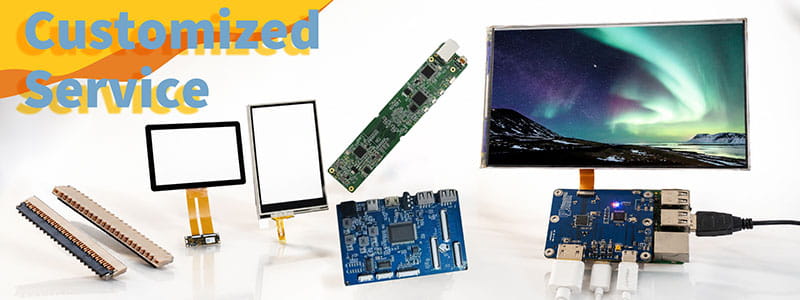
It`s just a beginning to get display panels from us, then clients need to solve cover glass/touch panel, driving board, connectors on PCB.Fortunately Panox Display provide complete display solutions.
Connectors
Panox Display provides free connectors for clients who purchase more than five products from us. Our product range includes connectors from Molex, Kyocera, AXE, AXG, JAE, Hiros, and more.
Cover Glass/Touch Panels
Panox Display provides a customized cover glass/touch panel service. We supply cover glass from Gorilla, AGC, and Panda, which all have excellent optical performance. We also supply driver ICs from Goodix and Focaltech.
Controller/Driver Boards
If your applications are directly connected to a PC, a cellphone, or Raspberry Pi, and you have enough space to insert a board to input video, Panox Display can provide customized Controller/Driver boards with input connections for VGA, HDMI, DVI, DP, Type-C video input, MIPI, RGB, LVDS, and eDP.
The functions of our boards include, but are not limited to, adjustment of brightness, sound output, touch interface, extra data transmission, and gyroscope.
Simple Instructions
#MIPI# How to Bring Up a MIPI DSI Display: A Practical Guide for Embedded Display Integration.
#MIPI# D-PHY and C-PHY Physical Layer Guide for Display Interfaces.
#MIPI#DSI PCB Layout Guidelines for Reliable Display Interfaces
#SPI#MCU# LCD MCU Interface and SPI Interface Explained: 8080 Parallel vs Serial LCD Connections.
#MIPI# DSI PCB Layout Guidelines for Reliable Display Interfaces
#MIPI# vs #LVDS# Display Interface Differences and Selection Guide
#MIPI DSI# Interface Guide: Protocol, D-PHY, Linux Driver Bring-Up, and Debugging
#POS LCD#How to Build Main and Secondary Display Output for POS Terminals
If our display fit your application, subscrlbe for monthly Insights
Panox Display Professional OLED/LCD Supplier and Manufacturer
- 📍 Shenzhen
- 📞 Phone: 86 755 3396 6409
- 📠 Skype: panoxwesley

If it`s urgent, try to contact
Whatsapp: +86 18665870665
Skype: panoxwesley
QQ: 407417798