
Specialist LCD/OLED Supplier
|
|






3d-printing display panel
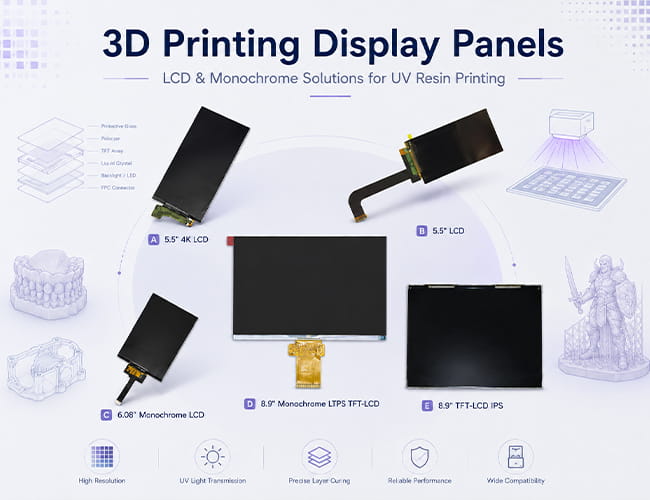
What Does “3D Printing Display Panel” Mean?
A 3D printing display panel is an LCD or monochrome LCD screen used as a light mask inside resin 3D printers. Instead of showing normal images for users, it controls where UV light passes through, helping cure each resin layer with pixel-level precision.
These panels are commonly used in LCD/MSLA resin printers, UV exposure systems, projector modules, and custom optical printing equipment.
-
Size(inch)
- 0.39~1.0
- 1.0~1.9
- 2.0~2.9
- 3.0~3.9
- 4.0~4.9
- 5.0~5.9
- 6.0~6.9
- 7.0~7.9
- 8.0~9.9
- 10~20
-
Interface
- I2C
- SPI
- Parallal
- MCU
- CPU
- RGB
- MIPI
- LVDS
- eDP
- HDMI
-
Display Color
- Monochrome
- Double Color
- Full Color
-
Orientation
- Landscape
- Portrait
| Model | Size | Display Type | Resolution | Interface | Display Brand | Image | ||||||||||
|---|---|---|---|---|---|---|---|---|---|---|---|---|---|---|---|---|

5.5 inch LCD For 3D Printing (ANYCUBIC Photon S/Wanhao D7)
|
5.5 | TFT-LCD | 1440(RGB)×2560 , Quad-HD | MIPI | Sharp |
|
||||||||||

5.5 inch LCD 4K Resolution For 3D Printing/Projector
|
5.5 | TFT-LCD | 2160(RG/BR/GB)×3840 (UHD) 658PPI | MIPI | Sharp |
|
||||||||||

6.0 inch LCD For Cellphone/3D Printing
|
6.0 | TFT-LCD | 1440(RGB)×2560 , Quad-HD | MIPI | Sharp |
|
||||||||||

6.08 inch monochrome LCD 2K Resolution For 3D printing
|
6.08 | TFT-LCD | 1620x2560 | MIPI | Tianma |
|
||||||||||
8.9-Inch Monochrome LTPS TFT-LCD Display for 3D Printer
|
8.9 | LTPS TFT-LCD CELL FOG | 3840 x 2400 WQUXGA 508 PPI | LVDS | BOE |
|
||||||||||

8.9 inch TFT-LCD IPS For Tablet/3D Printing
|
8.9 | TFT-LCD | 2560(RGB)×1600 , WQXGA | MIPI | JDI |
|
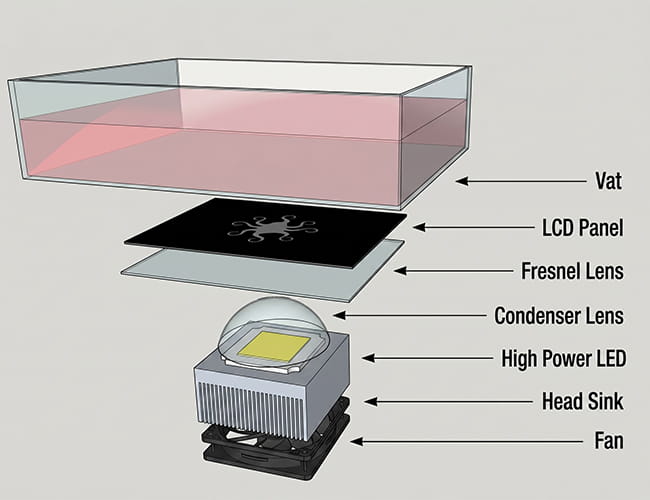
3D printing LCD means LCDs can be used on UV curing 3D printer.
UV curing 3D printer technology, in addition to SLA laser scanning and DLP digital projection, has now formed a new technology, which is to use LCD as a light source technology.LCD printing technology, the simplest understanding, is that the light source of DLP technology is replaced by LCD. We can review the characteristics of UV curing technology, the key is the solution around the light source problem, from SLA of laser scanning, to DLP of digital projection, to the latest LCD printing technology.
In fact, LCD 3D printing technology is divided into two kinds. The difference is the light source wavelength, one is 405nm UV, and the other is 400-600nm visible light. LCD Masking UV curing: With 405nm UV light (like DLP), plus LCD panel as a selective light transmission technology.
The LCD Masking technology has been being developed since 2013. The z-axis solution is nothing more than a slider, bumper and stepper motor, motor drive plate can be a single-chip computer or FDM's most popular RAMPS board solution. The LCD driver is actually the same as all displays, the VGA or HDMI connected to the LCD drive panel and the LCD panel without backlight with a 405nm bulb or LED array, and the lens to evenly distribute the light.
Advantages of LCD 3D printing,
1. High precision.
2. Smooth on the surface.
3. Support for various materials.
4. Less surface damage to the molded object.
5. Quickly print.
6. Reduce costs.
7. The finished product is waterproof.
The TFT LCD for 3D printing is without backlight, there are original Sharp LCDs that removed backlight, or customized 3D print LCDs that are original without backlight, and thicker thickness. Now Panox Display can provide 5.5 inch 2K, 5.5 inch 4K, 6.0 inch 2k, 6.08 inch 2k, and 8.9 inch 2k LCD for UV curing 3D printer LCD.
Why LCD Panels Matter in Resin 3D Printing
In resin 3D printing, the display panel directly affects print detail, exposure speed, layer accuracy, and surface quality. A suitable LCD panel can help create sharper edges, cleaner small features, and more stable curing results.
Key factors include resolution, pixel density, UV light transmission, contrast, panel lifetime, interface compatibility, and whether the screen is monochrome or standard TFT-LCD.
Common Applications for 3D Printing LCD Panels
3D printing display panels are widely used in desktop resin printers, dental model printing, jewelry casting, engineering prototypes, miniature models, research equipment, and custom UV exposure systems.
Compact 5.5-inch and 6.08-inch panels are often used for small-format printers, while 8.9-inch and 10.1-inch panels are suitable for larger build areas and professional resin printing systems.
Monochrome LCD vs. Standard TFT-LCD for 3D Printing
Monochrome LCD panels are often preferred for resin 3D printing because they can allow more UV light to pass through than traditional RGB LCD screens. This can help improve curing efficiency and reduce exposure time.
Standard TFT-LCD panels may still be suitable for certain 3D printing, projector, repair, or custom optical applications, especially when resolution, size, and interface match the project requirements.
How to Choose a 3D Printing Display Panel
When choosing a 3D printing LCD panel, start with the printer’s build area and target resolution. Smaller high-PPI screens are better for fine-detail printing, while larger panels are better for bigger models or batch production.
Important specs to check include screen size, resolution, active area, interface type, FPC direction, UV compatibility, backlight structure, and controller board support.
More About 3D Printing Display Panels
What Is a 3D Printing Display Panel? A Practical Guide to LCD Screens for Resin 3D Printers
Why Is the LCD Display Panel So Important in Resin 3D Printing?
Applications of 3D Printing Display Panels: Where LCD Screens Are Used in Resin 3D Printers
Customized Service
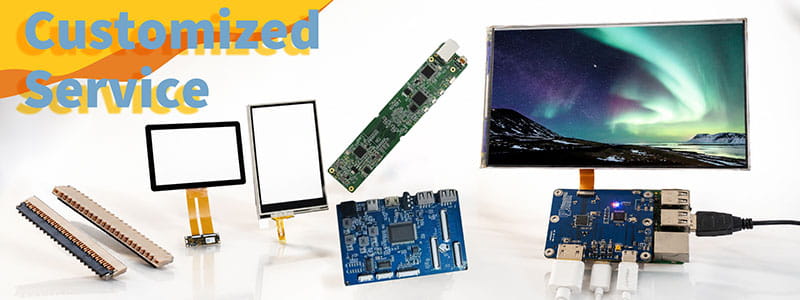
It`s just a beginning to get display panels from us, then clients need to solve cover glass/touch panel, driving board, connectors on PCB.Fortunately Panox Display provide complete display solutions.
Connectors
Panox Display provides free connectors for clients who purchase more than five products from us. Our product range includes connectors from Molex, Kyocera, AXE, AXG, JAE, Hiros, and more.
Cover Glass/Touch Panels
Panox Display provides a customized cover glass/touch panel service. We supply cover glass from Gorilla, AGC, and Panda, which all have excellent optical performance. We also supply driver ICs from Goodix and Focaltech.
Controller/Driver Boards
If your applications are directly connected to a PC, a cellphone, or Raspberry Pi, and you have enough space to insert a board to input video, Panox Display can provide customized Controller/Driver boards with input connections for VGA, HDMI, DVI, DP, Type-C video input, MIPI, RGB, LVDS, and eDP.
The functions of our boards include, but are not limited to, adjustment of brightness, sound output, touch interface, extra data transmission, and gyroscope.
Simple Instructions

#MIPI# How to Bring Up a MIPI DSI Display: A Practical Guide for Embedded Display Integration.
#MIPI# D-PHY and C-PHY Physical Layer Guide for Display Interfaces.
#MIPI#DSI PCB Layout Guidelines for Reliable Display Interfaces
#SPI#MCU# LCD MCU Interface and SPI Interface Explained: 8080 Parallel vs Serial LCD Connections.
#MIPI# DSI PCB Layout Guidelines for Reliable Display Interfaces
#MIPI# vs #LVDS# Display Interface Differences and Selection Guide
#MIPI DSI# Interface Guide: Protocol, D-PHY, Linux Driver Bring-Up, and Debugging
#POS LCD#How to Build Main and Secondary Display Output for POS Terminals
If our display fit your application, subscrlbe for monthly Insights
Panox Display Professional OLED/LCD Supplier and Manufacturer
- 📍 Shenzhen
- 📞 Phone: 86 755 3396 6409
- 📠 Skype: panoxwesley

If it`s urgent, try to contact
Whatsapp: +86 18665870665
Skype: panoxwesley
QQ: 407417798