







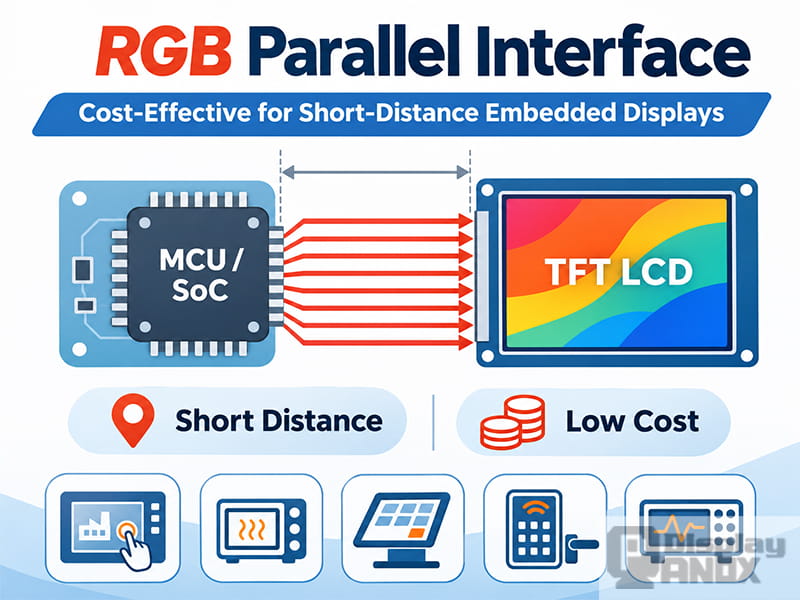
When selecting a TFT LCD for an embedded device, the display interface can have a significant impact on the overall system cost. While MIPI DSI and LVDS are widely used in modern display applications, the traditional RGB parallel interface remains a practical option for many industrial and consumer products.
RGB interfaces typically use 16, 18, or 24 parallel data lines, along with control signals such as HSYNC, VSYNC, DE (Data Enable), and PCLK (Pixel Clock). A 24-bit RGB888 interface can require up to 28 signal lines, making it considerably wider than a serial display interface.
With so many connections, why do manufacturers continue to choose RGB displays?
The answer depends on the processor, display resolution, physical layout, and total system cost.
What Is an RGB Parallel LCD Interface?
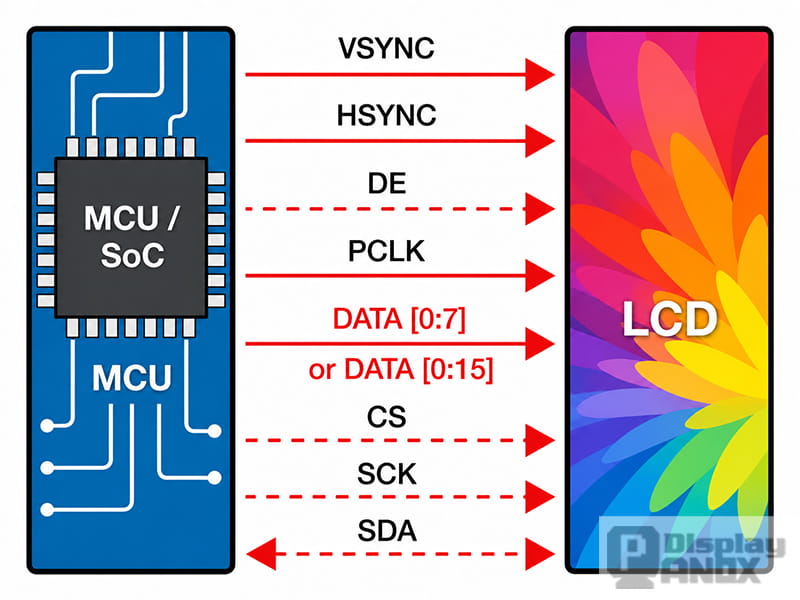
The RGB parallel interface, also known as a TTL RGB interface or Display Parallel Interface (DPI), transmits pixel data directly from the host processor to the display.
Unlike display modules that use an MCU-style interface with internal graphics memory (GRAM), conventional RGB displays receive a continuous stream of pixel data synchronized with the pixel clock.
The host processor's LCD controller reads image data from the framebuffer and generates the signals required for display timing.
Common RGB formats include:
-
RGB565: 16 data lines, supporting 65,536 colors.
-
RGB666: 18 data lines, supporting up to 262,144 colors.
-
RGB888: 24 data lines, supporting approximately 16.7 million colors.
The actual interface configuration depends on the display controller and panel requirements.
Because pixel data is transmitted continuously, the processor must provide sufficient memory bandwidth and maintain the required display timing.
Where Is an RGB Parallel Interface Most Cost-Effective?
RGB displays are particularly suitable for embedded systems where the processor and display module are located close to each other.
Industrial HMI and Control Panels
Industrial human-machine interfaces frequently use TFT LCDs to display operating parameters, equipment status, and graphical controls.
Many embedded processors and higher-performance microcontrollers include native RGB LCD controllers, allowing them to drive compatible displays without an additional interface conversion chip.
For example, a 4.3-inch 480 × 272 or 7-inch 800 × 480 TFT LCD can be a practical choice for an industrial control panel when the host supports the required RGB timing.
These configurations offer a useful balance between display performance, development complexity, and cost.

Home Appliances and Smart Control Systems
Washing machines, air conditioners, smart thermostats, and other household appliances increasingly use graphical user interfaces.
In products where the display and main control board share a compact enclosure, an RGB interface can simplify the overall display architecture.
It is particularly attractive when the main processor already provides the necessary LCD controller, GPIO resources, and framebuffer memory.
Instruments, POS Terminals, and Access Control Devices
Measurement instruments, payment terminals, and access control systems often require stable, predictable display updates.
RGB interfaces can support responsive menus, graphical indicators, waveforms, and other frequently changing visual information.
For manufacturers developing these products in volume, using the processor's native RGB output may help reduce component costs and simplify hardware integration.
Why Can RGB Reduce Display System Costs?
1. No Separate GRAM-Based Display Controller Required
One potential advantage of a conventional RGB display is that it does not require a separate display controller with integrated framebuffer memory.
Instead, pixel data is generated and transmitted by the host processor's LCD controller.
This can reduce the cost of the display-side electronics compared with certain MCU-interface modules.
However, the TFT LCD still requires its normal pixel-driving circuitry. The actual savings depend on the panel architecture and the components already integrated into the host system.
2. Suitable for Continuous Graphics Updates
RGB provides a continuous pixel stream, making it well suited to interfaces with animations, moving graphics, and regularly updated information.
With an appropriate LCD controller, sufficient memory bandwidth, and suitable graphics software, the system can deliver consistent frame updates without manually transferring every frame through a command-based display interface.
However, RGB does not automatically guarantee higher refresh rates or faster pixel response. Actual performance depends on the processor, panel specifications, and system configuration.
3. Straightforward Timing and Hardware Debugging
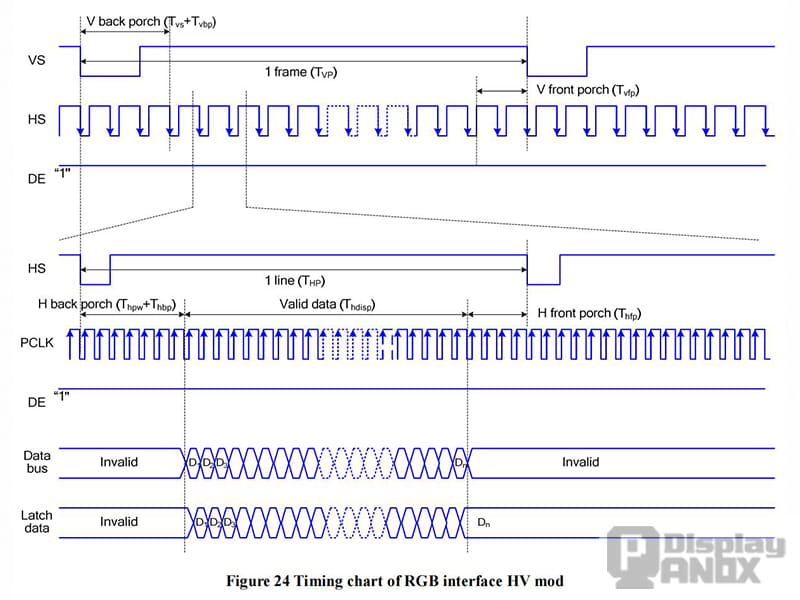
RGB uses defined pixel clock and synchronization signals rather than the packet-based transport used by MIPI DSI.
Developers can inspect pixel clock, synchronization timing, and data signals using standard measurement equipment.
For engineering teams familiar with parallel display interfaces, this can make hardware bring-up and troubleshooting relatively straightforward.
RGB vs. MCU vs. MIPI DSI vs. LVDS
Different display interfaces are designed around different system requirements.
| Interface | Main Advantage | Main Limitation | Suitable Applications |
|---|---|---|---|
| RGB Parallel | Direct pixel streaming and potentially low system cost | High pin count and demanding PCB routing | Industrial HMI, appliance controls |
| MCU 8080/6800 | Command-based updates and optional display-side GRAM | Full-screen update performance depends on bus bandwidth | Compact control screens, instruments |
| MIPI DSI | High bandwidth with fewer signal connections | Requires compatible DSI hardware and panel initialization | Mobile devices, compact high-resolution displays |
| LVDS | Differential signaling and improved suitability for longer internal connections | Requires compatible LVDS circuitry | Industrial monitors, larger embedded displays |
For simple interfaces with infrequent updates, a display with an MCU or SPI interface may be sufficient.
For compact products with higher display resolutions and limited connector space, MIPI DSI can offer substantial advantages.
LVDS is often worth considering when the display is physically separated from the main processor or the system requires a more robust differential connection.
RGB remains competitive when the host already supports parallel LCD output and the display is installed nearby.
What Should Engineers Check Before Choosing RGB?
Before selecting an RGB TFT LCD, several technical factors should be verified.
Processor compatibility: Confirm that the MCU or SoC provides a native RGB LCD controller and enough available pins for the selected color depth.
Framebuffer capacity: RGB displays generally require continuous pixel data from the host. Confirm that the available memory and bandwidth can support the target resolution and refresh rate.
Pixel clock and timing: Check the required PCLK frequency, HSYNC and VSYNC timing, horizontal and vertical porch intervals, and DE signal configuration.
Signal voltage: Verify that the logic levels of the processor and display are compatible. RGB interfaces may operate at different I/O voltages depending on the hardware.
PCB layout and EMI: Parallel RGB uses many single-ended signals. Long traces, poor grounding, and excessive clock skew can create signal integrity and electromagnetic interference problems.
Total system cost: Consider processor price, memory, connectors, PCB routing, interface conversion, and development effort rather than comparing display module prices alone.
These factors become especially important when moving from a prototype to mass production.
Choosing the Right RGB TFT LCD for Your Project
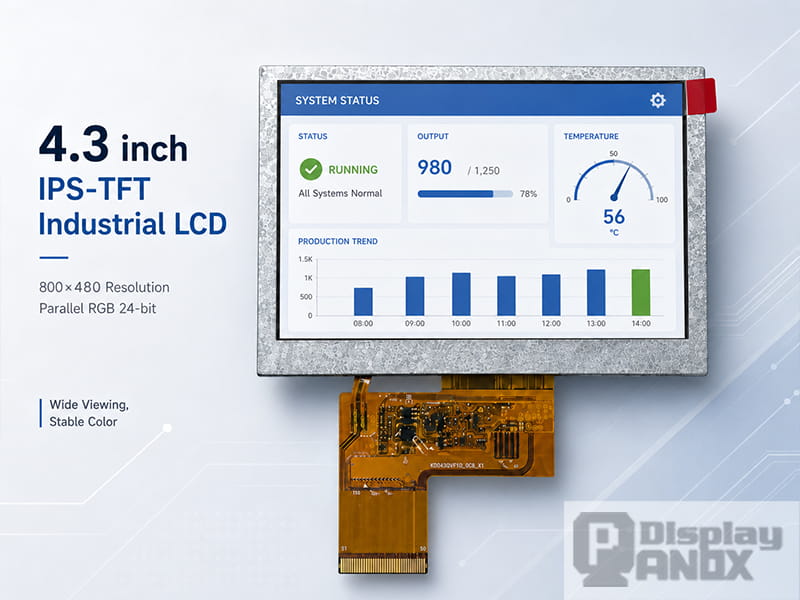
At Panox Display, we provide TFT LCD modules for industrial control systems, embedded devices, and consumer electronics.
For example, our 4.3-inch 480 × 272 RGB TFT LCD illustrates a practical parallel RGB display configuration for compact embedded applications.
You can also explore our TFT LCD display selection to compare panel sizes, resolutions, and interface options.
When evaluating a display, our team can assist with panel selection, interface compatibility, controller board options, and customized touch panel requirements.
Conclusion
The RGB parallel interface continues to be a practical choice for cost-sensitive embedded display systems.
Its greatest advantage appears when the host processor already includes a compatible LCD controller, the display is located close to the main board, and the required resolution can be supported without expensive additional components.
For industrial HMIs, home appliance control panels, and other integrated embedded products, RGB can provide an effective balance of cost, performance, and engineering simplicity.
The most cost-effective interface is ultimately the one that fits the complete system architecture.
For help selecting a compatible RGB TFT LCD module, contact Panox Display at [email protected].