







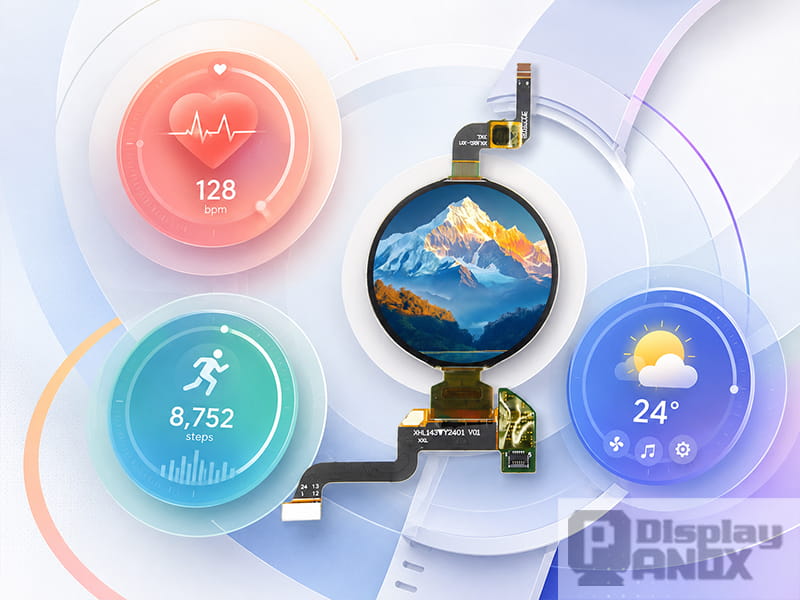
1.39 inch Round OLED 454x454 SPI 800 nits
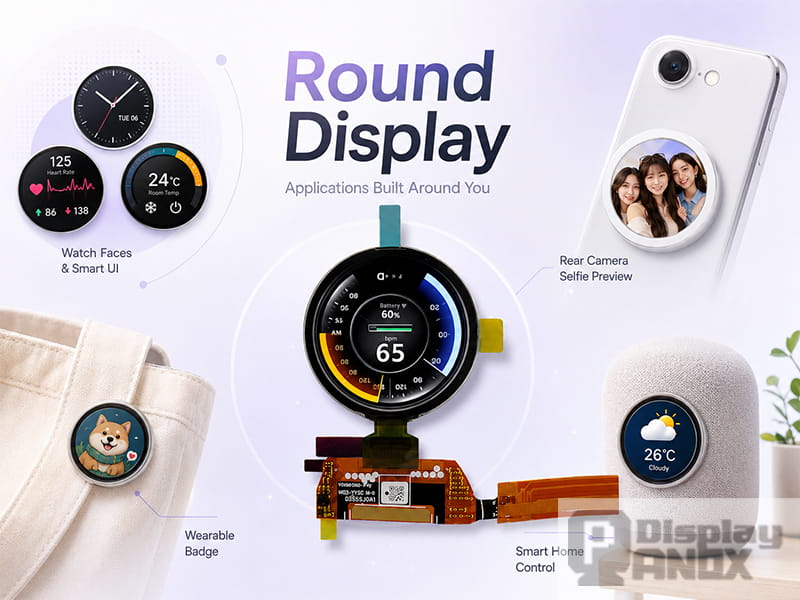
Round displays used to be seen mainly on smartwatches. Today, they are moving into a much wider range of products: electronic badges, magnetic phone accessories, rear-camera selfie monitors, smart home controllers, medical instruments, compact industrial HMIs, and even early concepts for AI wearable devices.
This shift is easy to understand. A circular display feels more like an object than a screen. It can look like a watch face, a button, a badge, a camera lens, a dashboard gauge, or a piece of personal decoration. For compact devices that need to be worn, held, attached to another product, or placed in a visible position, the round display offers a softer and more product-friendly form than a standard rectangular module.
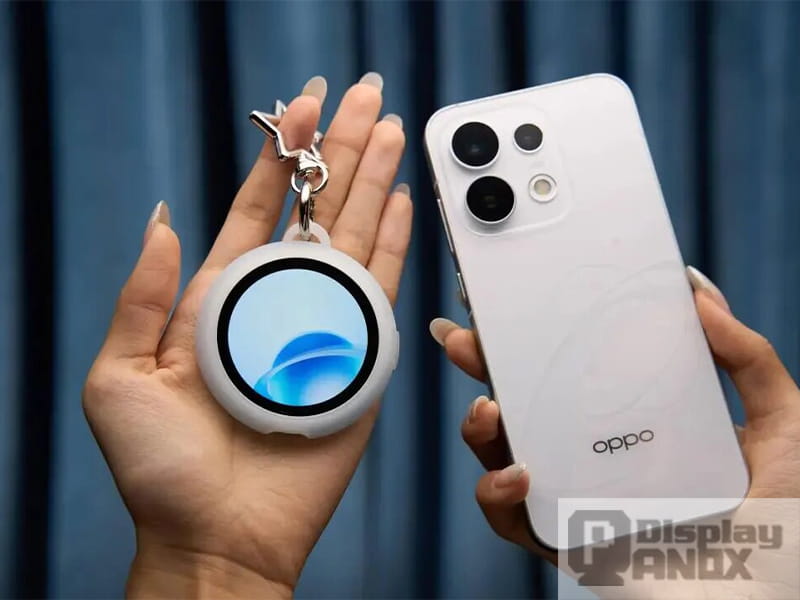
Recent phone accessories show this trend clearly. OPPO Bubble, a magnetic round AMOLED selfie screen, uses a 1.73-inch 466 × 466 display and can work as a custom wallpaper badge or a remote preview screen for rear-camera selfies. Honor has also shown a small magnetic circular display accessory for the Honor 600 series, with functions such as rear-camera preview, fill light support, remote control, timer and lifestyle decoration. These products are still simple, but they point to a larger direction: small round screens may become one of the most practical visual interfaces for phone-connected accessories and wearable AI devices.
For display developers, this is an important signal. The value of a round display is no longer limited to telling time. It can show identity, mood, status, camera framing, health data, AI prompts, device alerts and interactive controls in a compact and highly recognizable format.
1. Why Round Displays Are Becoming Popular Again
A round display has several advantages in product design.
First, it naturally fits wearable and portable objects. Watches, badges, camera accessories, smart rings with docking interfaces, small controllers and decorative IoT products often use rounded shapes. A circular screen avoids the “screen pasted on a case” feeling and makes the whole product look more integrated.
Second, circular displays are suitable for glanceable information. Battery level, recording status, heart rate, steps, timer progress, temperature, mode switching, call reminders and simple AI responses can all be displayed through circular layouts. Radial menus, ring progress bars, central icons and dashboard-style data make good use of the shape.
Third, the round format has strong emotional value. In consumer electronics, the screen is no longer only a technical component. It is also part of the product’s personality. A small round OLED display can show animated characters, pet photos, brand logos, music visuals or custom images, turning a device into something closer to an accessory.
This is why electronic badge products are gaining attention. A traditional badge is static. A digital badge can change its content, show motion, support seasonal themes, and connect to a phone app. For young users, creators, anime fans, event organizers and brands, that is much more expressive than a printed pin.
2. From Electronic Badge to Phone Extension
1.39 inch Round/Circular OLED For Wearable Smartwatch
The idea behind products like OPPO Bubble is simple: place a small round display outside the main phone screen.
When the accessory is attached to the back of a phone, it can become a rear-camera preview monitor. This solves a real problem. Rear cameras usually have better sensors, better lenses and stronger image processing than front cameras, but users cannot easily see the framing when taking selfies or recording vlogs with the rear camera. A small wireless round screen makes the rear camera usable for self-shooting.
When the accessory is removed from the phone, it can become a wearable display badge. It may hang from a bag, attach to clothing, stand on a desk or work as a decorative secondary screen. The content can change from a photo to a GIF, from an avatar to a brand logo, from a timer to a simple notification panel.
This dual use is important. A small display accessory does not need to compete with a smartphone screen. Instead, it gives the phone a new surface. It can extend the phone’s camera, personality and information output into places where the main screen is not convenient.
For hardware brands, this creates room for new product categories:
-
Magnetic selfie screens for smartphones
-
Electronic badges for bags, clothing and events
-
Portable creator tools for vlogging and livestreaming
-
Smart companions for fan culture and IP merchandise
-
Mini information displays for phone-connected AI assistants
-
Wearable status displays for sports, work and social scenes
In all these products, the round display is not chosen only because it looks different. It supports the whole product identity.
3. Why Round Displays Fit AI Wearable Hardware
The next stage may be AI wearable accessories.
Many people question whether the smartphone can be the final form of personal AI hardware. A phone is powerful, but it is usually in a pocket, on a desk or in a hand. It does not continuously face the world from the user’s point of view. It is also not always suitable for quick environmental recording, voice capture or instant visual interaction.
This is why the industry is exploring wearable AI pins, smart glasses, pendants and badge-like devices. Some concepts focus on cameras and microphones without a screen. Others may use a small display to show recording status, AI feedback, notifications, privacy indicators or simple control states.
A round display can be especially useful here because it is compact, friendly and easy to recognize. For AI hardware, the display does not need to show long text. In many cases, a small visual signal is enough. For AI devices worn on the body, trust is also important. Users need to know when a camera or microphone is active. A round OLED or Memory LCD display can act as a visible status window, making the device less mysterious and easier to understand.
This is a practical role for round displays in AI products: not replacing the smartphone screen, but giving AI hardware a clear and human-readable visual layer.
4. Key Application Areas for Round Display Modules
4.1 Electronic Badges and Digital Accessories
Electronic badges are one of the fastest-growing consumer uses for small round displays. The product can display photos, animations, names, logos, event information or fan art. Compared with a printed badge, the content is flexible and reusable.
For this application, the display should be compact, bright, colorful and power-efficient. AMOLED is attractive when the product needs vivid colors, high contrast and premium visual effects. TFT-LCD is often suitable when cost control and stable supply are more important. Memory LCD can be considered for always-on badges where low power consumption and sunlight readability matter more than rich animation.
Recommended display directions:
| Use Case | Suitable Display Type | Key Requirements |
|---|---|---|
| Fan badge / IP merchandise | Round AMOLED / round TFT-LCD | Vivid color, compact size, app-controlled content |
| Event badge / name badge | Round LCD / Memory LCD | Readability, low power, simple graphics |
| Premium digital accessory | Round AMOLED | High contrast, thin structure, animation support |
| Outdoor wearable badge | Memory LCD / sunlight-readable OLED | Low power, outdoor visibility |
4.2 Rear-Camera Selfie Screens
A magnetic round display can become a simple but useful rear-camera monitor. This is especially valuable for social media creators, vloggers and users who want better selfie quality from the main camera system.
In this application, the display needs fast response, good color, acceptable brightness and low latency support from the system side. The screen does not need to be large. A 1.4-inch to 2.1-inch round display is usually enough for framing, focus confirmation and basic control icons.
Round AMOLED is a strong fit for premium phone accessories because it offers high contrast, thin structure and a visually polished look. Circular TFT-LCD can also be used for cost-sensitive accessories or larger preview screens.
4.3 Smartwatch and Fitness Wearables
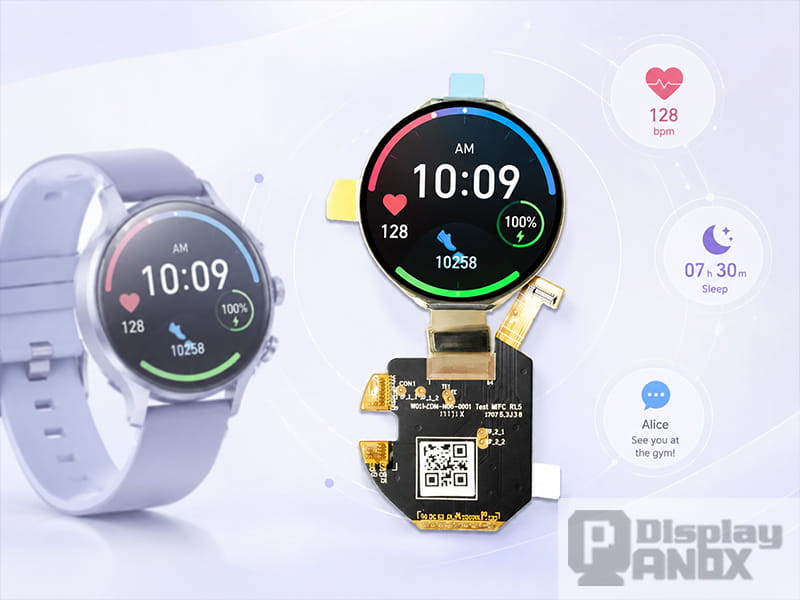
Smartwatches remain one of the most mature markets for round displays. A circular screen matches the traditional watch form and supports familiar watch-face design. The display must balance image quality, thickness, power consumption, touch performance and outdoor readability.
AMOLED is widely used in smartwatch products because it provides deep black, high contrast, vivid color and a thin module structure. For always-on sports watches or outdoor devices, Memory LCD can be a strong alternative because it offers very low power consumption and good sunlight readability.
Typical smartwatch display requirements include:
| Requirement | Why It Matters |
|---|---|
| High pixel density | Keeps text, icons and watch faces sharp |
| Low power consumption | Extends battery life in daily use |
| Wide viewing angle | Improves readability on the wrist |
| Touch integration | Supports compact interactive UI |
| Sunlight readability | Important for outdoor sports |
| Thin module structure | Helps reduce device thickness |
4.4 Smart Home Control Panels
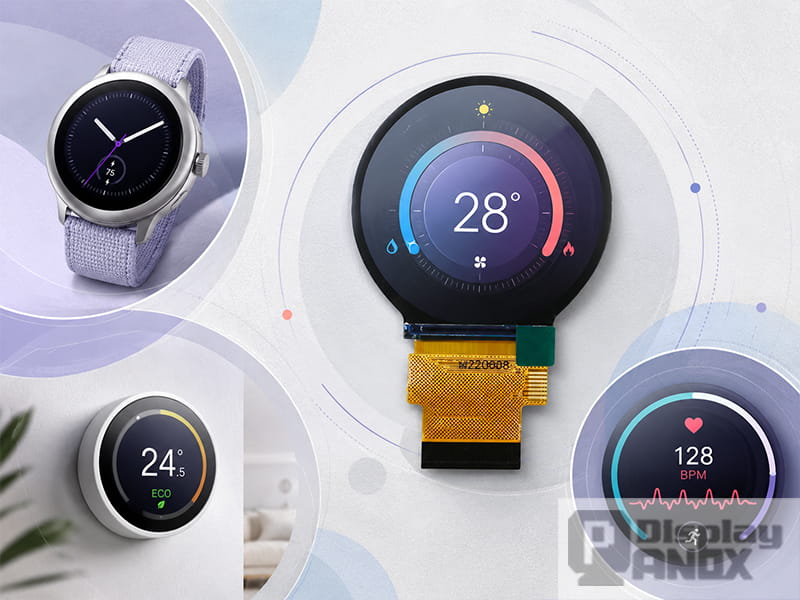
Round displays are also suitable for smart home products such as thermostats, lighting controllers, air conditioner panels, volume knobs, security hubs and desktop IoT devices.
A round interface can show temperature, humidity, brightness, mode switching and timer progress in a visually natural way. Users can rotate, tap or swipe around the circular layout. Compared with a rectangular panel, a round screen can make the product feel more like a control dial.
For smart home products, TFT-LCD with capacitive touch is often a practical choice because it provides stable color performance, good cost structure and easier integration. AMOLED can be used when the product needs a more premium visual effect or a thinner design.
4.5 Medical and Industrial Instruments
Many medical and industrial devices use round meters, knobs, gauges or compact status indicators. A circular display can modernize these traditional interfaces while keeping the visual language familiar.
Examples include:
-
Portable medical monitors
-
Oxygen or respiratory device indicators
-
Smart medicine storage devices
-
Handheld test instruments
-
Industrial control knobs
-
Vehicle auxiliary gauges
-
Compact equipment status displays
For these applications, the display selection should focus on reliability, operating temperature, interface compatibility, brightness, viewing angle and long-term supply. TFT-LCD modules with MIPI, RGB or SPI interfaces are often suitable. Touch customization and cover glass design are also important when the display is exposed to frequent operation.
5. Round Display Product Options from Panox Display
Panox Display provides round and circular display modules for wearable devices, smart home products, medical electronics, industrial equipment, vehicle interfaces, VR systems and compact embedded projects. The product range includes round TFT-LCD, round OLED, round AMOLED, flexible circular OLED, Memory LCD, touch panel options, cover glass customization and controller board support.
Below are several round display options that can be considered for different application directions.
| Panox Display Product | Key Specification | Best-Fit Applications |
|---|---|---|
| 1.28 inch Round TFT-LCD | 240 × 240 resolution, SPI interface, 300 cd/m² typical brightness, PCAP touch option, 55 Hz refresh rate | Entry smartwatch, electronic badge, compact IoT display |
| 1.2 inch Round OLED | 390 × 390 resolution, 325 PPI, MIPI/SPI/Q-SPI interface, on-cell PCAP touch, 60 Hz refresh rate | Premium wearable, compact smart accessory, high-contrast UI |
| 1.39 inch Round AMOLED | 454 × 454 resolution, MIPI interface, 462 PPI, thin AMOLED structure, sunlight-readable design | Smartwatch, wearable display, high-end digital badge |
| 1.43 inch Round AMOLED | 466 × 466 resolution, Q-SPI interface, 700 cd/m² typical brightness, on-cell touch, 60 Hz refresh rate | Magnetic selfie screen, premium badge, wearable assistant interface |
| 2.1 inch Round TFT-LCD Touch Panel | 480 × 480 resolution, SPI + RGB interface, ST7701S driver IC, 300 cd/m² typical brightness, PCAP touch | Smart home controller, medical device, handheld equipment |
| 2.47 inch Round TFT-LCD | 480 × 480 resolution, MIPI interface, 400 cd/m² typical brightness, 60 Hz refresh rate | Healthcare device, industrial HMI, dashboard-style display |
| 1.2 inch Memory LCD | 218 × 218 resolution, RGB interface, reflective display without backlight, 2.10 g, sunlight readable | Outdoor wearable, low-power badge, always-on status display |
| 1.39 inch Flexible Round AMOLED | 400 × 400 resolution, flexible AMOLED structure, designed for wearable devices | Curved wearable surface, experimental smartwatch, next-generation accessory |
These modules cover different design priorities. A product that focuses on animation and premium appearance may prefer AMOLED. A product that needs stable cost and easy integration may choose TFT-LCD. A product that must stay on for a long time under outdoor light may benefit from Memory LCD. A curved or body-fitting wearable device can explore flexible round AMOLED.
6. How to Choose a Round Display for a New Product
1.43 inch AM-OLED Full Color On-cell PCAP Touch
A successful round display product starts with the use case, not only the screen size.
For a digital badge, the key questions are content type, battery life and visual style. If the badge needs colorful animation, AMOLED or TFT-LCD is suitable. If the badge mainly shows a name, icon or simple status for many hours, Memory LCD may be more efficient.
For a rear-camera selfie screen, the key points are resolution, brightness, wireless preview performance, touch or button control, and mechanical attachment. A 1.43-inch 466 × 466 AMOLED display is close to the visual direction already seen in commercial accessories, while larger TFT-LCD options can work for more cost-sensitive designs.
For a smartwatch, the key balance is pixel density, thickness, power consumption, touch integration and outdoor readability. A 1.2-inch, 1.39-inch or 1.43-inch round OLED/AMOLED module can support a premium wearable design, while Memory LCD is better for outdoor sports products with long standby requirements.
For smart home and industrial products, the interface and mechanical structure matter heavily. MIPI, RGB, SPI or Q-SPI should match the mainboard platform. Cover glass, touch panel, FPC position, operating temperature and controller board support should be checked early in the design stage.
Panox Display can support display selection, cover glass customization, touch panel design, connectors, demo kits and controller boards. For projects that connect to Raspberry Pi, PC, HDMI, Type-C, MIPI, RGB, LVDS or eDP systems, controller board support can shorten the development process.
7. Design Tips for Circular UI
A round display should not simply crop a rectangular interface into a circle. The UI needs to respect the shape.
A good circular UI usually places the most important information in the center. Secondary information can follow the edge as rings, arcs or small icons. Progress bars, timers, volume levels, health indicators and battery status work well in circular layouts.
Text should be short. A round screen is not suitable for long paragraphs. For wearable accessories and AI devices, icons, numbers, status words and color states are often more effective than dense text.
For electronic badges, the screen content should leave safe margins near the circular edge. Important faces, logos or text should not be placed too close to the border. For camera preview accessories, the UI should keep framing clean and avoid covering the center of the image.
For industrial or medical devices, contrast and readability matter more than decorative motion. Clear numbers, simple color states and stable viewing angles are more important than complex animation.
8. The Future of Round Displays in AI-Era Hardware
The rise of OPPO Bubble, Honor’s magnetic mini display and other electronic badge products shows that small displays still have room for innovation. The smartphone is powerful, but it cannot cover every interaction surface. A small round display can live on the back of a phone, on a bag, on a wrist, on a home device, on medical equipment or on a future AI wearable.
The most interesting opportunity is the combination of display, sensor and AI. A round display badge with camera, microphone, wireless connection and AI software could become a phone companion. It could help record moments, show live status, display translation cues, indicate privacy state, or provide quick visual feedback from an AI assistant.
The display does not need to be large to be useful. It only needs to be visible at the right moment.
For brands developing smart accessories, wearable electronics or compact connected devices, round display modules offer a product language that is both technical and emotional. They can make a device easier to read, easier to wear and easier to recognize.
Panox Display provides circular OLED, AMOLED, TFT-LCD and Memory LCD solutions for these new product directions. From smartwatch displays to electronic badges, from smart home controllers to AI-ready wearable accessories, round displays are becoming a practical interface for the next generation of small connected devices.