







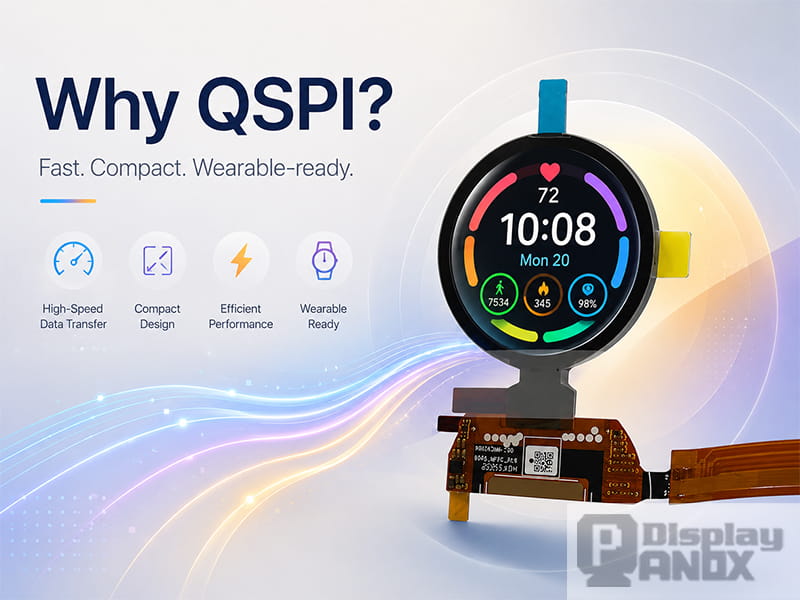
1.39 inch Round OLED 454x454 SPI 800 nits
Small AMOLED display panels have changed quickly. A few years ago, many compact screens were simple status displays with limited color, modest resolution, and slow UI updates. Today, a smartwatch-sized panel may have 368 × 448, 390 × 390, or even 466 × 466 pixels, full-color graphics, capacitive touch, animated icons, and a UI that needs to feel responsive.
That change creates a practical interface problem. A small wearable display still needs a compact FPC, low pin count, low power consumption, and compatibility with microcontrollers. At the same time, it needs enough bandwidth to refresh hundreds of thousands of pixels smoothly.
This is where QSPI, or Quad Serial Peripheral Interface, became useful. It gives small display modules more data bandwidth than classic SPI while keeping the connection much simpler than a phone-class MIPI DSI system. For many small AMOLED panels, especially smartwatch and compact touch displays, QSPI sits in a very practical middle ground.
The Real Problem: Small Screen, More Pixels, Limited Space
A 466 × 466 AMOLED panel may look small in the hand, but electrically it is no longer a tiny display. At 16 bits per pixel, one full frame contains about 3.47 Mbit of pixel data. Even at 30 full-frame updates per second, the raw pixel payload already reaches more than 100 Mbps before command overhead, bus gaps, and software limitations are considered.
Classic single-lane SPI often works well for simple 128 × 128, 240 × 240, or low-update UI displays. Once the panel moves into smartwatch-class resolution, the interface becomes a bottleneck. Users may not describe the issue as “interface bandwidth,” but they notice it as slow screen transitions, delayed touch response, visible tearing, or a UI that feels less premium than the display itself.
The display industry needed an interface that could move more pixel data without making the module wide, power-hungry, or difficult to route. QSPI answers that need by using four data lines instead of one.
QSPI Multiplies SPI Bandwidth Without Creating a Wide Bus
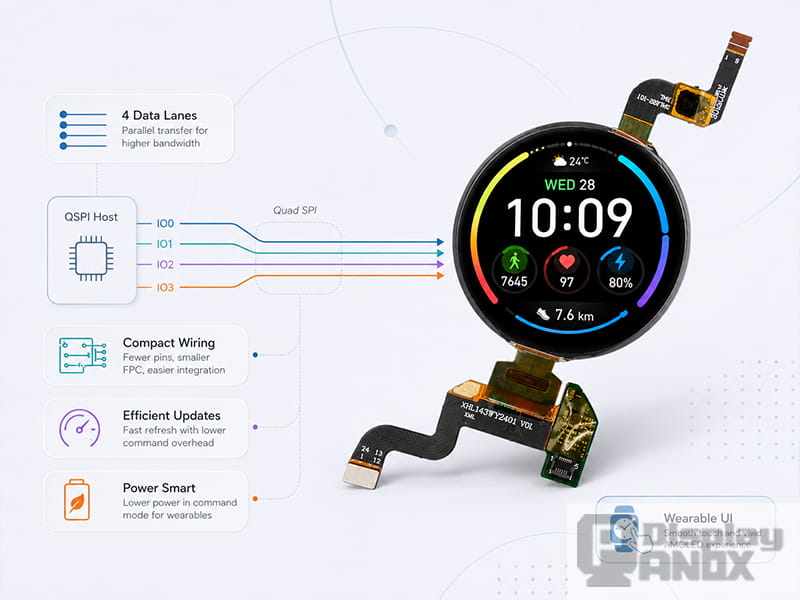
1.43 inch AM-OLED Full Color On-cell PCAP Touch
The simplest reason QSPI is used in small AMOLED displays is bandwidth. Classic SPI sends data over one serial data line. QSPI expands the data path to four parallel serial data lines, often labeled IO0, IO1, IO2, and IO3.
In practice, this means the same clock frequency can carry much more payload data. A 40 MHz single-lane SPI write gives a theoretical 40 Mbps data path. A four-lane QSPI write at the same clock can theoretically carry 160 Mbps. At 60 MHz, the data path rises to 240 Mbps. Real display performance depends on the driver IC, controller setup, DMA efficiency, memory bandwidth, and UI rendering pipeline, but the advantage is clear: QSPI gives small panels the bandwidth they need without moving to a much more complex display architecture.
STMicroelectronics’ Quad-SPI documentation shows the same principle in memory applications: a 1-4-4 Quad-SPI configuration can send the command on one line while address and data use four lines, and ST gives an example reaching 50 Mbytes/s at 100 MHz in SDR mode. The display use case is different, but the electrical logic is similar: widen the serial path while keeping the pin count controlled.
It Keeps the FPC and PCB Layout Compact
A small AMOLED module has very little space for connection. Smartwatches, sports devices, handheld controls, rotary knobs, and compact medical instruments often use narrow FPCs and dense main boards. Every additional signal line affects connector size, routing, assembly tolerance, and EMI control.
A parallel RGB or MCU-style bus can consume many pins. MIPI DSI uses high-speed differential signaling and requires careful impedance control. QSPI keeps the interface relatively lean: clock, chip select, four data lines, reset, TE, power, ground, and usually a separate I2C path for touch when the panel includes PCAP.
This is one of the quiet reasons QSPI became popular. It is not only about speed on paper. It also makes the mechanical and PCB design easier in the exact product categories where space is already painful.
It Fits MCU-Based Products Better Than Phone-Class Interfaces
MIPI DSI is a powerful display interface. The MIPI Alliance describes DSI-2 as a high-bandwidth link between host processors and displays, scalable with one or multiple data lanes and used across smartphones, smartwatches, VR headsets, tablets, laptops, automotive displays, and more.
For phone-class screens, high-resolution video, and large displays, that architecture is often the correct choice. The challenge is that many small embedded products do not use an application processor with a DSI host. They use MCUs such as STM32, GD32, ESP32-class chips, Nordic devices, or other embedded controllers. Adding a full DSI bridge can raise BOM cost, board complexity, firmware work, and power consumption.
QSPI works better for many MCU-centered designs because it stays closer to the SPI ecosystem. The host still sends commands and pixel data to a display controller, but the pixel payload can travel over four data lines. That makes it easier to build a compact wearable or handheld product without stepping into a full phone-style display stack.
This trend is visible in development hardware as well. Waveshare’s ESP32-S3 AMOLED boards, for example, include 466 × 466 AMOLED displays using a QSPI interface with driver ICs such as SH8601 or CO5300, showing how common this interface has become in small GUI development platforms.
QSPI Matches Command-Mode Display Operation
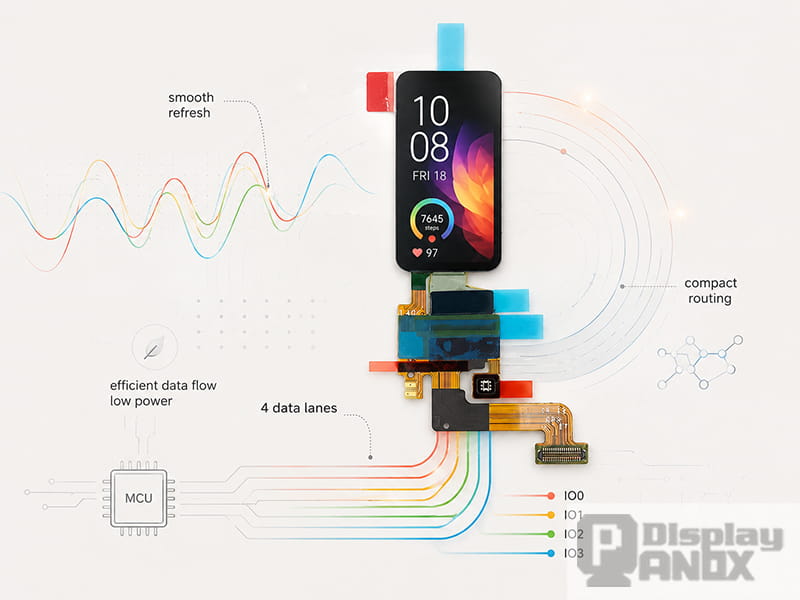
1.47 inch AM-OLED Full Color On-cell PCAP Touch
Many QSPI AMOLED panels are command-mode displays. The host processor sends display commands, sets a drawing window, and writes pixel data into the display driver’s internal memory. The panel driver then handles panel timing and refresh.
This is different from continuously streaming every pixel in real time from the host. For wearable and compact devices, command-mode operation is valuable because the UI often changes in small regions: a time digit updates, a battery icon moves, a heart-rate value changes, or a notification card slides in.
MIPI DCS is relevant here because it defines a standardized command set for display control functions and data supply, including setup and control commands such as brightness-related settings.Many QSPI AMOLED drivers follow a similar command vocabulary, even though the electrical bus is Quad SPI rather than MIPI DSI.
Espressif’s LCD documentation also describes controller-based LCD drivers where the frame buffer is located inside the external LCD controller’s GRAM. That model explains why command-driven panels can behave efficiently: the host writes image data into the display controller, and the controller manages the panel refresh internally.
It Helps Battery-Powered Products Avoid Unnecessary Transfers
A wearable display does not always need full-frame video. Much of the time, it shows static or slowly changing content: a watch face, a step count, a battery indicator, a notification list, a menu, or a sensor value.
With a QSPI command-mode AMOLED, the MCU can update only the changed region instead of pushing a continuous video stream all day. The display controller keeps the panel running from its internal memory, while the host processor can reduce activity between updates. That behavior matters in battery-powered products where every milliwatt counts.
The same logic appears in low-power graphics discussions for wearable-class panels. Infineon’s graphics application note uses a 1.43-inch 466 × 466 command-mode wearable panel as one of its representative display targets when discussing performance and power optimization for smartwatch-style graphics.
AMOLED Makes the Interface Choice More Important
AMOLED panels bring strong visual advantages to small devices: high contrast, vivid color, wide viewing angles, thin structure, and low power potential when dark UI design is used. Panox Display’s 1.2-inch round OLED product page highlights typical OLED advantages such as pure black, high contrast, vivid image, low weight, thin structure, and low consumption.
Those display advantages can be wasted if the interface cannot keep the UI responsive. A high-resolution AMOLED watch face needs smooth data transfer for animations, icons, notifications, and touch feedback. QSPI helps the interface keep up with what the panel can visually deliver.
For this reason, QSPI is especially common in small AMOLED modules with resolutions around 368 × 448, 390 × 390, 454 × 454, and 466 × 466. These panels are too detailed for basic low-speed SPI in many UI scenarios, while still small enough that a full MIPI DSI system may feel excessive for an MCU product.
Why QSPI Is Common in Smartwatch Displays
Smartwatch displays are almost the perfect use case for QSPI. They need rich color, high contrast, touch support, a thin module stack, compact wiring, and low-power operation. They also need enough bandwidth for smooth UI transitions, but they rarely need the same continuous video pipeline as a smartphone.
A 1.43-inch round AMOLED with 466 × 466 resolution is a good example. Panox Display’s TR143R2404A specification lists a QSPI interface, CO5300AF-08 driver IC, CHSC6417 touch IC, and 16.7M colors. That combination is very typical of modern wearable display design: high pixel density, full-color AMOLED output, integrated touch, and a compact serial interface.
The result is a panel that can support detailed watch faces, health widgets, icons, menus, and outdoor-readable UI while still being practical for a compact MCU-based wearable product.
Where QSPI Fits Between SPI and MIPI DSI
QSPI should be understood as a middle option. It is faster than plain SPI for pixel transfer, yet simpler than MIPI DSI in many embedded designs.
| Interface | Best suited for | Main advantage | Main limitation |
|---|---|---|---|
| SPI | Small low-update displays | Very simple wiring and broad MCU support | Limited bandwidth for high-resolution UI |
| QSPI | Small AMOLED and wearable-class displays | More bandwidth with moderate pin count | Still limited for large screens or sustained video |
| MIPI DSI | Phone-class, high-resolution, video-heavy displays | High bandwidth and scalable lane architecture | Requires DSI host, PHY, and more complex routing |
This is why QSPI does not replace every interface. A tiny status screen may still be better with SPI. A phone display, tablet display, AR/VR near-eye panel, or large video panel usually belongs to MIPI DSI, eDP, HDMI bridge, or RGB-style architecture. QSPI is strongest in the compact AMOLED zone where the display is visually rich but the system still wants MCU-level simplicity.
Panox Display QSPI Panel Examples
Panox Display’s QSPI display range focuses mainly on small AMOLED and OLED modules for wearable and compact interactive products.
1.43-inch AM-OLED Full Color On-cell PCAP Touch
The 1.43-inch round AMOLED module is a strong example of why QSPI is used in wearable displays. It offers 466 × 466 resolution, full-color AMOLED performance, on-cell capacitive touch, and a QSPI interface. The driver IC listed in the module specification is CO5300AF-08, with CHSC6417 used for touch.
This type of panel is suitable for smartwatches, round control interfaces, compact smart home panels, wearable medical devices, and premium small-format UI products.
2.04-inch AM-OLED Full Color On-cell PCAP Touch
The 2.04-inch AMOLED module provides 368 × 448 resolution, 700 cd/m² typical luminance, a CH13613 driver IC, and Q-SPI communication. Panox Display’s product page positions it as a thin, lightweight, vivid AMOLED display with low power consumption and broad MCU compatibility.
This panel fits projects that need a taller wearable-style display, outdoor-readable UI, fitness device screens, compact handheld controls, or small interactive terminals.
1.2-inch Round OLED 390 × 390 Q-SPI PCAP Touch Panel
The 1.2-inch round OLED module is useful when a design team wants interface flexibility. The product page lists a 390 × 390 full-color OLED panel with on-cell PCAP touch and MIPI/SPI/Q-SPI communication with MCU platforms such as GD32, STM32, and ARM.
This makes it a practical choice for projects that may begin with SPI during early testing and move to QSPI when smoother UI performance becomes necessary.
Design Checks Before Choosing a QSPI Display
QSPI makes small AMOLED integration easier, but it still needs careful engineering. Before choosing a panel, check these points early:
Confirm the Host Can Generate the Required QSPI Write Mode
Some MCU QSPI peripherals were originally designed for external flash memory. They may support quad read very well, while custom display write transactions need extra driver work. Check whether the host can send the panel’s required command, address, parameter, and pixel-data format.
Use DMA or a Similar Transfer Offload
A QSPI display may have enough bus bandwidth on paper, but UI performance also depends on how efficiently the host can move pixel data. DMA helps avoid wasting CPU time on long pixel transfers. Espressif’s LCD documentation, for example, shows SPI LCD transfer setup with DMA support in its LCD driver flow.
Budget Frame Buffer Memory
A 466 × 466 display at RGB565 needs about 434 KB for one full frame. Some MCUs can hold this internally; others need PSRAM, external RAM, line buffers, or partial rendering through a graphics library.
Use the TE Signal for Moving UI
For animations, scrolling, and touch-driven transitions, the TE signal can help synchronize updates with the panel refresh and reduce visible tearing.
Follow the Driver IC Initialization Sequence
AMOLED driver ICs often need a specific initialization sequence for power, gamma, brightness, scan direction, pixel format, and interface mode. Reusing a similar panel’s code may appear to work at first, then fail under temperature, brightness, or sleep/wake conditions. The panel datasheet and driver IC documentation should be treated as the source of truth.
When QSPI May Not Be the Best Choice
QSPI is strong, but it has limits.
For large displays, high-resolution video, camera preview, gaming, or phone-class UI, MIPI DSI is usually more suitable. MIPI DSI-2 is designed as a high-bandwidth display link and supports scalable lane configurations across mobile and mobile-influenced products.
For very simple screens, QSPI may be more than the project needs. A low-resolution status display, simple sensor readout, or static icon screen can often use plain SPI with lower firmware complexity.
The best choice depends on the display size, resolution, refresh behavior, host processor, available pins, power budget, UI complexity, and production cost target.
Why QSPI Will Continue to Matter
QSPI became common in small AMOLED panels because it solves a very real product problem. It gives compact devices enough display bandwidth for modern UI design while keeping the electrical interface friendly to MCU-based systems. It reduces pressure on FPC width, avoids a wide parallel bus, and allows command-mode updates that suit battery-powered products.
As wearable devices, smart home controls, medical instruments, handheld terminals, and compact IoT products continue to use richer displays, QSPI will remain one of the most practical interfaces in the small AMOLED category.
For engineering teams, the point is simple: when a display is too detailed for comfortable SPI but the product does not justify a full MIPI DSI system, QSPI is often the interface worth checking first.
Learn more: What Is a QSPI Display Panel? How Quad SPI Became the Interface of Choice for Small AMOLED Screens
FAQ
Why is QSPI used instead of SPI for small AMOLED displays?
QSPI uses four data lines instead of one, so it can transfer pixel data much faster at a similar clock frequency. This is helpful for smartwatch-class AMOLED panels with resolutions such as 368 × 448, 390 × 390, or 466 × 466.
Is QSPI better than MIPI DSI?
QSPI is better for certain compact MCU-based products because it is simpler to route and easier to integrate. MIPI DSI is better for higher-resolution displays, video-heavy products, and systems with a dedicated DSI host.
Can QSPI drive a smartwatch AMOLED display?
Yes. Many smartwatch-class AMOLED panels use QSPI, especially round or compact panels around 1.2 to 2.04 inches. Panox Display’s 1.43-inch round AMOLED and 2.04-inch AMOLED modules are examples of QSPI AMOLED display products.
Does QSPI reduce power consumption?
QSPI itself is mainly an interface choice, but it works well with command-mode display controllers that have internal GRAM. That allows the host to update only when content changes, which can help battery-powered devices reduce unnecessary data transfer.
What applications are suitable for QSPI AMOLED displays?
QSPI AMOLED displays are suitable for smartwatches, fitness trackers, wearable medical devices, smart home control panels, rotary knob displays, compact handheld instruments, and other small products that need vivid color, touch interaction, and a compact display connection.
What should engineers check before using a QSPI display?
Check the host controller’s QSPI write capability, DMA support, memory budget, TE synchronization, voltage levels, FPC connector, touch interface, and the driver IC initialization sequence. A working demo kit can reduce integration risk during early evaluation.