







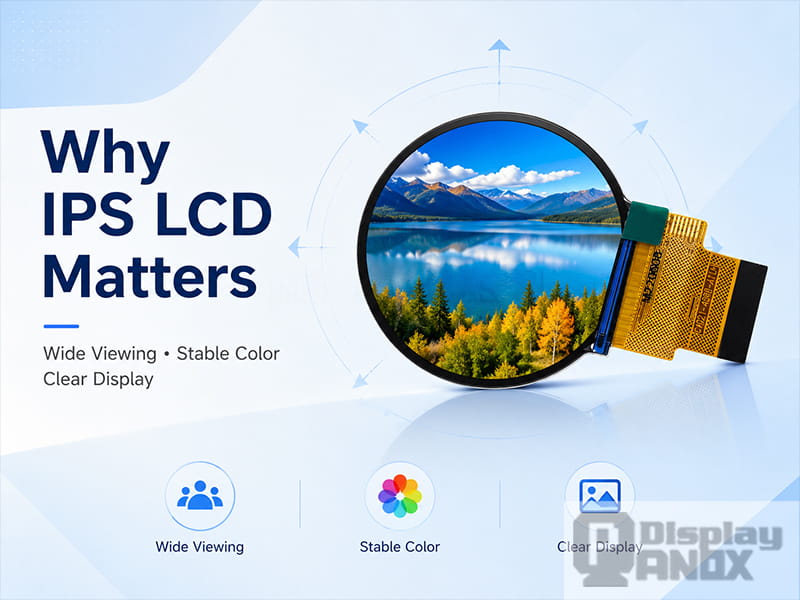
An IPS LCD screen matters because many products are no longer viewed from one fixed position. Industrial operators stand beside machines. Drivers glance at dashboards from changing angles. Handheld devices tilt in the user’s hand. Smart home panels are mounted at different heights. Tablet-style screens switch between portrait and landscape layouts. In these real-world conditions, a display must remain clear, stable, and readable beyond the perfect front view.
IPS, short for In-Plane Switching, was developed to improve the viewing-angle and color-shift limitations of earlier LCD structures. For product designers and engineers, its value is practical: it helps a screen keep consistent image quality when the viewing position changes. That single advantage can affect usability, perceived product quality, interface safety, and long-term customer satisfaction.
For PanoxDisplay, IPS-LCD is an important display direction across industrial control panels, tablet displays, long strip screens, embedded devices, smart home systems, vehicle-related interfaces, and high-resolution display modules.
1. IPS LCD Solves a Real Viewing Problem
A display specification may look good on paper, but the real test begins when the product is installed. A screen that looks sharp in a datasheet photo can become difficult to read when viewed from above, below, or the side. This is especially common in products where the display is mounted into equipment instead of held directly in front of the user.
IPS-LCD technology helps reduce this problem by keeping brightness, contrast, and color more stable across wider viewing directions. The benefit is easy to understand in daily use. A control panel can be checked by more than one operator. A vehicle display can be seen from the driver’s seat or passenger side. A long strip display can be integrated into a narrow space without forcing the user to stand at one exact point.
This is why IPS LCD screens are widely used in modern embedded products. They make the interface feel less fragile. The information on the screen remains more predictable, and the product looks more professional in different environments.
2. The Technical Reason IPS Looks More Stable
An LCD screen does not emit light by itself. It uses a backlight, liquid crystal layer, polarizers, color filters, and a TFT driving structure to control how light passes through each pixel. In an IPS LCD screen, the liquid crystal molecules rotate mainly within the plane of the glass substrate when voltage is applied.
This in-plane movement is the key. Since the molecular rotation is more parallel to the panel surface, the optical behavior changes less dramatically when the viewer moves away from the center. As a result, IPS panels can reduce the color inversion and grayscale shift often associated with older LCD modes.
The actual result still depends on the complete panel design. Liquid crystal material, pixel electrode layout, polarizer compensation, backlight quality, color filter design, and driving method all influence the final image. A good IPS LCD screen is the result of both the IPS mode and the full display module design.
3. Why Wide Viewing Angle Matters in Product Design
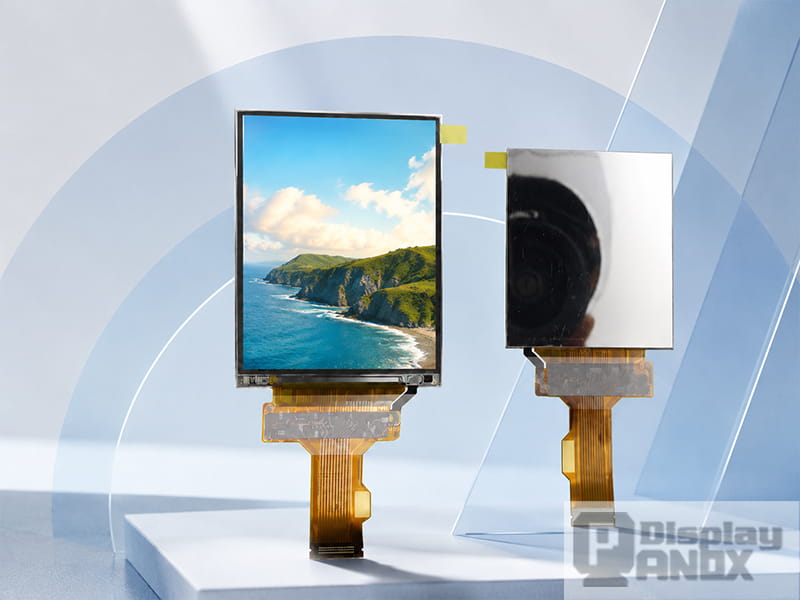
2.9 inch TFT-LCD 120 Hz For VR
Wide viewing angle is often treated as a visual feature, but in many products it is closer to a usability requirement.
In industrial equipment, the operator may not stand directly in front of the display during every step of operation. If the screen shifts color or loses contrast from the side, warning information and status values may become harder to read. In commercial terminals, the same screen may be viewed by customers and staff from different positions. In vehicle displays, the viewing angle can change with seating position, dashboard shape, and installation height.
For long strip displays, viewing stability is even more important. A stretched display is often installed in a dashboard, rearview system, PC case, shelf edge, or narrow control area. The screen shape itself encourages off-center viewing. IPS helps the display keep a clearer image across these changing angles.
A wide viewing angle also gives designers more freedom. The screen can be placed where the product shape needs it, instead of forcing the entire mechanical design to serve the ideal viewing position.
4. Stable Color Helps Interfaces Feel Trustworthy
Color is not only decoration. In many interfaces, color carries meaning. Green may indicate normal operation. Red may indicate alarms. Blue may show active modes or system states. If the same color looks different from different angles, the interface becomes less reliable.
IPS LCD screens are valuable because they help preserve color consistency. This is useful for dashboards, medical-style interfaces, smart home panels, testing instruments, industrial HMI systems, and handheld devices. The user does not need to constantly adjust the viewing position to confirm whether the screen is showing the correct state.
For consumer-facing products, stable color also affects perceived quality. A product with a consistent, vivid display feels more refined. Even when the internal hardware is excellent, a poor viewing-angle display can make the whole device look cheaper than it really is.
5. IPS LCD Supports Clearer GUI Design
Modern embedded products often use more visual interfaces than older devices. A simple numeric display may only need basic readability, but a graphical UI needs stable gradients, icons, charts, maps, buttons, and status cards.
An IPS LCD screen gives UI designers a stronger foundation. Interface elements can use more subtle color differences. Buttons and icons can be placed across the full screen area. Charts and status blocks remain easier to read when the device is tilted or mounted off-axis.
This is especially useful for industrial HMI and smart control systems. A 4.3 inch 800×480 IPS-TFT industrial LCD with a Parallel RGB 24-bit interface, for example, can support compact control panels where the interface needs to show status, values, menus, and simple graphics. The RGB interface also makes it suitable for many embedded platforms and MCU/MPU-based designs.
6. IPS LCD Is a Practical Choice for Embedded Integration
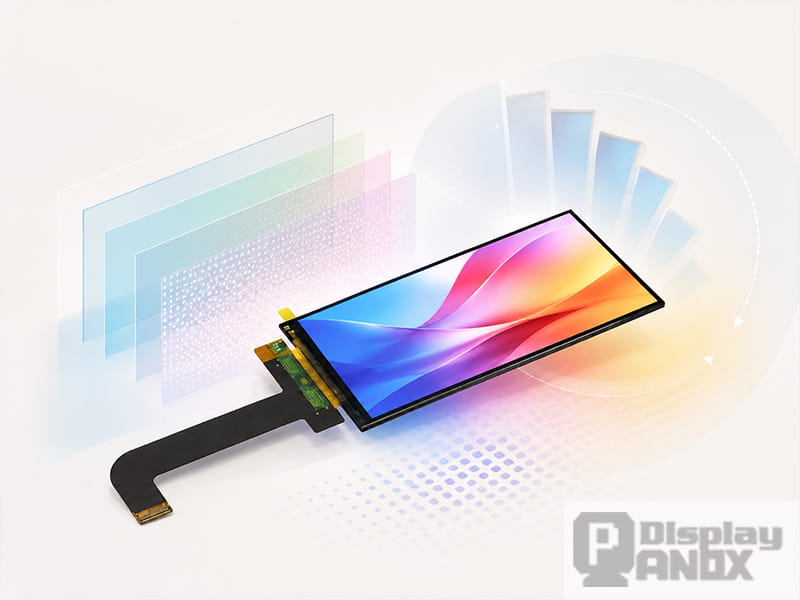
IPS-LCD is not only chosen for image quality. It is also chosen because the TFT-LCD ecosystem is mature.
Product teams can find IPS LCD screens in many sizes, resolutions, brightness levels, and interface types. Common interface options include RGB, MIPI DSI, LVDS, and eDP. For development projects, this matters because the display must match the host platform, PCB layout, signal bandwidth, connector structure, power design, and software driver.
A 7.0 inch LTPS TFT-LCD with 1200×1920 resolution and MIPI interface can be useful for tablet-style products and high-density embedded interfaces. A 9.7 inch QXGA TFT-LCD with eDP interface can support applications that need a larger high-resolution display area. A 6.8 inch long strip IPS TFT-LCD with 480×1280 resolution and MIPI interface can fit narrow product spaces where a conventional rectangular screen would waste mechanical space.
This flexibility is one reason IPS-LCD remains important. It can serve many product types without forcing every project into the same display size or interface path.
7. Why IPS LCD Is Still Relevant Beside OLED
OLED and AMOLED displays are excellent choices for many premium products. They offer self-emissive pixels, strong contrast, thin structures, and rich visual performance. However, IPS LCD screens still hold a strong position in industrial, embedded, and commercial product design.
The reason is balance. IPS LCD can provide wide viewing angle, stable color, mature sourcing, broad size coverage, and practical driving options. For products that need long operating hours, stable production planning, and easier controller board support, IPS-LCD can be a more predictable choice.
IPS LCD is also useful when the product does not require the ultra-thin structure or pixel-level black performance of OLED. Many industrial panels, smart terminals, machine interfaces, and vehicle-related modules prioritize readability, reliability, and supply stability over dramatic contrast.
The best technology depends on the product. IPS LCD is important because it provides a dependable middle ground: strong visual quality, manageable cost, mature manufacturing, and flexible integration.
8. Why IPS LCD Matters for Industrial Displays
Industrial displays are different from ordinary consumer screens. They may be used for long hours, installed in fixed equipment, exposed to changing temperatures, or operated by different users across a work shift. The display must remain readable and consistent.
IPS-LCD is well suited to many industrial HMI projects because it supports stable viewing from different positions. In an industrial panel, the screen may show equipment status, alarm information, production data, temperature readings, or operating menus. If the display loses clarity when viewed from the side, the interface becomes less efficient.
For compact industrial devices, a 4.3 inch IPS-TFT LCD is a practical size. It is large enough for a simple graphical interface while still fitting into small control boxes, handheld instruments, smart home devices, and embedded equipment. With an 800×480 resolution and Parallel RGB 24-bit interface, it gives engineers a clear path for many MCU and embedded board designs.
9. Why IPS LCD Matters for Tablet and Portable Devices
Portable products are constantly moved, rotated, and tilted. A user may view the screen while walking, holding the device in one hand, placing it on a stand, or sharing it with another person. In these conditions, viewing-angle stability becomes part of the user experience.
A high-resolution IPS LCD screen can make a tablet-style device feel more comfortable and polished. Text remains easier to read. Images look more consistent. UI elements stay visually stable when the user changes the device position.
For display modules such as a 7.0 inch LTPS TFT-LCD with 1200×1920 resolution, IPS-related wide-viewing performance is useful for portable monitors, tablet projects, smart terminals, and development platforms. The MIPI interface also matches many mobile and embedded processor platforms, although careful signal layout and initialization support are still required.
10. Why IPS LCD Matters for Long Strip Displays
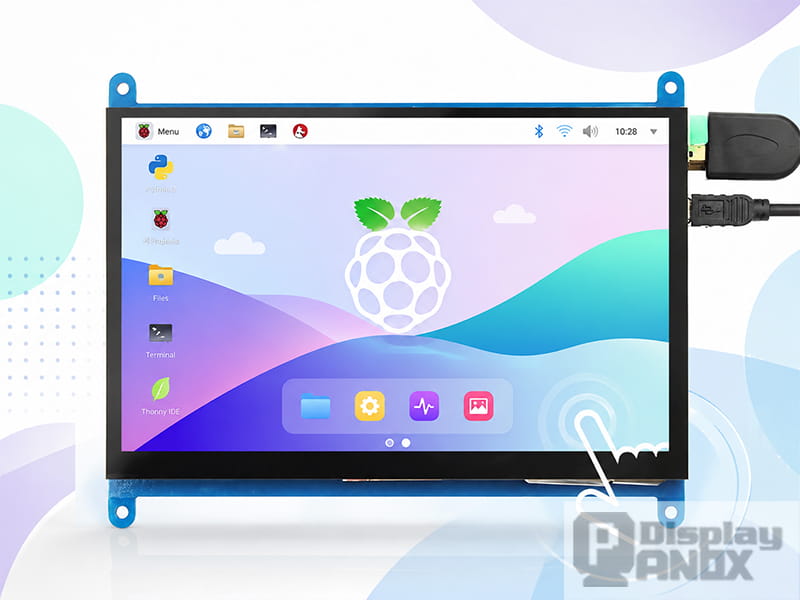
7 inch Raspberry Pi LCD Display Touch Screen
Long strip displays are used when product shape is limited or when the interface needs to follow a narrow horizontal or vertical space. They can be used in rearview systems, dashboards, smart home panels, PC case displays, shelf-edge information screens, industrial status bars, and dynamic information displays.
IPS is valuable in this category because long strip screens are rarely viewed from only one fixed point. A narrow display may be mounted across a dashboard, inside a device window, or along the edge of a product. The user’s view can shift along the screen length, so color and contrast stability become more visible.
A 6.8 inch long strip IPS TFT-LCD with 480×1280 resolution and MIPI interface gives product designers a narrow display format for compact embedded layouts. Instead of adapting the product around a standard display shape, the display can follow the product’s own design language.
11. Why IPS LCD Matters for High-Resolution Display Modules
High-resolution LCD modules need more than pixel count. A screen with many pixels can still look poor if the viewing angle is weak or the color shifts strongly off-axis.
This is why IPS-LCD is important for higher-resolution applications. A 9.7 inch QXGA TFT-LCD with 2048×1536 resolution and eDP interface can support detailed images, dense UI layouts, control interfaces, inspection systems, and tablet-like display products. The high pixel density gives visual detail, while IPS-related viewing stability helps that detail remain useful from different positions.
For engineers, the interface is also important. eDP is commonly used in higher-resolution panels because it can carry large display data bandwidth with fewer signal lines than older parallel approaches. When selecting such a panel, teams should confirm timing, voltage, connector definition, cable design, backlight power, and controller compatibility early in the project.
12. IPS LCD Can Improve Product Perception
A display is often the first part of a product that users judge. Even when the main function is mechanical, electrical, or software-based, the screen creates the first impression.
If the display looks washed out, shifts color, or becomes unclear from a small angle, users may question the product quality. A stable IPS LCD screen helps the product feel more refined. The screen remains visually consistent, the UI looks cleaner, and the device appears more carefully engineered.
This matters for B2B products as much as consumer products. A factory operator, system integrator, vehicle equipment buyer, or smart home installer may not know the exact LCD structure, but they will notice whether the screen is easy to read.
13. When IPS LCD Should Be Prioritized
IPS LCD should be strongly considered when the product needs a graphical interface that will be viewed from multiple directions. It is also a good option when color consistency matters, when the screen is mounted in fixed equipment, or when the product needs a mature LCD supply chain.
It is especially useful for:
industrial HMI panels and control systems
tablet-style embedded devices
smart home control panels
vehicle and mobility interfaces
long strip information displays
testing and measurement instruments
security devices and access terminals
portable monitors and development kits
The final decision should still be based on the full specification. Brightness, contrast ratio, response time, operating temperature, interface, backlight lifetime, touch panel structure, and mechanical size all need to match the application.
14. What to Check Before Choosing an IPS LCD Screen
A good IPS LCD selection process should start from the final product environment. Indoor products, vehicle systems, outdoor devices, handheld terminals, and industrial machines all place different demands on the display.
The first step is size and resolution. The screen must fit the mechanical design while giving enough space for the interface. A small control panel may only need 800×480, while a tablet-like display may require much higher pixel density.
The second step is interface compatibility. RGB may suit compact embedded systems. MIPI DSI is common in mobile and high-resolution compact panels. eDP is often used for high-resolution display modules. HDMI usually requires a controller board, which can simplify connection to PCs, Raspberry Pi boards, and other development platforms.
The third step is optical performance. Brightness, viewing angle, contrast, color depth, surface treatment, and bonding structure can all affect readability. For outdoor or bright environments, viewing angle alone is not enough. The backlight, cover lens, reflection control, and thermal design also matter.
The fourth step is integration support. A display module may need a touch panel, cover glass, custom FPC, connector change, backlight cable, driver board, or housing support. Considering these details early can prevent costly redesigns later.
15. How PanoxDisplay Supports IPS-LCD Projects
PanoxDisplay provides IPS-LCD display panels for industrial, embedded, tablet, long strip, smart home, vehicle-related, and high-resolution applications. The available product directions include compact RGB IPS-TFT modules, MIPI long strip IPS displays, tablet-style LTPS LCD modules, and high-resolution eDP TFT-LCD panels.
For engineering teams, the display panel is only one part of the project. A complete display solution may also require a controller board, PCB or PCBA support, touch panel, cover glass, connector matching, FPC customization, or sample testing. PanoxDisplay can support customers from display selection to integration planning, helping reduce the gap between panel specification and real product use.
When choosing an IPS LCD screen, the goal is not only to find a panel with a good datasheet. The goal is to choose a display that fits the device, the user environment, and the development path.
Conclusion
An IPS LCD screen is important because it improves how a display performs in real use. It helps the image remain clearer from different viewing directions, keeps colors more stable, supports modern graphical interfaces, and gives engineers a mature display platform for embedded and industrial products.
For industrial control panels, long strip displays, smart terminals, tablet-style devices, vehicle-related systems, and high-resolution modules, IPS-LCD offers a strong balance of visual quality, integration flexibility, and supply practicality.
As display products become more interface-driven, the value of IPS is not limited to a wider viewing angle. It helps the whole product feel easier to read, easier to trust, and better engineered.
Learn more: What Is an IPS LCD Screen? A Practical Guide to IPS-LCD Display Panels