







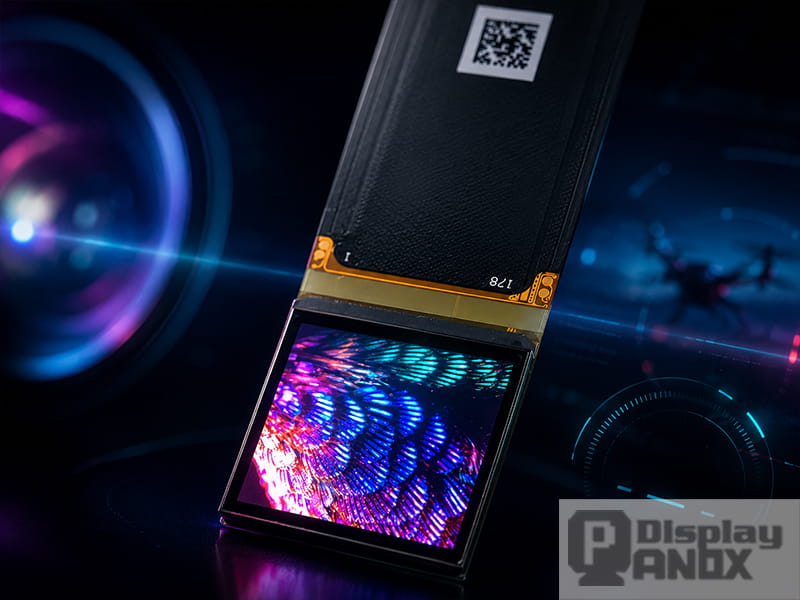
1.03 inch Micro OLED Display 2K for AR/FPV
High contrast is one of the first things users feel when they look at a display, even if they do not know the technical term behind it. A screen with good contrast has clearer text, stronger image depth, cleaner dark areas and more convincing highlights. A screen with weak contrast can look flat, gray and tiring, even when the resolution number looks impressive on paper.
For display panel selection, contrast is not only a visual preference. It affects readability, optical efficiency, UI design, power strategy, touch integration, VR immersion, 3D printing accuracy and the final product’s perceived quality. This is why high contrast display panels are used across very different applications, from Micro OLED near-eye modules and AMOLED mobile displays to round wearable screens, VR LCDs and high-resolution LCD panels for 3D printing.
Panox Display’s high contrast display category covers Micro OLED, AMOLED, TFT-LCD, flexible OLED and high-resolution LCD panels. These products do not serve the same market, yet they share one practical requirement: the screen must separate dark and bright information clearly enough for the user, the lens system or the device function to work properly.
Contrast Is What Makes Information Stand Out
A display does not only show color. It shows differences. White text must separate from a black background. A bright icon must stand out from a dark interface. A medical or industrial image must preserve small tonal changes. A VR scene must keep depth cues visible after the image passes through lenses.
High contrast improves that separation. In a mobile display, it makes photos and videos look richer. In a smartwatch or circular display, it keeps small UI elements readable within a limited screen area. In a Micro OLED used for AR or EVF systems, it helps fine symbols and image details remain clear after magnification. In a 3D printing LCD, it helps define the light pattern used for exposure.
This is why a high contrast display panel should be judged by the final application, not only by a single contrast ratio number. A tiny Micro OLED, a 5.5 inch AMOLED phone panel and an 8.9 inch monochrome LCD for resin printing need contrast for different reasons.
High Contrast Depends on Black Level, Brightness and Reflection
A strong contrast experience comes from three factors working together: dark black level, sufficient brightness and low reflection.
Black level decides how deep dark areas can become. OLED and Micro OLED panels are strong here because each pixel emits its own light. When a pixel displays black, light emission can be reduced at the pixel level. This gives OLED a natural advantage in scenes with dark backgrounds, night modes, high-contrast UI, camera viewfinders and near-eye optical systems.
Brightness decides whether the image can stay visible when ambient light or optical loss is present. This is especially important for AR/VR, outdoor handheld devices, industrial instruments and products with cover glass or touch layers. A panel with deep black may still look weak if it cannot produce enough luminance after the full optical stack.
Reflection decides how much surrounding light is added back to the screen surface. Reflected light raises the perceived black level and reduces real-world contrast. This is why cover glass, optical bonding, anti-reflective treatment and touch panel structure can change the final display quality even when the bare panel itself is good.
In practical product development, contrast should be considered together with the whole display stack: panel, touch layer, cover glass, driver board, brightness control, mechanical structure and the environment where the product will be used.
Why High Contrast Matters in OLED and AMOLED Displays
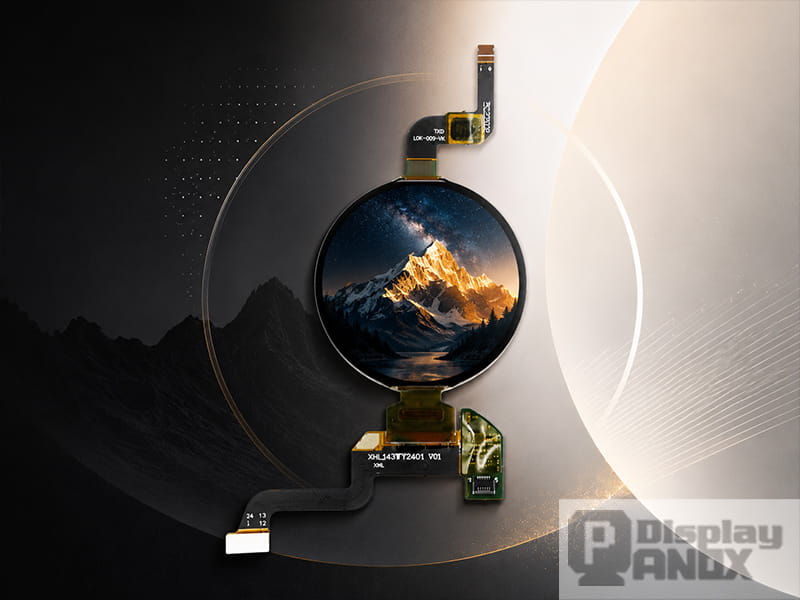
1.43 inch AM-OLED Full Color On-cell PCAP Touch
OLED and AMOLED panels are often selected for high contrast because they are self-emissive. Each pixel can generate light independently, giving the image strong control over dark and bright areas. This is useful for dark-themed interfaces, premium mobile products, handheld devices, wearable displays and visual systems where black backgrounds are common.
For example, the 5.5 inch OLED FHD On-cell PACP TP For Cellphone listed by Panox Display uses an AMOLED structure, 1080(RGB)×1920 resolution, MIPI interface and AUO panel source. This type of panel is suitable for mobile and handheld products that need high contrast, slim structure and integrated touch. Panox also lists a 5.48 inch Full Color OLED 1920×1080 G1548 MIPI Touch Panel with 1080(RG/BG)×1920 resolution, FHD, 327 PPI and GVO/Visionox source. For products where the display is close to the user’s eyes or used for rich media, this level of pixel density and contrast can make the interface look much more refined.
Another useful example is the 3.92 inch AMOLED PCAP 1080×1240 MIPI/eDP panel. Its compact size, high resolution and touch capability make it more relevant to handheld devices, compact instruments and custom control screens than large consumer monitors. In these products, high contrast helps the interface feel clear at a glance, especially when the display area is small and the user cannot rely on large text.
OLED contrast also affects perceived sharpness. A 1080p display with strong black separation may look cleaner than a higher-resolution screen with gray blacks and low edge contrast. This matters in small and medium displays because users often judge quality from icons, typography, camera previews and UI transitions rather than test charts.
Why High Contrast Matters in Micro OLED Near-Eye Displays
Micro OLED panels are used in applications where the display is extremely small but visually enlarged through optics. This changes the importance of contrast. In a normal handheld display, the user looks directly at the screen. In a near-eye display, the image passes through lenses, prisms, waveguides or other optical elements before it reaches the eye.
Any weakness in black level, pixel structure, brightness uniformity or contrast can become more visible after magnification. A dark area that looks acceptable on the test bench may appear hazy in the final optical system. A bright symbol may lose impact if the surrounding black is lifted by stray light or reflection.
Panox Display’s high contrast category includes several Micro OLED panels that fit this type of application. The 0.71 inch Micro OLED 1920×1080 LVDS 3000 nits panel uses a silicon-based Micro OLED structure, 1920(RGB)×1080 FHD resolution, 3078 PPI, LVDS interface and Sony source. This combination of high pixel density, small active area and high brightness makes it suitable for AR, EVF, optical modules and other near-eye systems.
The 0.49 inch Micro OLED Display 1920×1080 MIPI Interface is another example. It is listed as a Si-OLED/OLED panel with 1920(RGB)×1080 FHD resolution, 4391 PPI, SPI/MIPI interface and BOE source. A high-PPI Micro OLED like this can support very fine image detail in a compact optical engine.
Panox also lists a 0.5 inch Micro OLED with 1600×1200 resolution, I2C/MIPI interface, 1000 cd/m² luminance and 120 Hz refresh rate. For near-eye use, refresh rate and contrast work together: contrast helps the image look clean, while refresh behavior affects motion clarity and comfort.
For AR, VR, FPV, EVF and medical optical equipment, high contrast is tied directly to legibility. Symbols, menus, measurement marks and image details must remain clear after the display is magnified. A Micro OLED panel with strong contrast can reduce the washed-out look that makes near-eye content feel less precise.
Why High Contrast Matters in VR LCD Panels
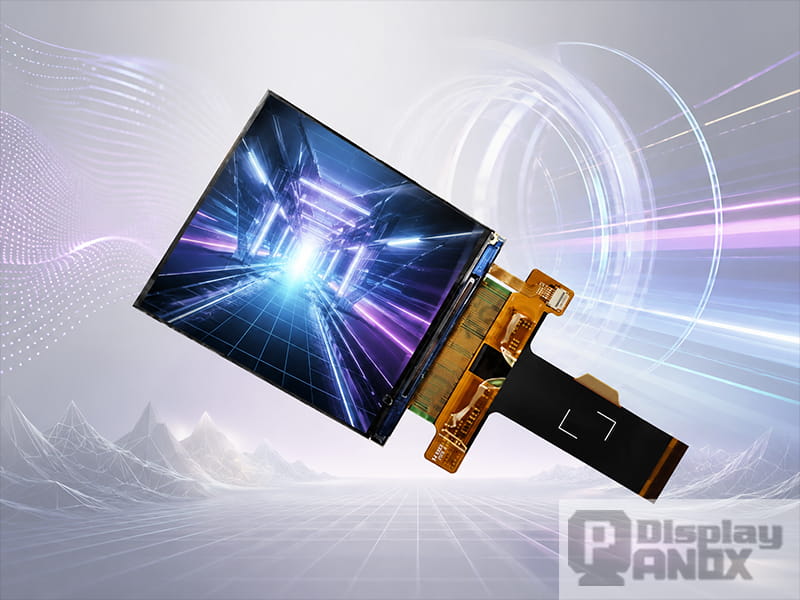
2.9 inch LCD 2K Resolution 90 Hz For VR
VR displays have a different challenge. The display is close to the eye, enlarged by lenses and used for motion-rich content. The user does not only see the panel; they see the panel through an optical system. This means resolution, refresh rate, brightness, black level and contrast all contribute to immersion.
Panox Display lists a 2.9 inch LCD 2K Resolution 90 Hz For VR. Its key specifications include 2.9 inch size, TFT-LCD technology, 2160×2160 resolution, MIPI interface and Sharp source. This type of square, high-resolution LCD panel is designed for VR applications where fine detail and motion performance matter. The 90 Hz refresh rate is important because VR content changes rapidly with head movement, while the 2K-class resolution helps reduce visible pixel structure.
Another VR-related example is the 3.5 inch LCD 90 Hz For VR, listed with 1440(RGB)×1600 resolution, MIPI interface and BOE source. Panox also lists a 3.81 inch OLED 90 Hz For VR with 1080(RGB)×1200 resolution, MIPI interface and AUO source. These examples show that VR display selection is not limited to one technology. LCD can provide high resolution and mature integration, while OLED can bring stronger black level and self-emissive contrast.
High contrast in VR helps in three ways. First, it improves scene depth, especially in dark virtual environments. Second, it makes UI overlays and text easier to read. Third, it supports visual comfort because the user does not need to work as hard to separate foreground information from the background.
For VR product design, contrast should be evaluated after the lens system is considered. A panel with good bench performance may look different inside the final headset. Lens transmittance, internal reflection, display brightness and optical alignment all affect the perceived contrast at the eye.
Why High Contrast Matters in Round and Wearable Displays
Round displays often have limited active area, compact mechanical space and close viewing distance. In this situation, contrast is important because the UI must remain readable without relying on large layout space.
The 1.28 inch Round LCD TFT 240×240 SPI 55Hz PCAP Touch Panel from Panox Display uses TFT-LCD IPS technology, 240×240 resolution, SPI interface and PCAP touch. It is suitable for smart watch, compact control, smart home and small embedded display projects. Although it is an LCD rather than OLED, contrast still matters because circular UI elements, icons, numbers and status indicators need clear separation from the background.
In small displays, interface design often uses dark backgrounds, bright rings, simple icons and large numerical information. A higher-contrast panel makes this kind of UI look cleaner. Even a 240×240 round display can feel sharp when the black level, viewing angle and touch cover are handled well.
AMOLED options are also common in wearable products. Panox lists compact AMOLED panels such as a 2.04 inch AM-OLED Full Color On-cell PCAP Touch panel with 368×448 resolution and SPI interface, as well as a 2.4 inch Color OLED panel with 450×600 resolution and SPI/MCU/MIPI interfaces. These panels support vivid color and strong contrast in small form factors, which is useful for wearable, handheld and compact control products.
For wearables, high contrast also supports power strategy. Dark UI design can be efficient on OLED-based displays because black pixels require far less emission than bright pixels. This makes contrast part of both image quality and product endurance planning.
Why High Contrast Matters in 3D Printing and Exposure LCDs
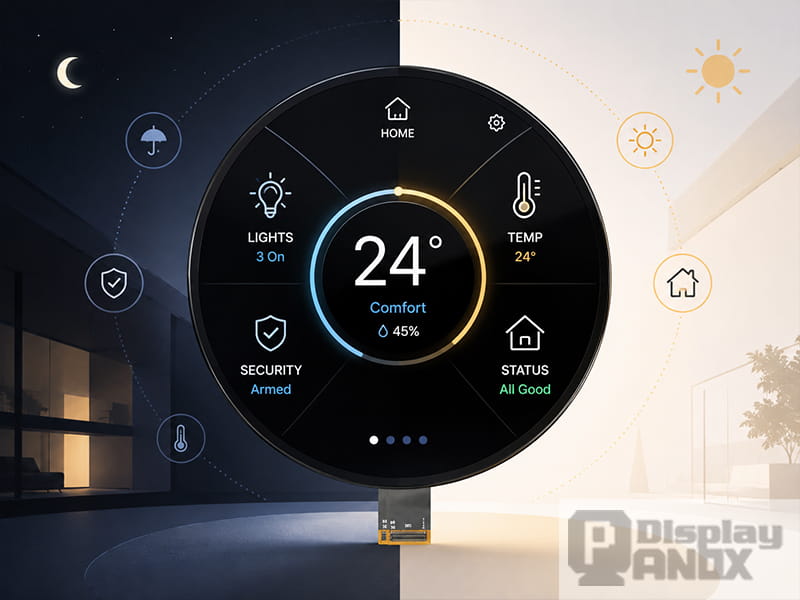
5.0 inch Round/Circular LCD Cover Glass Optional For Smart Home
In resin 3D printing and exposure systems, the display is not mainly used for visual enjoyment. It controls light. The LCD functions as a mask, allowing selected areas to pass exposure light while blocking others. In this application, contrast affects pattern definition.
If dark areas leak too much light, edges can become less clean. Fine details may blur, small holes may close, and exposure accuracy may suffer. This is why high-resolution LCD panels used for 3D printing need careful evaluation of resolution, pixel density, transmittance, contrast and optical stack.
Panox Display lists a 5.5 inch LCD 4K Resolution For 3D Printing/Projector with 2160(RG/BR/GB)×3840 UHD resolution, 658 PPI, MIPI interface and Sharp source. This is a very different use case from a mobile OLED panel, yet contrast is still central. The goal here is controlled light separation rather than cinematic image depth.
Another example is the 6.08 inch monochrome LCD 2K Resolution For 3D Printing, listed with 1620×2560 resolution, MIPI interface and Tianma source. Monochrome LCDs are often selected in exposure systems because they can offer better UV-related efficiency compared with color-filter structures, depending on the optical design. In this type of product, contrast helps define the boundary between exposed and blocked areas.
Panox also lists an 8.9 inch Monochrome LTPS TFT-LCD Display for 3D Printer with 3840×2400 WQUXGA resolution, 508 PPI, LVDS interface and BOE source. This panel size and resolution are useful for larger-format resin printing systems where fine detail and exposure area both matter.
For 3D printing customers, “high contrast” should be translated into production language: cleaner exposure boundaries, more stable detail reproduction and better control over light leakage.
Product Examples from Panox Display’s High Contrast Category
The table below gives selected examples from Panox Display’s high contrast display panel category. These are not the only available products, but they show how the same high-contrast requirement appears across Micro OLED, AMOLED, TFT-LCD, wearable, VR and 3D printing applications.
| Product Example | Technology | Resolution | Interface | Brand / Source | Why Contrast Matters |
|---|---|---|---|---|---|
| 0.71 inch Micro OLED 1920×1080 LVDS 3000 nits | Silicon-based Micro OLED | 1920(RGB)×1080, FHD, 3078 PPI | LVDS | Sony | Near-eye clarity, high brightness, deep black and compact optical integration |
| 0.49 inch Micro OLED Display 1920×1080 MIPI Interface | Si-OLED / OLED | 1920(RGB)×1080, FHD, 4391 PPI | SPI, MIPI | BOE | Ultra-high pixel density for AR, EVF, optical engines and compact imaging systems |
| 0.5 inch Micro OLED 1600×1200 120 Hz | Micro OLED | 1600×1200 | I2C, MIPI | Panox Display | Fast near-eye display response with strong image separation |
| 1.03 inch Micro OLED Display 2K for AR/FPV | Micro OLED | 2560×2560 | I2C, MIPI | Panox Display | Square high-resolution image for AR, FPV and compact optical systems |
| 1.28 inch Round LCD TFT 240×240 SPI 55Hz PCAP Touch Panel | TFT-LCD, IPS | 240×240 | SPI | Panox Display | Compact circular UI readability for wearable and smart control applications |
| 2.04 inch AM-OLED Full Color On-cell PCAP Touch | AMOLED | 368×448 | SPI | Truly | Small touch display with vivid color and strong UI contrast |
| 2.9 inch LCD 2K Resolution 90 Hz For VR | TFT-LCD | 2160×2160 | MIPI | Sharp | High-resolution VR image with motion-oriented refresh performance |
| 3.5 inch LCD 90 Hz For VR | TFT-LCD | 1440(RGB)×1600 | MIPI | BOE | VR display integration where refresh rate and image clarity are important |
| 3.92 inch AMOLED PCAP 1080×1240 MIPI/eDP | AMOLED | 1080×1240 | MIPI, eDP | GVO / Visionox | Compact high-resolution touch display for handheld or embedded devices |
| 5.5 inch OLED FHD On-cell PACP TP For Cellphone | AMOLED | 1080(RGB)×1920 | MIPI | AUO | Mobile and handheld display with high contrast, vivid color and on-cell touch |
| 5.48 inch Full Color OLED 1920×1080 G1548 MIPI Touch Panel | OLED / AMOLED | 1080(RG/BG)×1920, FHD, 327 PPI | MIPI | GVO / Visionox | High-resolution mobile-style display with rich contrast and touch integration |
| 5.5 inch LCD 4K Resolution For 3D Printing/Projector | TFT-LCD | 2160(RG/BR/GB)×3840, UHD, 658 PPI | MIPI | Sharp | Fine exposure control for 3D printing, projection and optical pattern systems |
| 6.08 inch Monochrome LCD 2K Resolution For 3D Printing | TFT-LCD | 1620×2560 | MIPI | Tianma | Light masking and exposure precision for resin 3D printing |
| 7 inch AMOLED OLED 1920×1080 MIPI | OLED / AMOLED | 1080(RGB)×1920, FHD, 315 PPI | MIPI | Panox Display | Larger embedded display with vivid color, contrast and mobile-style image quality |
| 8.9 inch Monochrome LTPS TFT-LCD Display for 3D Printer | LTPS TFT-LCD CELL FOG | 3840×2400, WQUXGA, 508 PPI | LVDS | BOE | Large-format high-resolution exposure panel for 3D printing |
This table also shows why “high contrast display panel” is a broad category. A Micro OLED panel uses contrast to support near-eye optical clarity. A VR LCD uses contrast together with resolution and refresh rate. A round LCD uses contrast to make compact UI readable. A 3D printing LCD uses contrast to control light. An AMOLED mobile display uses contrast to create rich visual quality and slim product design.
High Contrast Also Affects Touch and Cover Glass Design
Many display projects lose contrast during integration. The bare panel may look good, while the final assembled module looks less clear after adding touch glass, cover lens, adhesive, air gap or protective surface treatment.
For on-cell AMOLED panels, touch integration can help keep the module thin and visually clean. For LCD products, optical bonding and cover glass choices can improve perceived contrast by reducing internal reflection. For round displays and handheld products, the cover lens must also support touch response, durability and optical clarity.
Panox Display’s high contrast category is connected with services such as customized cover glass, touch panel support, connectors and controller boards. This matters because contrast performance does not stop at the panel. The final image depends on the whole optical stack and driving solution.
For example, a high-contrast AMOLED panel for a handheld device may need a cover glass with good transmittance and low reflection. A Micro OLED near-eye module may need the correct driver board and optical compatibility. A 3D printing LCD may need a stable interface, mechanical alignment and light source matching.
High Contrast Helps Product Interfaces Feel More Premium
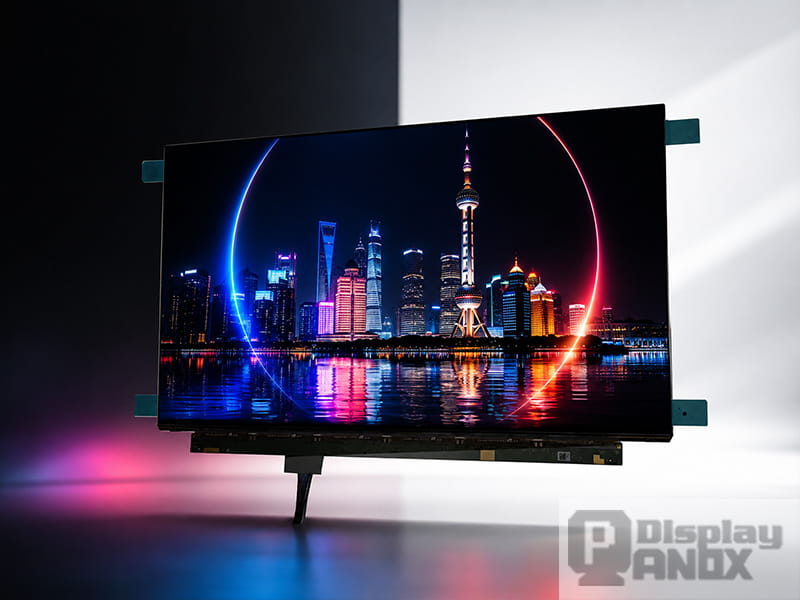
15.6 inch Full Color OLED Display 4K Touch Panel
A display is often the most visible part of a device. Users judge the product through the screen before they understand the hardware inside. High contrast helps a product feel more premium because the interface looks cleaner and more intentional.
In mobile and handheld devices, high contrast makes icons, buttons and image content feel sharper. In smart watches and compact round displays, it supports simple high-legibility UI. In industrial displays, it helps separate important values, warnings and navigation elements. In VR and AR, it makes the virtual image feel less washed out. In 3D printing, it supports functional accuracy rather than visual decoration.
This is why display selection should begin with the application scenario:
For near-eye optics, look closely at pixel density, brightness, black level, response and interface compatibility. A 0.71 inch Micro OLED FHD panel or 0.49 inch FHD Micro OLED can be more suitable than a larger display because the optical system needs compact size and high PPI.
For VR, consider resolution, refresh rate and lens loss together. A 2.9 inch 2160×2160 90 Hz LCD is selected for a different reason than a mobile AMOLED panel. The target is immersion, low visible pixel structure and stable motion.
For mobile and handheld devices, AMOLED panels such as 5.5 inch FHD on-cell touch displays are attractive because they combine high contrast, slim structure, vivid color and touch integration.
For 3D printing and projection, high-resolution LCD panels such as 5.5 inch 4K or 8.9 inch monochrome LTPS LCDs should be evaluated for exposure behavior, pixel density, interface and optical stability.
How to Choose a High Contrast Display Panel
When choosing a high contrast display panel, start from the environment and content type. A dark-mode wearable UI, a VR headset, an industrial handheld display and a 3D printer do not need the same panel even though all of them can benefit from contrast.
For visual products, evaluate whether the panel can produce deep blacks, bright highlights and stable color at the required viewing angle. For near-eye products, check pixel density, luminance, refresh behavior and optical compatibility. For exposure systems, focus on resolution, pixel structure, transmittance and light leakage control. For touch products, consider whether the touch layer and cover glass preserve contrast after assembly.
A useful selection checklist includes contrast behavior, brightness, resolution, pixel density, interface, refresh rate, touch integration, cover glass, power consumption, thermal design, FPC direction, mechanical outline and controller board availability. These factors work together. A display with strong native contrast may still need the right driver tuning and front glass design before it performs well in the final product.
Why Panox Display Supports High Contrast Display Projects
Panox Display supplies high contrast display panels across OLED, AMOLED, Micro OLED, flexible OLED and TFT-LCD categories. This product range is useful because high contrast is needed in many different forms: tiny Micro OLED panels for AR and EVF, compact AMOLED screens for handheld devices, round LCD modules for wearables, high-refresh LCDs for VR and high-resolution LCD panels for 3D printing.
Panox Display also supports connectors, customized touch panels, cover glass and controller or driver boards. For customers developing a new product, this can reduce the gap between selecting a panel and building a working display system.
For a high contrast project, the better question is not only “Which panel has the best contrast ratio?” A more useful question is: “Which display panel keeps the target content clear after the complete product is assembled?” That includes the panel technology, optical stack, interface, brightness control, viewing environment and content type.
Conclusion
High contrast is important because it controls how clearly a display separates information. It makes text easier to read, images more dimensional, UI elements sharper and optical systems more usable. In OLED and Micro OLED displays, contrast comes from pixel-level emission and deep black behavior. In LCD products, contrast depends on panel design, backlight control, optical stack and reflection management. In VR, high contrast works with resolution and refresh rate to support immersion. In 3D printing, contrast helps control exposure boundaries and detail accuracy.
Panox Display’s high contrast product range shows how wide this requirement can be. A 0.71 inch Micro OLED 1920×1080 LVDS 3000 nits panel, a 2.9 inch 2160×2160 90 Hz VR LCD, a 1.28 inch round 240×240 SPI touch LCD, a 5.5 inch FHD AMOLED on-cell touch display and an 8.9 inch monochrome LTPS LCD for 3D printing all use contrast in different ways.
The best high contrast display panel is the one that keeps the final product clear, readable and visually stable in its real application environment.
Learn more: High Contrast Display Technology: What It Means for OLED, LCD and Micro OLED Panels
FAQ
Why is high contrast important in display panels?
High contrast makes bright and dark information easier to separate. It improves text readability, image depth, UI clarity and the perceived sharpness of the display.
Why does OLED usually have better contrast than LCD?
OLED is self-emissive, so each pixel can control its own light output. This gives OLED strong black level performance and high contrast, especially in dark UI and video content.
Can LCD panels still be used for high contrast applications?
Yes. LCD panels are still useful for VR, 3D printing, tablets, embedded systems and industrial displays. Their contrast depends on panel structure, backlight, optical films, surface treatment and integration quality.
Why does high contrast matter in VR displays?
VR displays are magnified through lenses. Weak contrast, low resolution or poor motion behavior can become more visible after optical enlargement. High contrast helps virtual scenes, UI text and depth cues remain clearer.
Why is contrast important for 3D printing LCDs?
In resin 3D printing, the LCD controls where light passes and where it is blocked. Better contrast helps improve exposure boundaries and fine detail reproduction.
Which Panox Display panels are suitable for high contrast applications?
Panox Display offers Micro OLED panels for AR/EVF/optical systems, AMOLED panels for mobile and handheld devices, round TFT-LCD modules for compact UI, VR LCD panels with high resolution and refresh rate, and high-resolution LCD panels for 3D printing and exposure systems.