







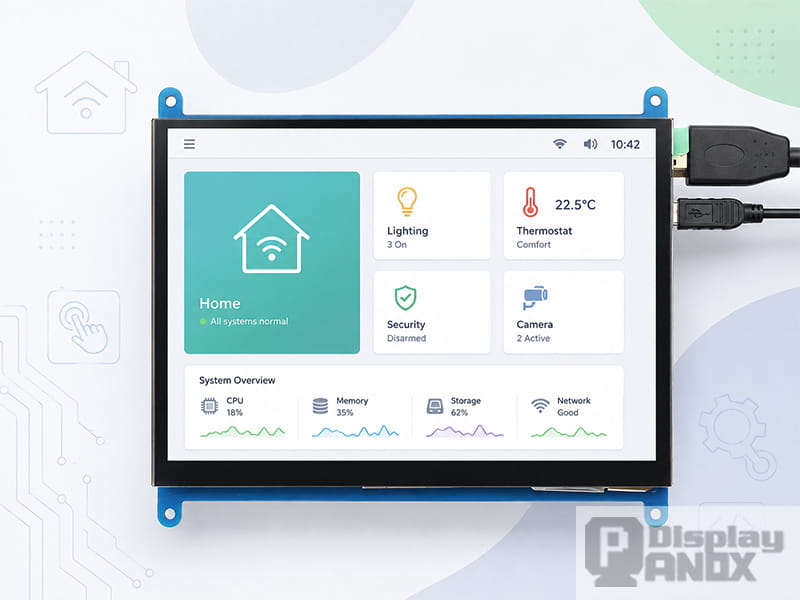
7 inch Raspberry Pi LCD Display Touch Screen
A 7 inch screen has become a familiar size in embedded electronics because it solves a practical design problem: how to give users enough visual space without making the device too large, too expensive, or too difficult to integrate. It is large enough for dashboards, touch controls, camera feeds, menus, maps, and real-time system data, while still fitting into handheld devices, wall-mounted controllers, industrial terminals, Raspberry Pi projects, and portable instruments.
This balance explains why the 7 inch display panel continues to appear across so many product categories. It can serve as a simple control interface, a compact monitor, a high-resolution tablet-style display, or a premium AMOLED screen for visual products. The final result depends on the display technology, interface, brightness, resolution, touch structure, and mechanical design.
For product developers, the value of a 7 inch screen is rarely about the diagonal size alone. The real advantage comes from the way this size supports a readable user interface, a manageable enclosure, and a flexible hardware architecture.
The 7 Inch Format Gives UI Designers Enough Room to Work
A display becomes useful when people can read it, touch it, and understand it quickly. Very small screens can work well for simple status indicators or wearable devices, but they often force designers to compress menus, icons, numbers, and alerts into tight layouts. Larger displays provide more space, although they also increase the product footprint, power budget, and mechanical cost.
A 7 inch screen sits in the middle. It gives UI designers enough area to create a complete interface with clear hierarchy. A smart home panel can show room controls, temperature, security status, and energy data on one screen. A portable instrument can show live measurements, settings, warnings, and trend charts without constant page switching. A Raspberry Pi display can become a dashboard, kiosk, control console, media panel, or test interface with a comfortable viewing area.
This is especially important for touch-based products. Buttons need enough space for fingers. Text needs enough contrast and size for quick reading. Information should be grouped in a way that users can scan without hesitation. A 7 inch touch screen gives designers room to build these elements with better spacing, making the product feel more polished and easier to use.
It Fits Many Devices Without Taking Over the Product
A 7 inch display panel is large enough to become the visual center of a device, yet it can still be integrated into compact product structures. This makes it useful for both portable and fixed installations.
In handheld devices, the screen can provide a strong visual experience while leaving space for grips, batteries, speakers, buttons, antennas, and internal boards. In wall-mounted controllers, it can create a clean control surface without looking oversized. In industrial machines, it can fit into control boxes and front panels where a larger screen may require a complete enclosure redesign.
The physical size also works well for development and prototyping. Engineers can test real interfaces on a screen that is close to the final product experience. A 7 inch Raspberry Pi LCD display, for example, can help teams build and evaluate software dashboards before moving into deeper hardware customization. For many projects, this reduces the gap between early UI testing and final device design.
It Supports Both Simple and Premium Product Positions
One reason the 7 inch screen is so versatile is that the same diagonal size can support very different product levels. A 7 inch LCD screen can be used in cost-sensitive equipment where stability and availability matter most. A 7 inch HDMI touch display can simplify prototyping and single-board computer integration. A high-resolution 7.0 inch MIPI LCD can support sharper tablet-style layouts. A 7 inch AMOLED display can bring stronger contrast, richer color, and a more premium visual impression.
This flexibility allows manufacturers to choose the right level of display performance for the product, instead of forcing every device into the same technical direction.
For an industrial interface, the display may need stable operation, a clear touch response, and a long supply lifecycle. For a handheld entertainment device, color performance, contrast, response time, and pixel density may carry more weight. For a smart home or information dashboard, the priorities may be clean readability, easy installation, and a friendly software environment.
A 7 inch display size can support all of these directions. That is why it is often selected early in product planning: it gives teams room to adjust the technology path without changing the entire product concept.
Readability Is Stronger Than the Size Suggests
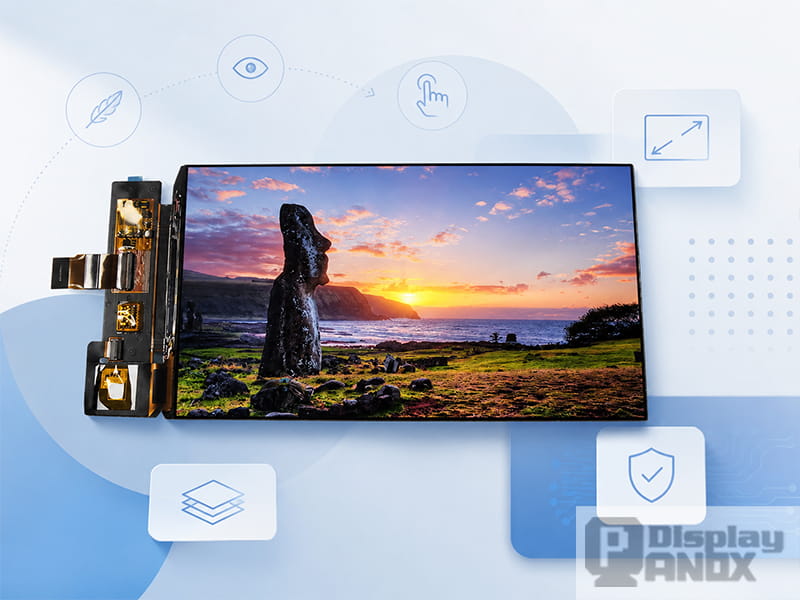
7 inch AMOLED OLED 1920X1080 Mipi
A good 7 inch screen can feel larger than its physical footprint when the interface is designed well. The diagonal size provides enough space for practical typography, icons, charts, and image content. This matters because readability is shaped by more than resolution. Ambient light, viewing distance, contrast, surface reflection, viewing angle, brightness, and UI design all affect how the display feels in real use.
In a factory, users may read the screen from a standing position or at an angle. In a vehicle, sunlight and vibration can change the viewing condition. In a handheld product, the user may hold the screen close and notice text clarity, motion response, and color consistency. In a wall controller, the display may be viewed by different users from different heights.
A 7 inch screen gives enough room to compensate for these conditions through layout. Important data can be larger. Controls can be separated. Warnings can be visually stronger. A designer can place main actions near the thumb area, keep secondary information in side panels, and avoid overly dense interfaces.
The result is a display size that works well not only on a datasheet, but also in real product use.
The Interface Options Make 7 Inch Screens Easier to Adapt
The same 7 inch display category can be built around different interface strategies. This is valuable because embedded projects do not all use the same host system.
For Raspberry Pi and mini PC projects, HDMI is often convenient. A 7 inch HDMI LCD touch screen can behave like a compact monitor, which helps developers test interfaces quickly. It is suitable for dashboards, portable Linux terminals, automation panels, maker projects, and demonstration systems. When the project needs a faster path from concept to working prototype, HDMI can reduce early development friction.
For more compact and high-resolution products, MIPI DSI is often preferred. MIPI DSI is widely used in mobile and embedded devices because it supports high-speed data transmission with fewer signal lines than traditional parallel interfaces. It is a strong choice for display modules where cable space, signal integrity, and power efficiency matter. A 7 inch AMOLED display or high-resolution tablet-style LCD often uses MIPI because the host must drive much more pixel data.
For custom products, controller boards can also bridge the gap between panel-level hardware and system-level integration. A display panel may use MIPI internally, while an external board converts HDMI or Type-C input for easier use with PCs, Raspberry Pi boards, or other development platforms. This kind of approach can help teams test product ideas before committing to a custom motherboard.
The key is to choose the interface based on the host platform, development timeline, and final product structure. A 7 inch screen gives enough product coverage to support several integration routes.
7 Inch LCD and 7 Inch AMOLED Serve Different Design Goals
LCD and AMOLED displays can both work well at 7 inches, but they serve different priorities.
A 7 inch LCD screen is usually chosen when the project needs mature supply, predictable cost, stable brightness, and broad compatibility. LCD modules are common in smart control panels, industrial equipment, portable monitors, vehicle accessories, and Raspberry Pi displays. When paired with a suitable touch panel and controller board, a 7 inch LCD can become a practical display solution for many embedded systems.
A 7 inch AMOLED display is attractive when the visual experience is central to the product. AMOLED pixels emit their own light, which helps achieve deep black levels, high contrast, fast response, and vivid color. This can be valuable for handheld entertainment devices, high-end control panels, media products, and interfaces where image quality directly affects user perception.
The choice should follow the product’s actual use case. A machine controller may benefit more from stable availability and readable brightness. A premium handheld device may justify AMOLED for its contrast and color. A portable dashboard may need HDMI convenience more than extreme display performance. A high-density tablet-style product may need MIPI and a sharper panel structure.
At 7 inches, the display is large enough for users to notice the difference between these technologies, so the selection has a direct effect on the final product experience.
PanoxDisplay 7 Inch Screen Options for Different Projects
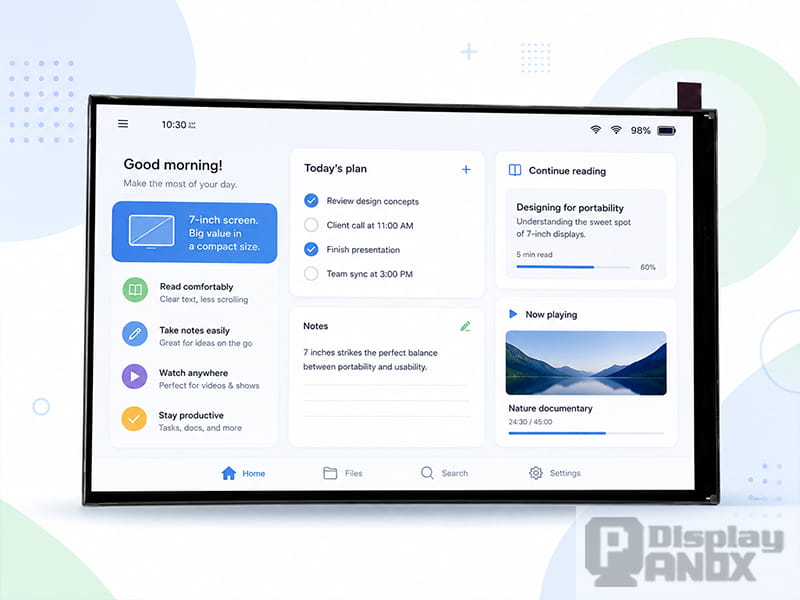
PanoxDisplay’s 7 inch display category covers several practical directions, allowing developers to match the display to the project rather than forcing one panel type into every application.
For visual-focused products, the 7 inch AMOLED OLED 1920×1080 MIPI display is suited to applications that need high contrast, rich color, and a premium screen feel. Its 315PPI pixel density makes it suitable for detailed graphics, handheld interfaces, and applications where the screen is viewed at close range.
For single-board computer projects, the 7 inch Raspberry Pi LCD Display Touch Screen provides a more direct integration path. With HDMI input and touch support, it can be used for smart home control panels, development dashboards, automation projects, test systems, and compact interactive terminals.
For tablet-style embedded devices, the 7.0 inch LCD for Tablet with MIPI interface is a suitable direction when the product needs a sharper LCD panel and a compact display connection. It can support vertical or horizontal interface concepts depending on the mechanical and software design.
These options show why the 7 inch screen category is useful for product planning. One size can support multiple display technologies, interface strategies, and product positions.
A 7 Inch Touch Screen Improves Interaction Without Overcomplicating the Device
Touch control is one of the main reasons 7 inch displays are popular. A 7 inch touch screen can replace many physical buttons while still giving users a clear and comfortable control surface.
In a smart home panel, touch input makes it easy to adjust lighting, climate, security, and media. In industrial equipment, it can simplify parameter settings and status checks. In portable instruments, it can reduce the number of mechanical controls and make the device easier to update through software. In Raspberry Pi projects, touch control turns a display into a self-contained interface rather than a passive monitor.
The size is important here. A smaller touch screen can feel cramped once the interface includes menus, icons, sliders, and alerts. A much larger touch screen can become difficult to mount or hold. A 7 inch panel gives enough room for finger-friendly targets while keeping the hardware compact.
Touch integration should still be planned carefully. Cover glass thickness, sensor type, bonding method, FPC direction, touch controller, and enclosure design all affect the final experience. A good touch screen feels natural because the display, glass, electronics, and UI were designed together.
It Works Well for Both Prototypes and Commercial Products
Many embedded projects begin as prototypes. A team may start with a Raspberry Pi, a development board, or a mini PC, then later move toward a custom PCB and enclosure. A 7 inch display fits this workflow well.
During early testing, a 7 inch HDMI touch display can help the team evaluate the UI, user flow, dashboard layout, and touch behavior. Once the project becomes more mature, the team can decide whether to keep the same display solution, use a different controller board, or move to a direct MIPI panel for a more compact final design.
This path is useful because display selection often affects software, mechanical design, electrical design, thermal planning, and user experience at the same time. A screen that is easy to prototype with can save time during concept development. A screen that also has a clear path toward production can reduce redesign later.
A 7 inch screen is large enough to represent a real product interface during testing. It is also common enough that developers can find multiple technology and interface options when the project moves forward.
Where 7 Inch Screens Are Most Useful
A 7 inch screen is especially useful in products where the user needs to see multiple pieces of information at once. It is a strong fit for control-centered interfaces.
In smart home systems, it can show room status, scene controls, temperature, energy use, and security information in one clean layout. In industrial equipment, it can display machine status, alarms, production data, and parameter settings. In vehicle-related products, it can handle navigation, camera feeds, diagnostics, and control menus. In medical or laboratory equipment, it can present data clearly while keeping the device compact. In maker and Raspberry Pi projects, it can act as a flexible dashboard for automation, monitoring, media, or custom software.
The common point across these applications is interaction. A 7 inch screen is often chosen when the display is part of the product’s control experience, not only a place to show a logo or a single number.
What Engineers Should Confirm Before Choosing a 7 Inch Display
A 7 inch display should be selected with the full product system in mind. The diagonal size may be fixed early, but the real design work depends on the details.
The first question is how the screen will be viewed. Indoor, outdoor, handheld, wall-mounted, vehicle-mounted, and industrial environments all place different demands on brightness, viewing angle, surface reflection, and temperature range.
The second question is how much visual detail the interface needs. A simple control panel can use a lower pixel load than a handheld media device or a tablet-style interface. Higher pixel density can improve clarity, but it also affects processing, interface bandwidth, and power consumption.
The third question is which host platform will drive the screen. A Raspberry Pi or mini PC may favor HDMI during development. A compact custom product may need MIPI. A production design may require a custom controller board, adapter board, or specific FPC direction.
The fourth question is how touch will be integrated. A touch panel changes the optical stack and the mechanical structure. It should be reviewed together with the cover glass, housing, display active area, and connector placement.
The fifth question is supply continuity. Commercial products need more than a good sample. They need stable sourcing, datasheet support, connector availability, and practical technical communication.
Why the 7 Inch Screen Remains a Safe Starting Point
A 7 inch screen gives product teams a strong starting point because it keeps the design flexible. It is large enough to support a mature interface, compact enough for embedded hardware, and available across several display technologies.
For teams building a new device, this reduces risk. The same product concept can be explored with an HDMI touch display, refined with a MIPI LCD, or upgraded with AMOLED depending on the target market. The enclosure can stay reasonably compact. The UI can remain readable. The development path can move from prototype to production without changing the user experience completely.
This is why 7 inch displays continue to appear in smart home controllers, Raspberry Pi dashboards, industrial HMIs, portable systems, vehicle devices, and handheld electronics. The size gives engineers and designers a practical compromise: enough screen area to create a useful interface, with enough flexibility to fit real hardware constraints.
Final Thoughts
A 7 inch screen is popular because it supports the way modern embedded products are actually built. It gives users a comfortable viewing area, gives designers enough space for a clear interface, and gives engineers multiple integration paths through HDMI, MIPI, controller boards, LCD, touch, and AMOLED options.
The right 7 inch display panel still depends on the product. A Raspberry Pi dashboard may need an easy HDMI touch solution. A tablet-style embedded device may need a high-resolution MIPI LCD. A premium handheld product may benefit from AMOLED contrast and color. An industrial terminal may prioritize reliability, readability, and long-term supply.
PanoxDisplay provides 7 inch screen options for these different needs, including 7 inch AMOLED, 7 inch Raspberry Pi LCD touch display, and 7.0 inch MIPI LCD solutions. For a successful product, the best choice begins with the real application: how the display will be viewed, touched, powered, mounted, and used every day.
Learn more: 7 Inch Screen: A Practical Guide to 7 Inch Display Panels for Embedded Devices
FAQ
Why is a 7 inch screen common in embedded devices?
A 7 inch screen is common because it gives enough space for a readable interface while keeping the product compact. It works well for touch control, dashboards, industrial panels, Raspberry Pi projects, smart home systems, and portable devices.
Is a 7 inch touch screen suitable for Raspberry Pi projects?
Yes. A 7 inch Raspberry Pi LCD touch screen is a practical choice for dashboards, smart home controls, automation panels, portable Linux interfaces, media systems, and development projects. HDMI input can make early setup easier for many users.
When should a product use a 7 inch AMOLED display?
A 7 inch AMOLED display is suitable when high contrast, vivid color, fast response, and a premium visual experience are important. It is often considered for handheld devices, media interfaces, gaming products, and visually rich control panels.
When should a product use a 7 inch LCD screen?
A 7 inch LCD screen is suitable for products that need stable performance, broad compatibility, mature supply, and practical cost control. It is widely used in smart home panels, industrial HMIs, portable instruments, and embedded control systems.
What is the most important factor when choosing a 7 inch display panel?
The most important factor is the actual application. Resolution, brightness, interface, touch structure, operating temperature, viewing angle, mechanical outline, and supply support should all be selected around the final product environment.