







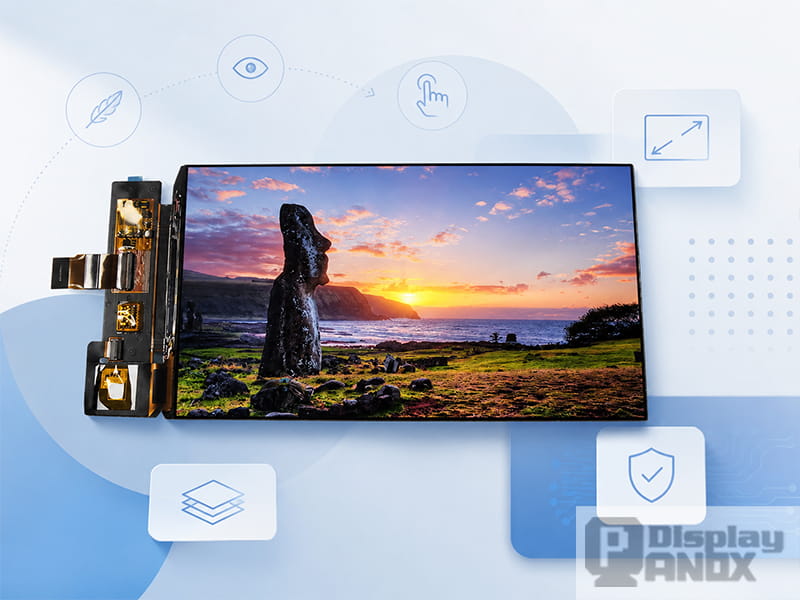
7 inch AMOLED OLED 1920X1080 Mipi
A reliable 7-inch display module should be purchased by exact model, interface, resolution, touch configuration, and integration level. The term “7-inch display” covers everything from raw MIPI panels and parallel RGB LCDs to HDMI touch-screen kits. Two products with the same diagonal size may require completely different host hardware, controller boards, connectors, power rails, and software.
For product development, a specialist display supplier is usually the most practical source. Panox Display offers several 7-inch display solutions, ranging from an 800 × 480 TFT-LCD and a plug-and-play Raspberry Pi touch screen to a Full HD 165 Hz AMOLED. Its catalogue also includes 7.8-inch flexible OLED and 7.84-inch stretched LCD options for projects that fall just outside the standard 7.0-inch format.
Small quantities and evaluation kits can be ordered through the online-store links on the relevant product pages. Development projects, customized assemblies, and volume orders are better handled through a direct quotation so that panel revision, touch integration, controller compatibility, warranty coverage, lead time, and shipping terms can be confirmed together.
Start with the Type of Display Being Purchased
A product listing may describe any of the following as a 7-inch display module:
| Product level | Usually included | Typical purchasing goal |
|---|---|---|
| Raw display panel | LCD or OLED panel, driver IC, FPC and connector | Integration into custom embedded hardware |
| Panel with touch | Raw panel with On-Cell, In-Cell or external capacitive touch | Handheld terminals and interactive products |
| Display kit | Panel, controller board, cables and sometimes touch | Faster prototype development |
| Finished touch monitor | Enclosure, video input, power circuit and controls | Immediate connection to a PC or single-board computer |
This distinction affects both price and compatibility. A raw MIPI panel requires compatible DSI timing, initialization commands, voltage sequencing, lane configuration, and a matching connector. According to the MIPI Alliance, MIPI DSI is a high-speed serial interface between a host processor and a display module. The presence of a MIPI connector alone does not make two devices electrically or mechanically compatible.
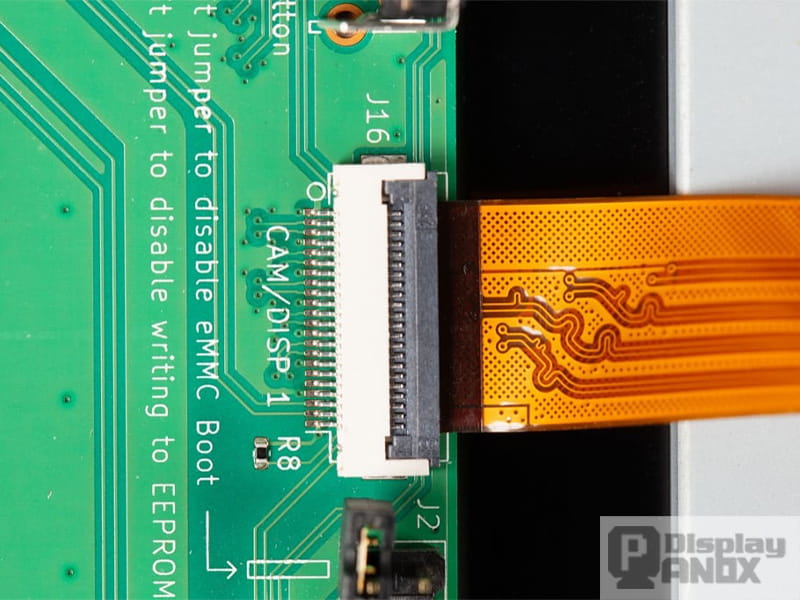
Raspberry Pi projects can also use several different display paths. The official Raspberry Pi Touch Display uses a DSI cable for display and touch data, while GPIO carries power, as shown in the Raspberry Pi display documentation. An HDMI-based third-party display uses HDMI for video and usually USB for touch. The required cables and setup therefore depend on the complete display assembly.
Panox Display’s 7-Inch and Related Display Range
Panox currently lists four exact 7.0-inch products and two closely related 7.8/7.84-inch products. They address very different projects and should not be treated as interchangeable panels.
| Product | Display and resolution | Interface | Touch | Best suited to |
|---|---|---|---|---|
| PO070FMTO 7-inch AMOLED | 7.0-inch AMOLED, 1080 × 1920, 315 PPI | Four-lane MIPI | On-Cell Touch | Premium handhelds, gaming devices, GPS and portable multimedia products |
| 7-inch Raspberry Pi LCD Touch Screen | 7.0-inch TFT-LCD, 1024 × 600 | HDMI video, USB touch | Integrated 10-point touch | Raspberry Pi dashboards, education, home automation and quick prototypes |
| AT070TN92 7-inch TFT-LCD | 7.0-inch a-Si TN TFT-LCD, 800 × 480 | 50-pin parallel RGB | None | Cost-sensitive embedded equipment, control panels and replacement projects |
| LT070ME05000 7-inch JDI LCD | 7.0-inch LTPS IPS TFT-LCD, 1200 × 1920, 332 PPI | Four-lane MIPI | Custom touch available | Tablets, detailed embedded interfaces and high-resolution LCD products |
| RO780FA1920M 7.8-inch Flexible OLED | 7.8-inch flexible AMOLED, 1440 × 1920, 308 PPI | Dual-port MIPI | Base version without touch; touch version available | Curved products, experimental interfaces and specialty portable devices |
| TM078L1280 7.84-inch Long Strip LCD | 7.84-inch TFT-LCD, 1280 × 400, 171 PPI | Four-lane MIPI | None | AIDA64 secondary screens, vehicle displays and status panels |
The two larger options belong to the same general 7-inch-class search range, although their mechanical shapes differ substantially from a conventional 7.0-inch display. The diagonal size should never be used as the only enclosure-design reference.
Which Panox 7-Inch Display Is Best for Each Project?
PO070FMTO: Best for High-Performance Portable Devices
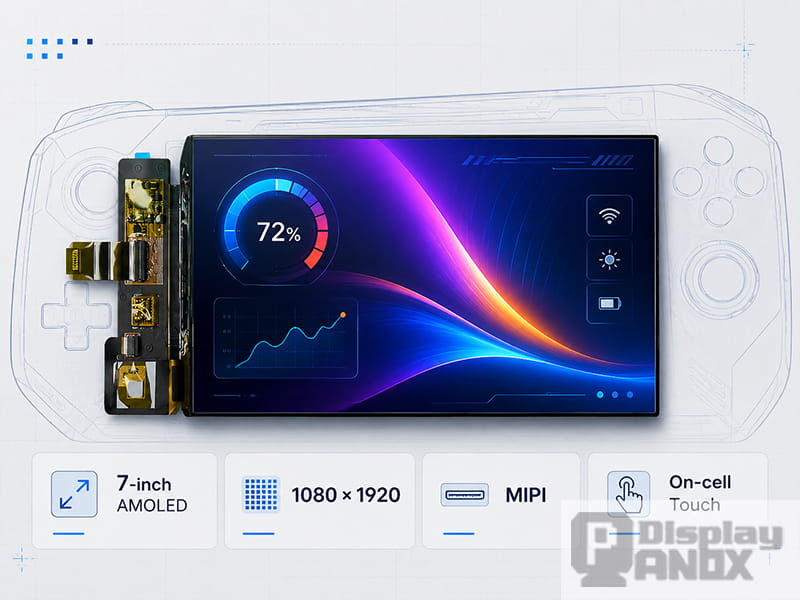
The PO070FMTO 7-inch AMOLED is the strongest option when image quality, motion performance, thickness, and touch integration are central to the product.
Its native portrait resolution is 1080 × 1920, equivalent to Full HD orientation when rotated. The panel provides approximately 315 PPI, 800 cd/m² typical luminance, a 100,000:1 typical contrast ratio, and support for refresh rates up to 165 Hz. It also supports 10-bit RGB color and approximately 1.07 billion colors.
On-Cell Touch integrates the touch function into the display structure, helping reduce thickness and additional optical interfaces. The published module outline is approximately 89.13 × 160.91 × 1.1 mm, making it suitable for compact handheld products.
Typical applications include:
-
Handheld game consoles
-
Portable navigation devices
-
Premium control terminals
-
Multimedia products
-
Mobile and tablet-style devices
The final refresh rate depends on the host processor, MIPI bandwidth, controller firmware, and selected display timing. A system designed only for 60 Hz will not automatically operate the panel at 165 Hz.
The published operating-temperature range is −40°C to 70°C. Finished products still require system-level thermal, mechanical, touch, and image-retention testing under their actual operating conditions.
1024 × 600 HDMI Touch Screen: Best for Raspberry Pi Prototypes
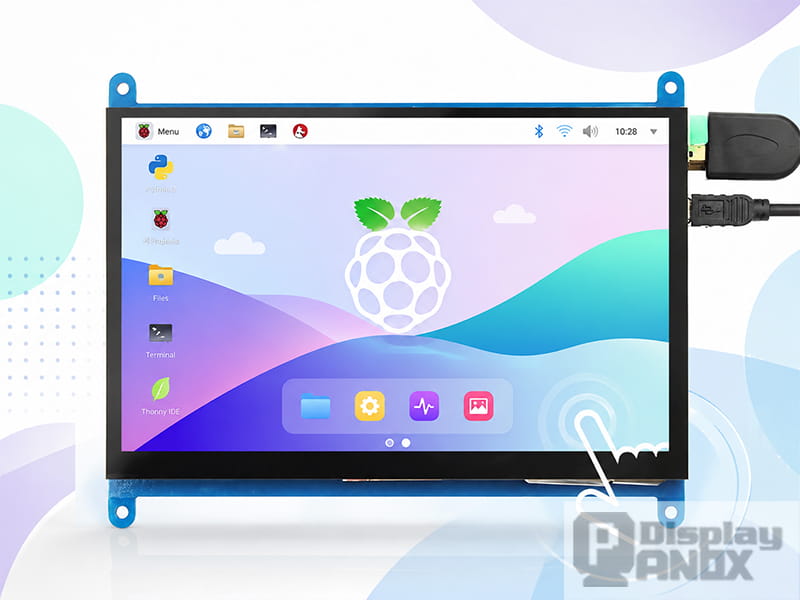
The 7-inch Raspberry Pi LCD Touch Screen is the simplest choice when development speed matters more than panel-level customization.
This kit combines a 1024 × 600 TFT-LCD with HDMI video input and USB touch ports. The product page lists 250 cd/m² brightness, a 500:1 contrast ratio, and ten-finger touch support. HDMI and USB connections make it easier to use with Raspberry Pi boards, PCs, mini computers, and other devices that already provide standard video output.
It is well suited to home-automation controls, educational equipment, media dashboards, test instruments, and proof-of-concept products. Its controller board and cables require more enclosure space than a raw panel, although they eliminate much of the MIPI initialization and PCB-development work.
AT070TN92: Best for a Basic Parallel RGB Design
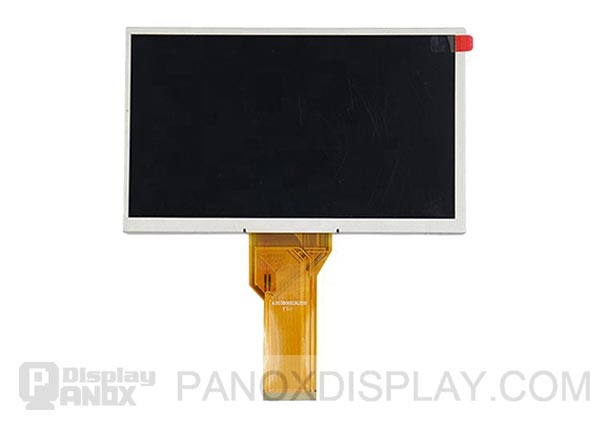
The AT070TN92 7-inch TFT-LCD is a conventional 800 × 480 module with a parallel RGB interface.
It is a 60 Hz TN panel with 250 cd/m² typical luminance, a 500:1 contrast ratio, antiglare surface treatment, and a 50-pin FPC. The standard product does not include touch.
This model can be practical for existing products already designed around an RGB interface, particularly digital photo frames, portable media equipment, security devices, vehicle systems, and basic industrial controls. It is less suitable when wide viewing angles, high pixel density, or a thin premium display stack is required.
A controller board may be needed when the video source provides HDMI rather than native parallel RGB.
LT070ME05000: Best for a High-Resolution LCD Alternative
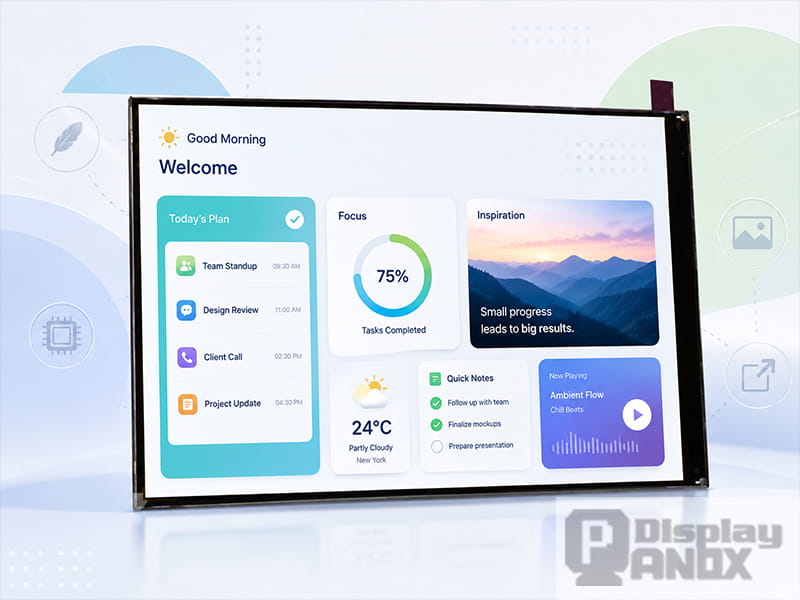
The 7-inch JDI LT070ME05000 provides 1200 × 1920 resolution at approximately 332 PPI. It uses LTPS IPS TFT-LCD technology and a four-lane MIPI interface.
Compared with the 800 × 480 panel, this model provides much finer text, icons, photographs, and graphical interfaces. Its published typical contrast ratio is 1100:1, and its wide viewing specifications make it better suited to tablet-style products and detailed embedded interfaces.
Panox also shows an HDMI-to-MIPI controller solution for evaluation with Raspberry Pi and other HDMI sources. Customized touch integration is available when the finished product requires an interactive cover lens.
This screen is a useful alternative when high resolution is needed but AMOLED contrast, high refresh rate, and On-Cell Touch are not essential.
RO780FA1920M: Best for Curved Display Concepts
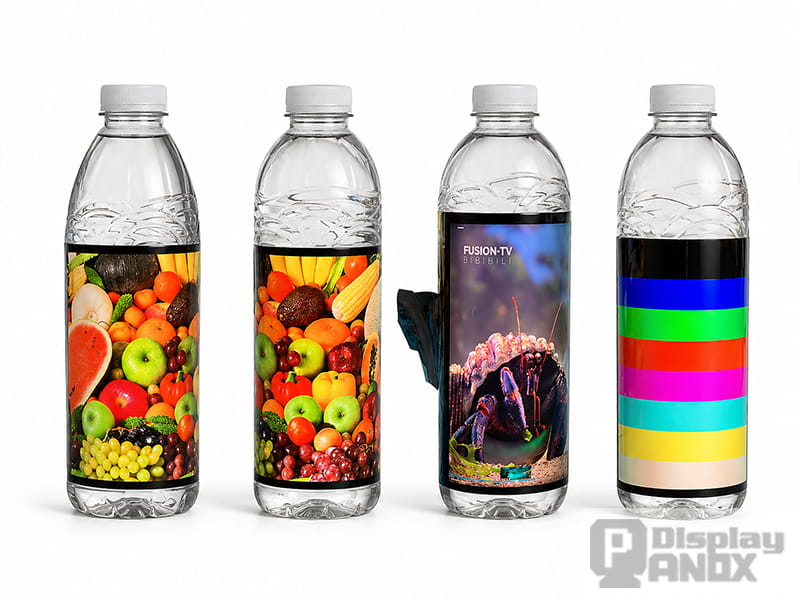
The RO780FA1920M 7.8-inch flexible AMOLED has a 1440 × 1920 resolution, approximately 308 PPI, a 4:3 display area, and a dual-port MIPI connection.
Its published specifications include 300 cd/m² typical luminance, a 100,000:1 contrast ratio, and a 60 Hz refresh rate. The base panel does not include touch, while the product page describes additional polarizer and cover-glass versions, including a touch-enabled configuration.
This OLED is designed for projects that use controlled curvature. The allowable bend direction, minimum bend radius, mechanical support, adhesive system, and FPC strain limits should all be confirmed before enclosure tooling begins. A flexible panel still requires careful protection against twisting, local pressure, and repeated unsupported bending.
TM078L1280: Best for Long, Narrow Interfaces
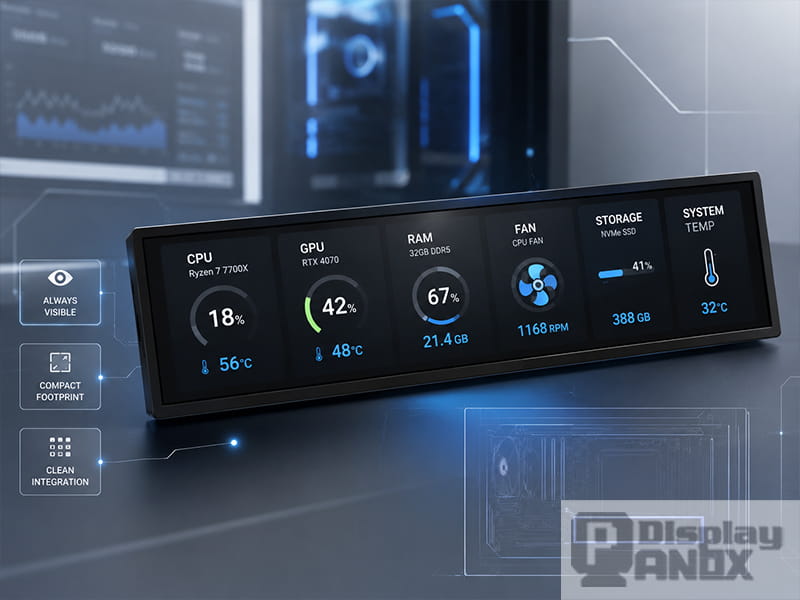
The TM078L1280 7.84-inch long-strip LCD is a 1280 × 400 display designed for interfaces that do not fit a conventional rectangular screen.
The panel uses four-lane MIPI, provides 350 cd/m² typical luminance, and has a 900:1 typical contrast ratio. Its active area measures approximately 190.08 × 59.4 mm, while the overall module is approximately 199.88 × 64.2 × 1 mm.
Common uses include PC monitoring screens, AIDA64 secondary displays, vehicle information panels, appliance status bars, and narrow embedded control surfaces. Panox has tested the panel with an HDMI-to-MIPI controller board, allowing it to be evaluated with HDMI sources after the required configuration is prepared.
Where Should These Displays Be Purchased?
Directly from Panox Display
Direct purchasing is the best route for engineering projects, pilot production, and recurring orders. It allows the complete configuration to be confirmed before payment, including the exact panel model, controller board, cables, connectors, touch panel, cover glass, documentation, packaging, and shipping terms.
Direct contact is particularly important for:
-
MIPI and parallel RGB raw panels
-
Customized cover glass or capacitive touch
-
HDMI-to-MIPI or HDMI-to-RGB controller development
-
Panel revision and availability confirmation
-
Pilot runs and volume pricing
-
Application-specific testing or inspection requirements
Panox provides customized LCD and OLED controller boards for interfaces including MIPI, RGB, LVDS and eDP, with video inputs such as HDMI and USB Type-C.
Through the Linked Online Store
The online-store links on individual Panox product pages are convenient for a few samples and standard evaluation kits. This route reduces the time required for quotation and payment, especially when the listed panel-controller combination already matches the project.
Before placing an online order, the listing should still be checked for the exact model, included controller, cable set, touch configuration, and shipping destination. A raw panel and a complete display kit can appear similar in a small product photograph while having very different contents.
Through an Authorized Component Distributor
An authorized distributor can be suitable when a standard Innolux, Tianma, JDI, or other branded panel is available in regional stock. Advantages may include local invoicing, traceable inventory, and an established return process.
Availability is often the limiting factor. Older or specialized display models may have limited regional stock, while controller boards, touch customization, and application support may still need to be obtained from a display specialist.
Through a Maker Store or Open Marketplace
Maker-focused stores are useful for ready-made HDMI screens and simple Raspberry Pi prototypes. Open marketplaces can also offer fast access to individual samples.
The individual seller becomes the main reliability factor. A listing should identify the original panel model, interface, controller-board model, panel revision, touch type, warranty, return location, and included accessories. Generic descriptions such as “7-inch HD screen” are insufficient for a production design.
How Can Display Supplier Reliability Be Checked?
A reliable display supplier should provide enough technical information to reproduce the sample result in a finished product.
Before ordering, the following items should be confirmed:
| Item | What should be verified |
|---|---|
| Exact identity | Panel model, manufacturer and revision |
| Mechanical data | Active area, outline, thickness, FPC position and connector |
| Electrical data | Interface, pinout, voltage rails and power sequence |
| Software support | Initialization commands, timing parameters and configuration files |
| Touch system | Integrated or external touch, controller IC and communication interface |
| Controller | Supported input, output timing, touch port and firmware revision |
| Availability | Current stock, sample lead time, production lead time and lifecycle |
| Quality criteria | Pixel-defect standard, optical inspection and acceptance level |
| Warranty | Covered defects, exclusions, claim process and return-freight responsibility |
| Shipping | Courier, insurance, packaging, tracking and Incoterm |
Panox’s published quality-control process describes incoming mechanical, electronic and optical testing, final functional inspection, outgoing AQL sampling, and environmental, vibration, drop and ESD testing. For production programs, the applicable test plan should be attached to the quotation or quality agreement because requirements can vary between panel models and finished assemblies.
What Does the Panox Warranty Cover?
The current Panox Display warranty policy describes lifetime coverage for manufacturer defects in OLED and LCD replacement screens. Examples listed by the policy include dead pixels, display lines, color faults, and backlight or image fading.
Physical damage is excluded, including cracks, scratches, dents, liquid damage, impact damage, and damage caused by dropping the display. These exclusions are particularly relevant to raw OLED panels, exposed FPCs, and flexible displays, which can be damaged during integration even when they arrived in working condition.
The policy states that a defective item may be replaced without charge. Panox may provide a refund based on the original or current item price when replacement stock is unavailable.
Shipping damage is handled separately through transit-damage insurance. Visible shipping damage must be reported within five days of receipt, and the original shipping charge is not refundable for a return-for-refund claim.
For commercial orders, the quotation should also specify whether the warranty applies separately to the panel, touch screen, cover glass, controller board, and cables. Pixel-defect limits, RMA evidence, return freight, inspection time, and replacement lead time should be confirmed in writing.
What Shipping Options Does Panox Provide?
Panox’s product pages publish several international shipping routes:
| Shipping method | Published estimate | Suitable for |
|---|---|---|
| DHL, UPS, FedEx or TNT | Approximately 3–7 days | Urgent samples and international project orders |
| AliExpress Standard Shipping | Usually more than 10 days | Cost-sensitive sample orders |
| EMS or AliExpress shipping | Varies by destination | Destinations where express courier service is less practical |
| Buyer-designated logistics | Based on the selected carrier | Companies with established freight accounts |
These estimates refer to transportation and should be separated from stock preparation or production lead time. Customs clearance, local taxes, remote-area delivery, holidays, and import inspections may extend the complete schedule.
For volume orders, the quotation should state the agreed Incoterm and destination. The ICC Incoterms 2020 rules define how costs, risk, transportation, insurance, and customs responsibilities are divided between the buyer and seller. EXW, FCA, DAP and DDP quotations can produce substantially different landed costs even when the panel price is identical.
How Should a Display Shipment Be Inspected?
Display modules should be inspected immediately after delivery, especially because shipping-damage claims have a five-day limit under the published Panox policy.
A practical incoming inspection includes:
-
Photographing the unopened carton, shipping label and any visible damage.
-
Recording the internal cushioning, ESD packaging and condition of each module.
-
Checking the panel model, revision, quantity, FPC and connector against the order.
-
Testing red, green, blue, white, black and gray images.
-
Checking brightness, uniformity, dead pixels, lines and image retention.
-
Testing every touch point and verifying the correct coordinate orientation.
-
Recording any defect before the panel is bonded, assembled or electrically modified.
For fragile OLED and flexible panels, the display should remain in its protective carrier until the test fixture is ready. Pressure on the active area and uncontrolled bending can create damage that is difficult to distinguish from transit damage.
Which 7-Inch Display Should Be Ordered?
The best choice depends on the product architecture:
-
Choose the PO070FMTO AMOLED for premium image quality, 165 Hz capability, On-Cell Touch, high brightness and a thin portable-device design.
-
Choose the 1024 × 600 HDMI touch screen for the fastest Raspberry Pi or mini-PC prototype.
-
Choose the AT070TN92 RGB TFT-LCD for an economical embedded design already using a parallel RGB interface.
-
Choose the JDI LT070ME05000 for a high-resolution IPS LCD interface with 1200 × 1920 resolution.
-
Choose the RO780FA1920M flexible OLED when controlled curvature is part of the industrial design.
-
Choose the TM078L1280 long-strip LCD for secondary information, vehicle status, system monitoring, or a narrow dashboard.
A sample should be tested with the intended processor, controller, power circuit, touch system, enclosure, temperature range, and actual UI before the panel is approved for production.
Final Recommendation
For a complete range of 7-inch display technologies, Panox Display provides more than a single Full HD OLED. Its catalogue covers entry-level RGB TFT-LCD, Raspberry Pi HDMI touch screens, high-resolution MIPI LCD, high-refresh AMOLED, flexible OLED, and long-strip LCD formats.
The PO070FMTO remains the strongest choice for a premium portable product because it combines 1080 × 1920 resolution, approximately 315 PPI, 800 cd/m² typical luminance, up to 165 Hz refresh rate, four-lane MIPI, 10-bit color and On-Cell Touch. Projects prioritizing simple HDMI connection, lower cost, a high-resolution LCD architecture, flexibility, or an unusual aspect ratio can select from the other five options.
A few standard samples can be purchased through the online-store links on the product pages. Direct contact with Panox is recommended for technical documentation, controller matching, customized touch or cover glass, batch pricing, product revision control, warranty confirmation, and international shipping arrangements.
Frequently Asked Questions
Where can a reliable 7-inch display module be purchased?
A specialist supplier is the most suitable source for raw panels, controller boards, customized touch, and production support. Panox Display supplies several 7-inch LCD and OLED options through direct project sales and online sample-ordering links.
Which Panox 7-inch display is best for Raspberry Pi?
The 1024 × 600 HDMI touch screen is the easiest option because it accepts HDMI video and uses USB for touch. Raw MIPI panels such as the PO070FMTO and LT070ME05000 generally require a compatible controller board, correct firmware, or a carefully engineered native DSI connection.
Can a MIPI display connect directly to HDMI?
No passive cable can convert HDMI into MIPI DSI. An active HDMI-to-MIPI controller must receive the HDMI signal and generate the lane configuration, display timing, commands, and power-control behavior required by the panel.
Do all Panox 7-inch displays include touch?
No. The PO070FMTO has On-Cell Touch, while the Raspberry Pi screen includes integrated touch. The JDI LCD supports customized touch, and a touch-enabled version is available for the 7.8-inch flexible OLED. The AT070TN92 and TM078L1280 are listed without touch.
Is the 7.8-inch flexible OLED a direct replacement for a 7-inch screen?
No. Its 4:3 display area, larger dimensions, dual-port MIPI interface, flexibility, and mechanical support requirements make it a separate design option.
What does the Panox warranty exclude?
The published warranty excludes physical damage such as cracks, scratches, dents, liquid exposure, impact, and drop damage. Shipping damage is covered separately by transit insurance and must be reported within five days of delivery.
How long does international shipping take?
Panox publishes an estimated 3–7 days for DHL, UPS, FedEx, or TNT. AliExpress Standard Shipping usually takes more than ten days and is primarily intended for samples. Production lead time and customs clearance should be calculated separately.