







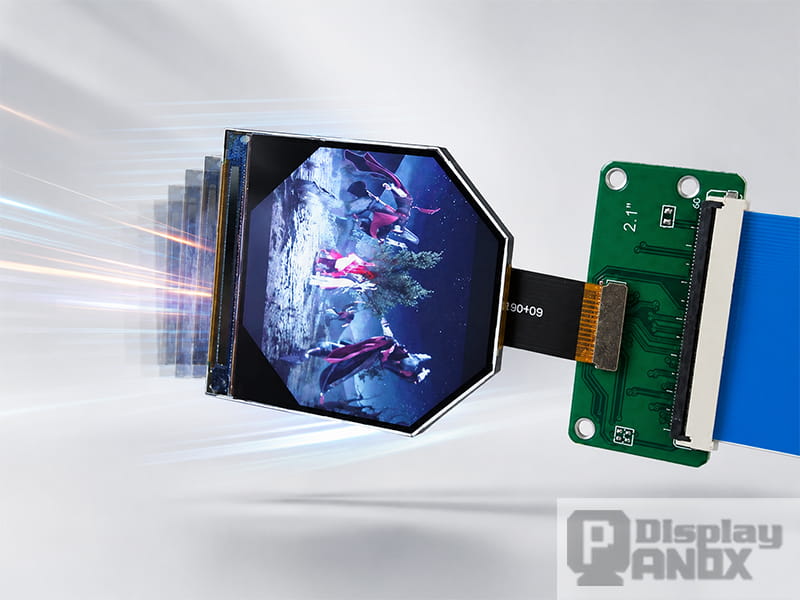
2.1 inch LCD 90 Hz For VR HDMI Board
Most of the conversation around VR and AR displays focuses on resolution and contrast, but the specification that decides whether a headset feels comfortable or makes people queasy is speed. A panel that cannot keep up with rapid head movement smears the image, breaks the sense of presence, and for many users triggers motion sickness within minutes. Fast LCD is the technology built to solve that problem, and it has quietly become the workhorse panel inside a large share of today's VR and mixed reality hardware.
This guide explains what a fast LCD actually is, how response time, refresh rate, MPRT and low-persistence driving work together, how it compares to OLED and Micro OLED, and how to choose the right panel for a near-eye or high-speed embedded project.
What Is a Fast LCD?
A fast LCD is a liquid crystal display panel designed to update images quickly enough for motion-sensitive applications. In practical product selection, "fast" refers to a combination of quick pixel response, high refresh rate, suitable driving electronics, and controlled image persistence. A panel with only one strong number on the datasheet can still look soft in motion if the rest of the display system is not designed well.
For many years, the term was associated with TN panels, because TN liquid crystal could switch faster than many early IPS or VA designs. Today it is broader. In small and medium display modules, a fast LCD may use advanced TFT-LCD structures such as LTPS or ADS-class designs, combined with high-speed MIPI interfaces, optimized timing, and sometimes low-persistence backlight driving. This is why fast LCD panels are now common in VR headsets, near-eye viewers, handheld instruments and compact monitors.
The structure underneath is still a standard LCD. A backlight passes through a layer of liquid crystal held between two glass substrates, and an electric field twists those molecules to control how much light reaches each subpixel through the color filters and polarizers. What separates a fast LCD from an ordinary panel is the combination of faster-switching liquid crystal, high-frequency driving, overdrive circuitry, and backlight control that compresses the whole transition into a fraction of the usual time.
The most useful way to think about it: resolution, PPI and contrast decide how sharp a still image looks, while response time, refresh rate and persistence decide how stable that image stays once the content moves.
Why LCD Speed Matters in VR
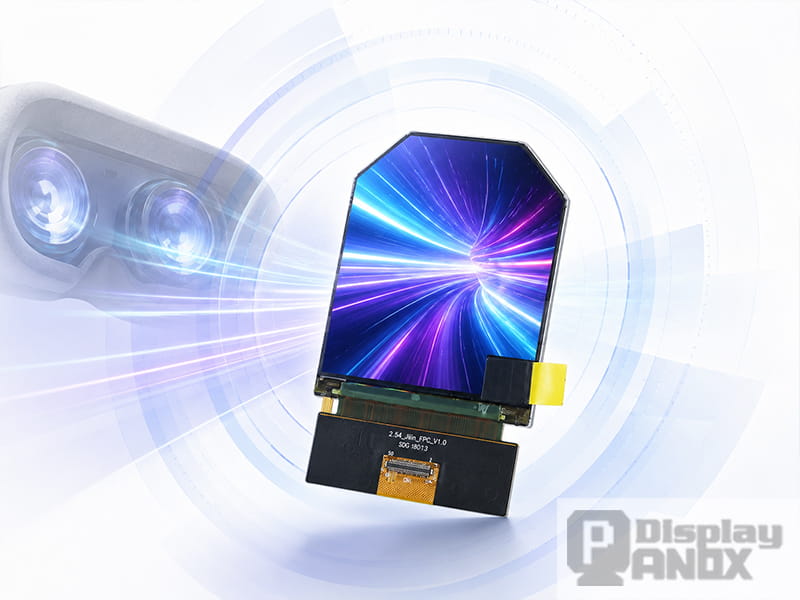
2.54 inch round/circular TFT-LCD For VR
LCD pixels do not emit light by themselves. When the display changes from one image to the next, the liquid crystal molecules need time to move into their new optical state, and that transition is measured in milliseconds. If it is too slow, the previous frame stays partially visible while the next one is already showing, which appears as smearing, ghosting or trailing edges.
This matters far more in a headset than on a desktop. A traditional LCD in a monitor or television may have a response time in the range of tens of milliseconds, which is fine for static viewing but problematic for the rapid movement of VR. The screen sits centimeters from the eye and is magnified through lenses, so even a small artifact fills a large part of the field of view and becomes easy to notice. Industry implementations of fast LCD cut that response figure down toward 5 ms or below to keep motion clean.
There is a second, subtler reason a panel needs to be fast, and it has nothing to do with the liquid crystal. When you turn your head in VR, your eyes track the virtual world smoothly while the display holds each frame for the full refresh cycle, then jumps to the next. The brain integrates those held frames into a blur. This is known as hold-type or sample-and-hold blur, and research in the field has shown that even a hypothetical panel with zero pixel response time would still produce motion blur purely because of this hold-type behavior and the eye-tracking effect behind it.
Display engineers describe the fix in terms of persistence, which is how long a single frame stays lit during each cycle. A high-persistence display keeps the frame illuminated for most of the frametime and smears motion across the retina. A low-persistence display flashes each frame briefly, then goes dark until the next one arrives, and because all of this happens in milliseconds the eye perceives crisp, stable motion. Google's own VR documentation treats low persistence as essential for preventing the motion blur that breaks immersion and contributes to discomfort.
Refresh rate is the other half. Running a panel at 90 Hz or 120 Hz shortens the interval between frames and gives the display more chances to update as the user moves. Meta has publicly treated 90 Hz as the practical minimum for a comfortable VR experience, and academic work on flicker perception uses that figure as a benchmark. Peer-reviewed research on motion-blur-free LCD for high-resolution VR reported a motion picture response time of 1.5 ms when the panel was driven at 90 Hz with a 17 percent duty ratio, a result the authors described as comparable to a CRT and producing essentially indistinguishable motion blur. That CRT-like responsiveness, combined with the resolution and manufacturability of a modern flat panel, is exactly what fast LCD chases.
Response Time, Refresh Rate and MPRT: What They Actually Mean
Display speed specs get confusing because several numbers are used in similar contexts. For engineering selection it helps to separate them.
| Parameter | What it describes | Why it matters |
|---|---|---|
| Gray-to-gray (GtG) response | How long a pixel takes to move between gray levels | Closely tied to ghosting and transition blur in real images |
| Rise/fall response | How long a pixel moves between two defined optical states | Useful, but may not represent all real image transitions |
| Refresh rate | How many times the panel updates per second | Higher rates shorten frame time and make motion smoother |
| MPRT | Moving Picture Response Time, tied to perceived blur | Often closer to what users actually see in motion |
| Persistence | How long each frame stays visible to the eye | Low persistence improves motion clarity, especially in VR |
A 60 Hz display updates every 16.67 ms, a 90 Hz display every 11.11 ms, and a 120 Hz display every 8.33 ms. If the pixel transition takes too long relative to that frame time, the panel cannot fully use the higher refresh rate, which is why a high refresh rate LCD still needs fast response. At the same time, response time alone does not tell the whole story. Because LCDs are sample-and-hold displays, each frame stays visible for most of the frame period unless a special backlight method is used, so perceived blur can persist even when the liquid crystal is already quick. This is why fast LCD panels for VR often pair a high refresh rate with low-persistence backlight driving, showing each frame for a shorter slice of the cycle.
How Fast LCD Panels Improve Motion Clarity
Fast LCD performance comes from a mix of materials, panel design and driving methods rather than any single trick.
The liquid crystal material and cell design set the floor. Lower-viscosity LC mixtures, thinner cell gaps and optimized optical modes shorten how long the molecules need to settle. In high-PPI near-eye modules this balance is delicate, because the panel has to hold brightness, contrast and transmittance at the same time, and the LC needs time to stabilize before the backlight should illuminate it. Patent work in this area focuses heavily on overlapping that settling period with the driving scheme to claw back milliseconds.
The TFT backplane has to support fast addressing. High-resolution near-eye panels lean on high-speed TFT technologies and MIPI DSI interfaces because the data rate is demanding; a 2.9 inch panel running 2160 × 2160 at 90 Hz needs far more bandwidth than a standard embedded display.
Overdrive pushes the liquid crystal toward its target faster by briefly applying a stronger voltage during a transition, then settling back. Tuned well, it compresses gray-to-gray transitions; pushed too hard, it overshoots and creates bright or dark halos.
Low-persistence backlight control reduces how long each frame is visible, which is the single most effective lever for motion clarity in VR. The trade-off is brightness: a shorter illumination window means less total light reaches the eye, so fast LCD panels for VR are typically paired with powerful or Mini LED backlights to compensate.
Fast LCD vs OLED vs Micro OLED: How to Choose
No display technology wins on every metric, and the right call depends entirely on what the product is balancing.
OLED pixels emit light directly and switch very quickly, with excellent black level and high contrast because each pixel can turn off individually. Where contrast and true blacks are the top priority, OLED is attractive. Its historical weaknesses in VR are burn-in risk on static interfaces and, for standard OLED, lower achievable pixel density than LCD.
Micro OLED, also called OLED-on-silicon or OLEDoS, sits at the premium end. Built directly onto a silicon wafer, it reaches extremely high pixel density, self-emissive deep blacks, contrast beyond 10,000:1, and pixel update times in the microsecond range. For the sharpest, most compact near-eye systems it is hard to beat and it pairs naturally with thin pancake optics. The catch is cost and brightness behavior, since Micro OLED is difficult to manufacture and expensive, and pancake lenses are optically inefficient and favor polarized light.
Fast LCD occupies the middle, which is exactly why it has been so widely adopted. It delivers the refresh rates and low-persistence response VR needs, carries no burn-in concern, and reaches high pixel density at a fraction of the cost of a silicon-based OLED solution. Mainstream fast LCD headsets have achieved roughly 1000 PPI per eye, well ahead of many traditional OLED panels used in VR, while keeping the display-and-optics module dramatically cheaper. Industry cost analysis has put a Mini-LED-backlit fast LCD with pancake optics at well under half the cost of a comparable OLEDoS configuration. Its main weakness is contrast: because the backlight is always present in some form, blacks render as dark gray rather than true black, and engineers narrow that gap with Mini LED local dimming and quantum dot layers.
The industry roadmap reflects this split rather than a winner. BOE, one of the largest panel makers, has pursued high-PPI fast LCD and Micro OLED in parallel for AR/VR, pushing past 1400 PPI in fast LCD development while continuing to advance silicon-based OLED. The two leading optical-engine approaches in modern headsets are Micro-OLED-based pancake optics and fast-LCD-based pancake optics, and both will coexist because they serve different price and performance tiers.
Where Fast LCD Display Panels Are Used
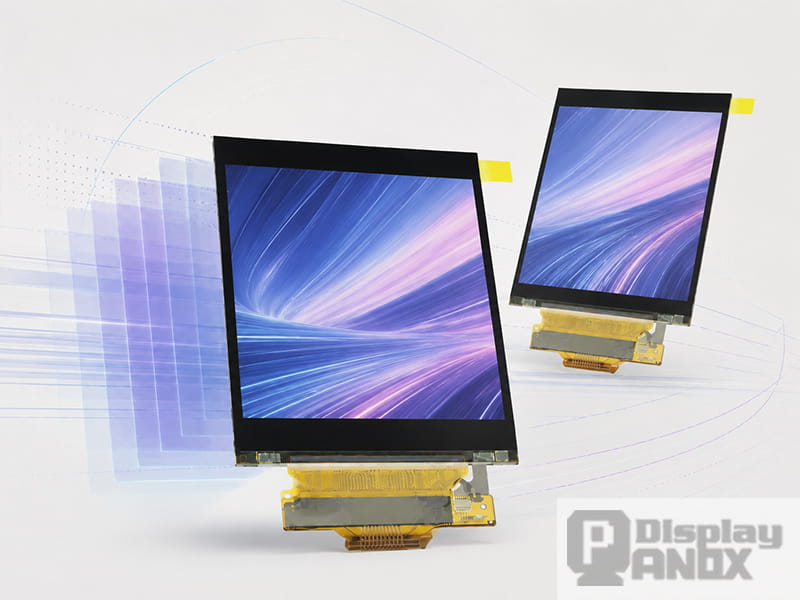
2.9 inch TFT-LCD 120 Hz For VR
Fast LCD earns its place wherever a screen has to show motion, tracking feedback or rapidly changing information.
In VR and near-eye devices it provides high pixel density, mature manufacturing, stable supply and competitive cost. High PPI reduces the screen-door effect, while fast response and high refresh rate handle motion clarity. These panels are physically small but very high in resolution, in classes such as 1440 × 1600, 1600 × 1600, 2160 × 2160 and 1920 × 3664.
In handheld instruments, fast LCD helps when users read moving waveforms, camera feeds or rapidly refreshed UI. The benefit is less dramatic than in VR, but the screen simply feels more responsive. In industrial vision, camera monitors and FPV devices, fast response reduces motion smear when the image changes quickly, and engineers balance that against brightness, operating temperature and interface availability. In compact monitors and development kits, fast LCD panels paired with HDMI-to-MIPI or Type-C controller boards shorten the development path, letting a team validate optics, UI and mechanical fit before committing to a custom driver board.
Panox Display Fast LCD Lineup
The Fast LCD category at Panox Display centers on small, high-resolution TFT-LCD modules for VR and near-eye use, sourced from manufacturers including BOE, Sharp and LG. The specifications below are drawn from the current product datasheets.
| Panel | Key specs | Suitable for |
|---|---|---|
| 2.1 inch VR LCD | 1600 × 1600, 1058 PPI, 90 Hz, MIPI (4 data lanes), 650 cd/m², 5.5 ms GtG (max), a-Si TFT, BOE | VR / AR HMD development |
| 2.54 inch round/circular | 1440 × 1600, 90 Hz, MIPI DSI, 200 cd/m², 700:1, 5 ms GtG (max), LTPS / ADS, BOE | Round-optic VR, wearable viewer, handheld optical device |
| 2.9 inch 120 Hz | 1440 × 1440, 120 Hz, MIPI, Sharp | Motion-critical VR and near-eye systems |
| 2.9 inch 2K | 2160 × 2160, 90 Hz, MIPI, Sharp | High-resolution VR display modules |
| 3.5 inch VR LCD | 1440 × 1600, 90 Hz, MIPI, BOE | VR, development kits, optical display systems |
| 5.5 inch 4K-class | 1920 × 3664, MIPI, LG | High-resolution / Oculus-class VR projects |
These are not ordinary low-resolution panels with a "fast" label. Their value is the combination of compact size, high pixel density, high refresh rate, MIPI interface and response characteristics suited to motion-sensitive use. Every panel in the category uses a MIPI DSI interface, the standard for high-bandwidth, low-pin-count near-eye displays.
Beyond the bare panel, Panox Display supports development with HDMI-to-MIPI and Type-C controller boards, free connectors from suppliers such as Molex and JAE, customized cover glass and touch panels, and the datasheets, schematics and bring-up assistance most engineering teams need. This is useful when a project has to evaluate a high-speed LCD quickly before moving to a custom PCB or final enclosure.
How to Choose a Fast LCD for Your Project
Start by defining the motion requirement. A static control panel, a handheld scanner and a VR headset do not need the same display speed. If the product shows mostly menus and text, refresh rate is less critical; if it shows head-tracked content, video or real-time camera images, response time and refresh rate move to the front.
Check the response-time type on the datasheet. GtG is usually more meaningful for real content than a simple black-to-white figure, because natural images move between intermediate tones, and response time shifts with temperature, drive voltage and gray level. Then confirm refresh rate and interface bandwidth, since a high-resolution fast LCD generally needs MIPI DSI with multiple data lanes, and the host processor, bridge IC or controller board has to support that timing. An HDMI-to-MIPI board is handy for early testing, but production hardware should be designed around the final interface.
Brightness and backlight design matter more than they first appear. Low-persistence driving improves motion clarity but reduces perceived brightness, so a panel used in a bright environment or behind pancake lenses needs its backlight and optical stack chosen with that loss in mind. Finally, plan mechanical integration early. High-PPI near-eye panels are thin and delicate, and the active area, outline size, FPC direction, connector type and polarizer treatment all shape the final optical engine. A panel that looks ideal on paper can become difficult to integrate if the mechanical layout is left until late.
Common Misunderstandings About Fast LCD
A fast LCD is not the same as a gaming-monitor panel. Many of these modules are small embedded displays for VR, near-eye and development use, and they need MIPI driving, special controller boards or customized integration rather than a plug-in cable.
A higher refresh rate does not guarantee better motion by itself. The panel still needs fast enough gray-to-gray transitions, correct timing and a suitable backlight strategy behind that number. A "1 ms" marketing figure should be read carefully too, since some displays quote MPRT, some quote GtG, and some quote a single best-case transition; for engineering, the measurement condition matters as much as the number.
And OLED does not make fast LCD obsolete. OLED is excellent for many products, but LCD stays highly practical when a project needs high PPI, mature sourcing, cost control, brightness flexibility and reduced burn-in concern.
The Bottom Line
Fast LCD is best understood as a complete high-speed display solution rather than a single fast spec. The panel has to switch quickly, refresh at the right rate, receive enough data through the interface, and work with a suitable backlight strategy. When those parts are matched, a fast LCD display panel delivers sharp motion, high pixel density and dependable performance for VR, near-eye, handheld and embedded systems. Micro OLED will keep defining the premium tier and conventional LCD will stay in slower applications, but for a large share of mainstream and mid-range headsets, a well-driven fast LCD remains the most balanced choice on the table.
For teams evaluating panels for a near-eye build, the Panox Display fast LCD lineup covers the common VR sizes and resolutions, with the connector, controller and engineering support to move a design from sample to production.
Learn more: Where Fast LCD Display Panels Are Used: From VR to FPV
FAQ
Is fast LCD good for VR?
Yes. Fast LCD is a strong VR choice when the panel combines high PPI, a suitable refresh rate, low enough response time and a driving method that controls persistence. Many VR designs use it because it pairs high resolution with mature production and stable supply at a lower cost than Micro OLED.
What refresh rate should a fast LCD have?
For near-eye and motion-sensitive use, 90 Hz and 120 Hz are the common targets, with 90 Hz widely treated as the comfort floor. A lower rate can still work for handheld or industrial devices if the content is not highly dynamic. The right value depends on the application, processor performance and acceptable power draw.
Is GtG response more important than black-to-white response?
For real images, usually yes, because most content changes between intermediate tones rather than pure black and white. A panel with good GtG behavior tends to show cleaner motion and fewer visible trails.
Why do some fast LCD panels still need a low-persistence backlight?
Because LCD is sample-and-hold. Even if pixels switch quickly, each frame can stay visible long enough to create perceived blur, and low-persistence backlight driving shortens that visible window, which is especially valuable under VR head movement and lens magnification.
Is fast LCD better than OLED or Micro OLED for VR?
Neither is universally better. Fast LCD offers high pixel density and cost-effective availability with no burn-in risk; OLED and Micro OLED offer deeper blacks, higher contrast and microsecond response at higher cost. Fast LCD suits mainstream and mid-range headsets, while Micro OLED suits premium near-eye systems.
Can Panox Display provide controller boards for fast LCD panels?
For selected panels, yes. Panox Display supports HDMI-to-MIPI, Type-C and customized controller-board solutions, which lets developers test fast LCD modules before building the final product electronics.