







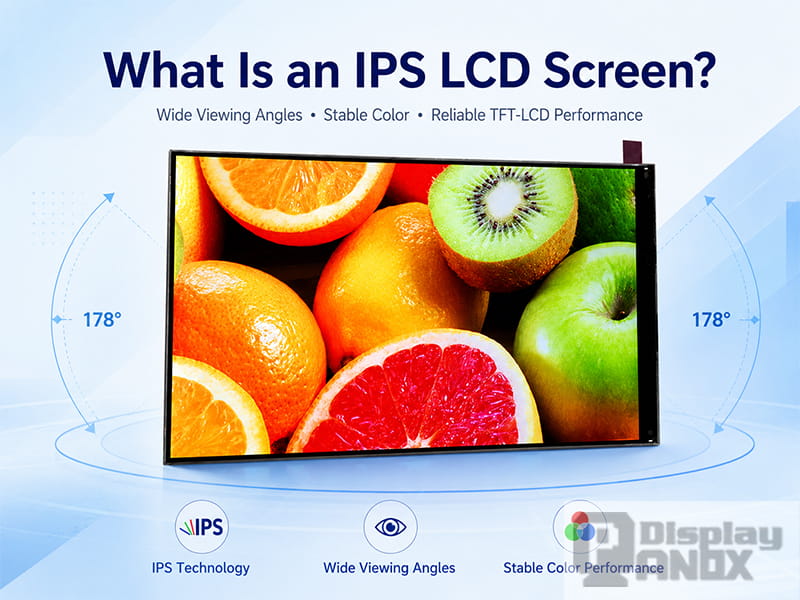
An IPS LCD screen is a type of TFT-LCD display designed to keep image quality stable when the screen is viewed from different directions. IPS stands for In-Plane Switching, a liquid crystal display mode developed to improve the viewing-angle limitations and color shift problems found in earlier LCD structures.
For many product designers, IPS-LCD is still one of the most practical display technologies available. It can offer wide viewing angles, good color consistency, mature manufacturing, flexible interface options, and long-term supply advantages. That is why IPS LCD screens are commonly used in industrial control panels, vehicle displays, tablets, handheld terminals, smart home devices, 3D printing systems, test instruments, and embedded development projects.
At PanoxDisplay, IPS-LCD panels are usually selected when a project needs a reliable full-color screen that remains readable from the side, supports a standard embedded interface, and can be paired with touch panels, cover glass, connectors, or controller boards.
1. What Is an IPS LCD Screen?
An IPS LCD screen is a liquid crystal display in which the liquid crystal molecules rotate mainly within the plane of the glass substrate. In a typical LCD, the image is created by controlling how much light from the backlight passes through each pixel. The TFT array controls the voltage applied to the liquid crystal layer, while color filters form the red, green, and blue subpixels.
The key difference in IPS is the way the liquid crystal molecules are driven. In many earlier LCD structures, the electric field changes the molecular orientation in a way that creates stronger viewing-angle dependence. As the viewer moves away from the center, contrast, grayscale, and color can shift visibly. IPS uses electrodes arranged on the same substrate to generate a lateral electric field, so the liquid crystal molecules rotate more horizontally. This gives the display a more stable optical response across a wider viewing cone.
In simple terms, an IPS LCD screen is built for consistency. It is chosen when the displayed content must remain clear from different positions, such as a control panel shared by several operators, a vehicle screen viewed by both driver and passenger, or a tablet display that rotates between portrait and landscape use.
2. How IPS-LCD Technology Works
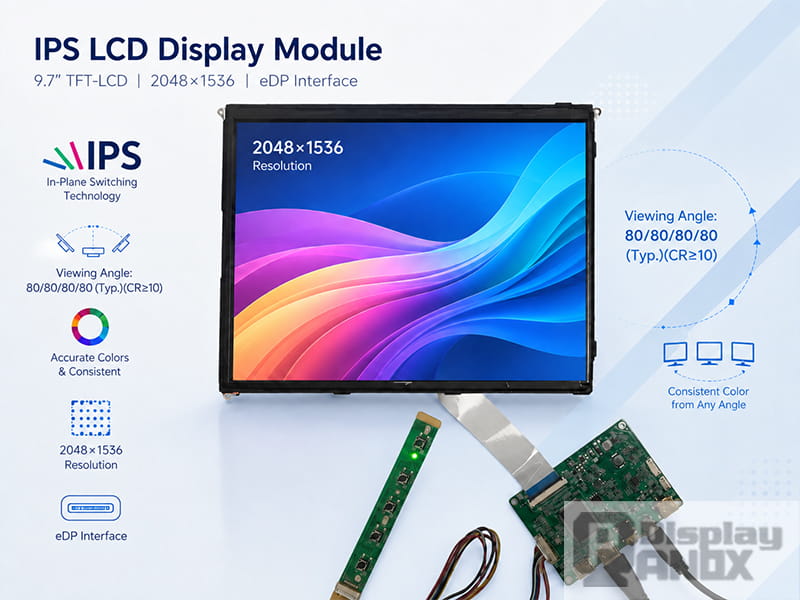
9.7 inch TFT-LCD 2048x1536 eDP Interface
An IPS-LCD panel still belongs to the LCD family, so it needs a backlight. The liquid crystal layer does not emit light by itself. Instead, it modulates the light passing through the panel. A simplified IPS LCD stack usually includes a backlight unit, polarizers, TFT glass, liquid crystal material, color filter glass, and sometimes a touch panel or cover lens.
Inside the pixel structure, IPS places the pixel electrode and common electrode on the same substrate. When voltage is applied, the electric field runs mainly parallel to the glass surface. The liquid crystal molecules rotate in that plane, changing the polarization of light and controlling how much light can pass through the upper polarizer.
This structure is the technical reason behind the wide viewing angle of IPS. Since the liquid crystal motion is more symmetrical from different viewing directions, the panel can reduce color inversion and grayscale shift. The actual performance still depends on many details: liquid crystal material, electrode design, aperture ratio, polarizer compensation, backlight quality, color filter design, and driving method.
IPS technology has also evolved into related and improved wide-viewing LCD modes. For example, FFS and other fringe-field structures were developed to improve transmittance, aperture ratio, power efficiency, and optical performance in thin mobile devices. In practical product selection, many buyers still use “IPS LCD” as a broad term for wide-viewing TFT-LCD panels, especially in small and medium-size display modules.
3. Why IPS Became Important
The main value of IPS is not a single specification. It is the balance of stable viewing, color performance, and mature supply.
Early LCDs were often acceptable when viewed straight on, then weaker when viewed from above, below, or the side. For personal calculators or simple monochrome devices, this was manageable. For full-color graphical interfaces, the limitation became much more visible. A screen used in an HMI, medical device, vehicle dashboard, POS terminal, or tablet must remain readable even when the user’s eyes are not perfectly aligned with the panel center.
IPS helped LCD technology move into more demanding visual applications. It allowed LCD panels to compete in areas where color and viewing consistency mattered, including monitors, TVs, tablets, professional control systems, and high-resolution mobile displays.
For embedded products, this advantage is very practical. A machine operator may stand beside an industrial display rather than directly in front of it. A vehicle display may be seen from different seats. A handheld device may be tilted during use. A smart home panel may be mounted at eye level for one person and lower for another. In these situations, an IPS LCD screen can make the interface feel more stable and easier to trust.
4. IPS LCD vs TN, VA, and OLED
IPS is often compared with TN, VA, and OLED. Each technology has its own engineering logic, so the best choice depends on the application rather than the name alone.
| Display Type | Typical Strength | Typical Limitation | Common Use Case |
|---|---|---|---|
| TN LCD | Low cost, fast response in many basic panels | Narrower viewing angle and stronger color shift | Entry-level devices, simple instruments, low-cost panels |
| IPS LCD | Wide viewing angle, stable color, mature supply | Contrast and black level depend on backlight and cell design | Industrial HMI, tablet, vehicle, smart home, embedded systems |
| VA LCD | Higher native contrast in many large panels | Viewing-angle color and gamma shift can still appear | TVs, monitors, signage |
| OLED / AMOLED | Self-emissive pixels, high contrast, thin structure | Burn-in risk, lifetime and cost considerations for some projects | Smartphones, wearables, premium consumer products, near-eye display |
IPS LCD is often selected when the product needs a reliable screen with a long supply window, moderate cost, good color stability, and easier driving options. OLED may be better when true black, extremely thin design, or flexible form factors are central to the product. VA may be better for some large-format high-contrast applications. TN may still fit low-cost or simple display needs.
The important point is that “IPS” describes the liquid crystal switching mode. It is an LCD technology. OLED and AMOLED use a different self-emissive principle, so they should be evaluated with a different set of design criteria.
5. Key Advantages of IPS LCD Screens
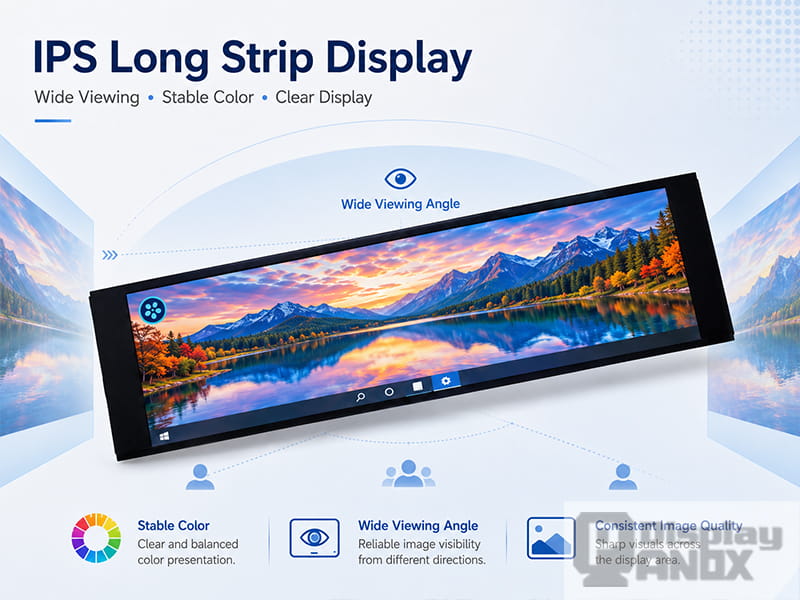
6.8 inch long strip LCD IPS TFT
5.1 Wide Viewing Angle
IPS panels are widely known for viewing angles such as 80/80/80/80 or 85/85/85/85 under common contrast-ratio measurement conditions. These values mean the image remains usable from a large cone around the front view. For real products, this helps reduce complaints like “the screen looks washed out from the side” or “the color changes when the device is tilted.”
Wide viewing angle is especially useful for shared interfaces. Industrial control panels, vehicle displays, medical instruments, POS systems, and public information screens may be viewed by more than one person or from changing positions.
5.2 More Stable Color and Grayscale
A good IPS LCD screen can maintain more consistent color and grayscale performance at off-axis angles. This matters for graphical user interfaces, warning colors, maps, camera previews, dashboards, and content with gradients. When the same color looks different from different angles, the interface can feel less professional and less reliable.
IPS does not automatically guarantee high color gamut or professional calibration. Color depth, backlight spectrum, color filter quality, and driving design still matter. However, the IPS structure gives a stronger foundation for stable visual performance than many older LCD modes.
5.3 Mature TFT-LCD Supply Chain
IPS-LCD has been widely manufactured for years, so it is available in many sizes, resolutions, brightness levels, and interface types. This is useful for product development because engineers can choose from MIPI, RGB, LVDS, eDP, or HDMI-driven solutions depending on the host system.
For small and medium-size projects, this supply-chain maturity often matters as much as the optical performance. A display that looks good on paper still needs connectors, timing compatibility, sample availability, mechanical drawings, touch integration, and a clear driving path.
5.4 Suitable for Long-Term Embedded Projects
Industrial and embedded products often have longer life cycles than consumer electronics. A display used in a machine, kiosk, medical device, or vehicle accessory may need stable procurement, consistent testing, and replacement planning. IPS-LCD modules from established panel makers can be a practical choice when the project requires predictable performance and easier system integration.
6. Limitations of IPS LCD Screens
IPS is strong, but it is not a magic label. A good selection process still needs to check the full specification.
The first limitation is contrast. IPS LCD screens use a backlight, so black level depends on how well the liquid crystal cell blocks light and how the backlight is managed. A high-quality normally black IPS panel can achieve strong contrast for many applications, while a lower-end module may look gray in dark environments.
The second limitation is power consumption. Since LCDs require a backlight, brightness settings can strongly affect system power. In battery-powered devices, engineers should evaluate backlight current, panel driving voltage, CABC function, sleep mode, and real application brightness rather than reading only the typical panel power value.
The third limitation is outdoor visibility. IPS improves viewing stability, but sunlight readability needs enough luminance, proper cover glass design, low-reflection surface treatment, optical bonding in some cases, and a suitable contrast target. A 300 cd/m² IPS panel may work well indoors, while an outdoor handheld device may need higher brightness and better anti-reflection design.
The fourth limitation is interface complexity. High-resolution IPS LCD panels often use MIPI DSI, LVDS, or eDP. These interfaces require matching signal timing, voltage levels, initialization code, connector pinout, and sometimes a bridge or controller board. For fast prototyping, an HDMI or Type-C controller board can reduce development risk.
7. Common Applications of IPS LCD Display Panels
7.1 Industrial HMI and Control Panels
Industrial equipment needs readable interfaces. An IPS LCD screen can show status information, alarms, menus, process graphics, and real-time values with stable viewing from different working positions. For example, a 4.3 inch 800×480 IPS-TFT industrial LCD with RGB interface is suitable for compact control panels, smart home control, navigation devices, security equipment, and other embedded systems.
When selecting an IPS display for industrial use, operating temperature, luminance, viewing angle, interface, backlight lifetime, and touch panel options should be checked early. A panel used near machinery may also need a stronger cover lens, custom FPC, or a sealed front structure.
7.2 Vehicle and Transportation Displays
Vehicle displays often face changing viewing angles, vibration, temperature variation, and mixed lighting conditions. IPS-LCD panels are used in navigation screens, rear-seat displays, instrument modules, control terminals, and transport information screens.
For vehicle-related projects, the viewing angle is only one part of the decision. Designers also need to consider brightness, anti-glare treatment, operating temperature, response time at low temperature, mechanical fixation, and the availability of a suitable driving board.
7.3 Tablets, Pads, and Portable Devices
Portable devices benefit from IPS because users naturally rotate and tilt the screen. High-resolution IPS LCDs, such as 7 inch WUXGA panels, 8.9 inch 2560×1600 panels, 9.7 inch 2048×1536 panels, and 10.1 inch 2560×1600 modules, are often chosen for tablet-like products, portable monitors, field instruments, and high-density UI systems.
In these applications, pixel density and interface bandwidth become important. A high-resolution MIPI DSI panel may require a stronger processor platform, correct initialization sequence, and careful layout of high-speed differential signals. If the project connects to a PC, Raspberry Pi, or media board, an HDMI-to-MIPI or eDP controller board may make development easier.
7.4 3D Printing and UV Exposure Systems
Some high-resolution TFT-LCD panels are used in resin 3D printing systems or custom optical exposure devices. In this type of application, resolution, pixel density, transmittance, aperture structure, thermal behavior, and backlight or UV source compatibility matter more than ordinary visual display performance.
IPS-LCD panels can be useful when the system also needs good image uniformity and high-resolution mask control. The final choice should be based on the light source, wavelength requirements, thermal design, mechanical fit, and long-term exposure conditions.
7.5 Smart Home and Commercial Terminals
Smart thermostats, room controllers, access terminals, POS devices, and commercial dashboards often need a display that looks clean from multiple angles. IPS-LCD is a practical choice because it can support colorful UI design without pushing the product into a high-cost display category.
For these products, a moderate-resolution IPS panel with RGB, MIPI, or HDMI board support can shorten development time. If touch is required, the cover glass and PCAP structure should be considered together with the display from the beginning, rather than being added at the end of the mechanical design.
8. How to Choose the Right IPS LCD Screen
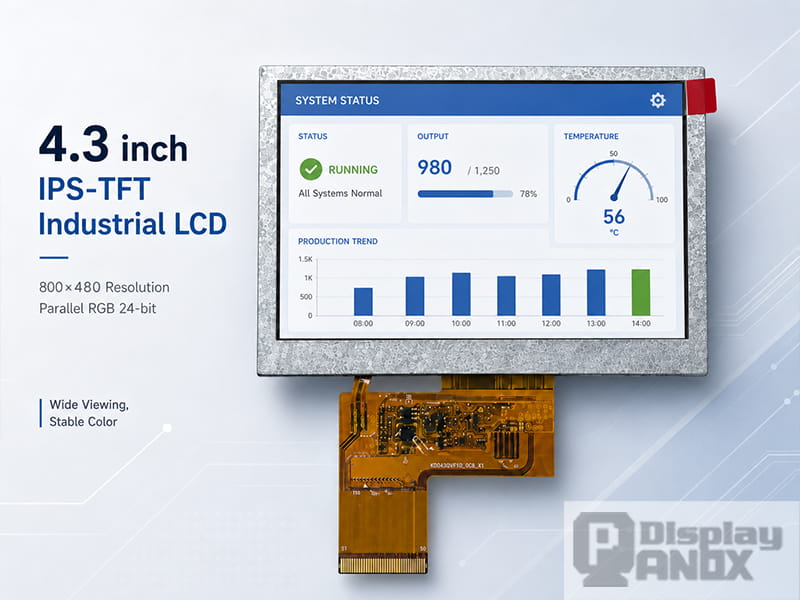
4.3 inch 800x480 IPS-TFT Industrial LCD Display Parallel RGB 24 Bits
A display should be selected from the system outward. The most beautiful panel may become inconvenient if the interface, connector, voltage, or mechanical structure does not fit the product.
Start with size and resolution. A 4.3 inch 800×480 LCD may be enough for a compact controller. A 9.7 inch 2048×1536 or 10.1 inch 2560×1600 panel provides high pixel density for detailed images, tablet products, and content-heavy interfaces.
Then check the interface. RGB is common in embedded MCU/MPU systems. MIPI DSI is common in mobile and high-resolution compact panels. LVDS is often used in industrial and medium-size TFT-LCDs. eDP appears in some high-resolution tablet and laptop-style modules. HDMI is usually implemented through a controller board, which is helpful when the source device is a PC, Raspberry Pi, or single-board computer.
Brightness should be chosen according to the environment. Indoor devices may work well at 250–400 cd/m². Industrial or semi-outdoor equipment may need higher brightness. Outdoor products should consider brightness, contrast under ambient light, optical bonding, anti-glare or anti-reflection cover glass, and thermal management.
Operating temperature is another key point. A panel used in a consumer indoor product has different requirements from a panel used in vehicles, outdoor kiosks, industrial workshops, or warehouse terminals. The LCD material, backlight, polarizer, and touch panel adhesive can all affect performance across temperature ranges.
Finally, plan the driving and integration path. Ask whether the project needs a bare panel, a panel with FPC and connector, a custom touch panel, a cover lens, an HDMI controller board, a Type-C board, or a complete display kit. For development teams, this step can save more time than repeatedly changing the display after the PCB design has started.
9. PanoxDisplay IPS-LCD Product Directions
PanoxDisplay’s IPS-LCD tag includes small and medium-size TFT-LCD panels for embedded systems, industrial devices, vehicle products, tablets, 3D printing, and high-resolution display projects. The selection covers multiple interface types, including RGB, MIPI, LVDS, eDP, and HDMI controller board solutions.
For compact industrial interfaces, the 4.3 inch 800×480 IPS-TFT display with parallel RGB 24-bit interface is a practical option for smart home panels, navigation equipment, security devices, and general embedded control systems. Its wide viewing angle and industrial-style operating temperature range make it suitable for products that need stable image visibility in daily operation.
For medium-size embedded and vehicle applications, the 8 inch 1024×768 IPS TFT-LCD with LVDS interface offers a classic 4:3 display format. This kind of panel is suitable for machine interfaces, vehicle equipment, digital products, and systems that need a balanced screen size with straightforward display control.
For high-resolution tablet and optical systems, PanoxDisplay also lists 8.9 inch 2560×1600, 9.7 inch 2048×1536, and 10.1 inch 2560×1600 IPS-LCD-related panels. These modules are useful when the project needs high pixel density, detailed UI rendering, or image-rich content. Depending on the model, MIPI, eDP, or controller board support may be available.
Beyond panel supply, PanoxDisplay can support development with connectors, customized touch panels, cover glass, and controller/driver boards. This is especially important for IPS-LCD projects because the display panel is only one part of the final system. A project also needs electrical compatibility, mechanical matching, optical protection, and a reliable driving method.
10. Frequently Asked Questions About IPS LCD Screens
Is an IPS LCD screen better than a normal TFT LCD?
IPS is a type of TFT-LCD technology. In most product pages, “TFT LCD” describes the active-matrix display structure, while “IPS” describes the liquid crystal switching mode. An IPS-TFT LCD usually provides better viewing-angle stability than many basic TN TFT-LCD panels.
Does IPS mean the screen is sunlight readable?
IPS improves viewing-angle performance, but sunlight readability depends on luminance, contrast, surface reflection, cover glass, bonding, and backlight design. A low-brightness IPS screen may still be difficult to read outdoors.
Is IPS LCD better than OLED?
The answer depends on the product. OLED has self-emissive pixels and excellent black levels. IPS LCD has a mature supply chain, strong viewing stability, broad size options, and good long-term practicality for many embedded and industrial applications. For products that need long operating hours, stable procurement, and standard controller board support, IPS LCD can be a very efficient choice.
Can an IPS LCD screen be used with Raspberry Pi?
Yes, if the interface and timing are supported. HDMI IPS LCD modules or panels with HDMI controller boards are easier for Raspberry Pi projects. Bare RGB, MIPI, LVDS, or eDP panels may require extra hardware, configuration, or a compatible driver board.
What should be checked before buying an IPS LCD panel?
The most important items are size, resolution, interface, active area, outline dimensions, viewing angle, brightness, contrast ratio, operating temperature, backlight lifetime, connector type, driving voltage, touch panel option, and controller board availability. For production projects, mechanical drawing and datasheet confirmation are essential.
Conclusion
An IPS LCD screen is one of the most dependable choices for products that need a clear, full-color display with wide viewing angles and stable image quality. Its strength comes from the in-plane movement of liquid crystal molecules, which helps reduce viewing-angle color shift and improves visual consistency in real use.
For industrial equipment, vehicle systems, tablets, smart home panels, 3D printing devices, and embedded development platforms, IPS-LCD remains a practical balance of performance, cost, availability, and integration flexibility. The best result comes from matching the panel to the real application environment: interface, brightness, resolution, operating temperature, touch structure, and controller board should all be considered together.
PanoxDisplay provides IPS-LCD display panels in multiple sizes and interfaces, with support for connectors, touch panels, cover glass, and driver board solutions. For engineers and product teams, this makes IPS-LCD selection more than a panel purchase; it becomes a complete display integration path from sample testing to product development.
Learn more: Applications of IPS LCD Screens: Where IPS-LCD Display Panels Are Used