







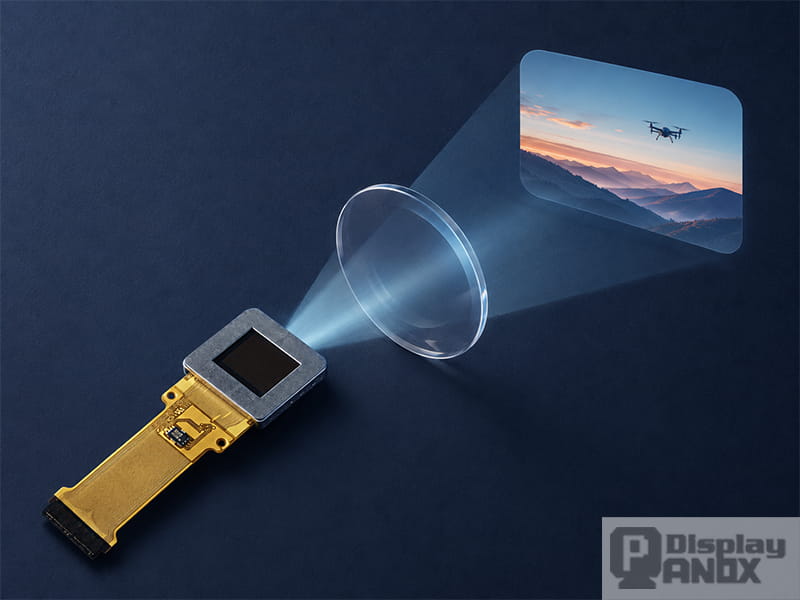
A viewfinder is the viewing system on a camera that shows the scene being framed before a photograph or video is recorded. It helps the photographer judge composition, focus, timing, and—in an electronic viewfinder—exposure and color. Although “view finder” is a common search phrase, the standard spelling is viewfinder.
The small eyepiece can contain a direct optical path, a mirror-and-prism assembly, or a miniature electronic display. That difference separates the two viewfinder technologies found in most modern cameras: the optical viewfinder (OVF) and the electronic viewfinder (EVF).
What Does a Viewfinder Do on a Camera?
The basic task of a viewfinder is simple: it defines the portion of the scene that will appear in the image. A good viewfinder also makes it easier to follow motion, place a subject precisely within the frame, confirm focus, and monitor essential camera settings without looking away from the scene.
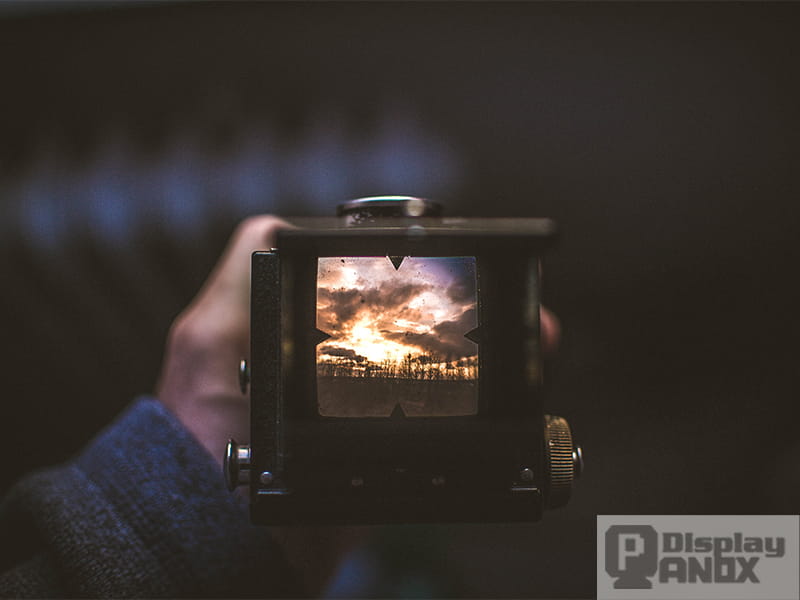
Holding a camera to the eye gives the body an additional point of support and shields the viewing image from ambient glare. This is one reason viewfinders remain important even though almost every digital camera has a rear LCD. The eyepiece provides a concentrated, stable view that is especially useful in bright sunlight, during handheld shooting, and when tracking fast subjects.
The image inside the finder does not necessarily come from the same source in every camera. An optical system directs real light toward the eye. An electronic system converts the sensor output into a live image on a very small screen. Both support framing, but the viewing experience and the information available are quite different.
What Are the Main Types of Camera Viewfinders?
Optical Viewfinder (OVF)
An optical viewfinder presents the scene through lenses, mirrors, or prisms rather than through a digital display. In a DSLR, light enters the camera lens, reflects from a mirror, passes through a focusing screen and pentaprism or pentamirror, and reaches the photographer’s eye. When the shutter is released, the mirror moves out of the way so light can reach the image sensor.
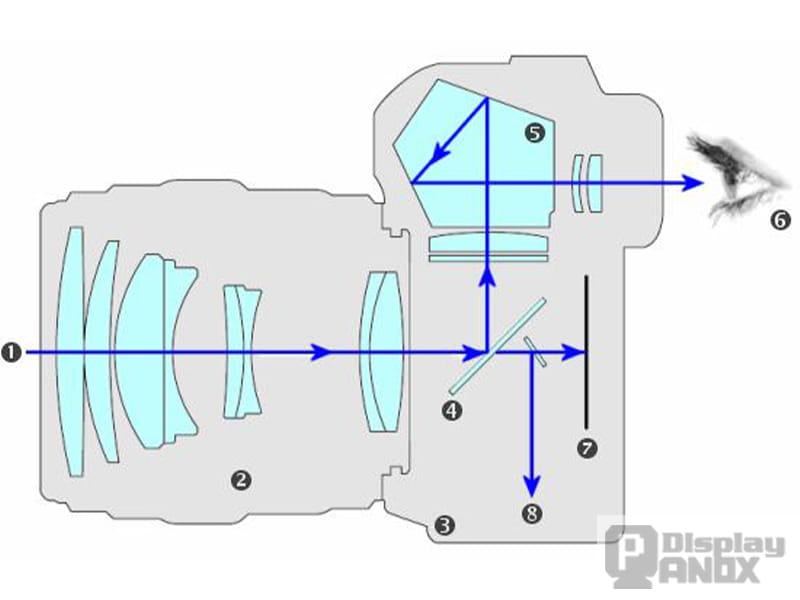
This through-the-lens design shows the same general field of view as the taking lens and avoids the parallax error associated with a separate viewing window. Nikon’s explanation of DSLR architecture illustrates this optical path clearly.
Some rangefinder and compact cameras use a separate optical window. These finders can remain bright and responsive, but the viewing axis is offset from the camera lens. At close distances, the framing seen through the finder may differ from the image captured through the lens.
An OVF offers a natural, continuous view with effectively no electronic display lag. It also consumes little or no power during viewing. Its limitations are equally clear: the scene does not preview exposure compensation, white balance, picture styles, or the sensor’s low-light response, and the mirror assembly adds mechanical volume to a DSLR body.
Electronic Viewfinder (EVF)
An electronic viewfinder is a miniature screen viewed through a magnifying eyepiece. It receives a live feed from the camera’s image sensor, usually after the image processor has applied exposure, white balance, color, and display corrections.
EVFs are standard in mirrorless cameras because there is no reflex mirror to redirect light into an optical finder. The sensor remains exposed to the incoming image and supplies the viewfinder feed directly. This architecture allows the camera to preview how many settings will affect the final image before the shutter is released.
An EVF can also display histograms, focus peaking, magnified focus assistance, horizon levels, autofocus tracking boxes, zebras, menus, and image playback. Canon’s viewfinder guide notes that exposure, white balance, and Picture Style effects can be seen in the EVF while shooting.
The trade-offs come from the electronic pipeline. Sensor readout, image processing, transmission, and display scanning introduce some latency. The EVF also consumes power and may show noise in very dark scenes. Modern high-end systems reduce these issues with faster sensors, processors, high-refresh displays, and blackout-control techniques.
Hybrid Viewfinder
A hybrid viewfinder combines an optical finder with an electronic overlay or a switchable EVF. It can preserve the immediate optical view while adding framing guides and shooting data, then change to a fully electronic preview when exposure simulation or precise through-the-lens framing is more useful. Hybrid systems are less common because their optics and mechanisms are more complex, but they remain attractive in cameras designed around a rangefinder-style shooting experience.
Optical vs Electronic Viewfinder: What Is the Difference?
Neither system is universally superior. The better choice depends on the camera design and the type of work being photographed.
| Feature | Optical Viewfinder (OVF) | Electronic Viewfinder (EVF) |
|---|---|---|
| Image source | Real light directed through an optical path | Live image produced by the camera sensor |
| Exposure and color preview | Not shown directly | Can reflect exposure, white balance, and color settings |
| Display lag | Effectively none | Low but dependent on the complete imaging pipeline |
| Low-light view | Limited by available light and lens aperture | Can amplify a dark scene, sometimes with visible noise |
| Shooting information | Basic overlays and status indicators | Histograms, focus peaking, zebras, menus, playback, and customizable overlays |
| Power use | Minimal during viewing | Requires continuous sensor, processor, and display operation |
| Camera structure | Usually needs mirrors or separate viewing optics | Supports compact mirrorless body designs |
| Image during bursts | Mirror movement can interrupt the view | Can support short blackout or blackout-free operation, depending on the camera |
OVFs remain appealing for wildlife, documentary work, and long sessions where an uninterrupted natural view and battery endurance matter. EVFs are particularly useful when exposure accuracy, manual-focus aids, low-light visibility, video tools, or extensive on-screen information are priorities.
How Does an Electronic Viewfinder Work?
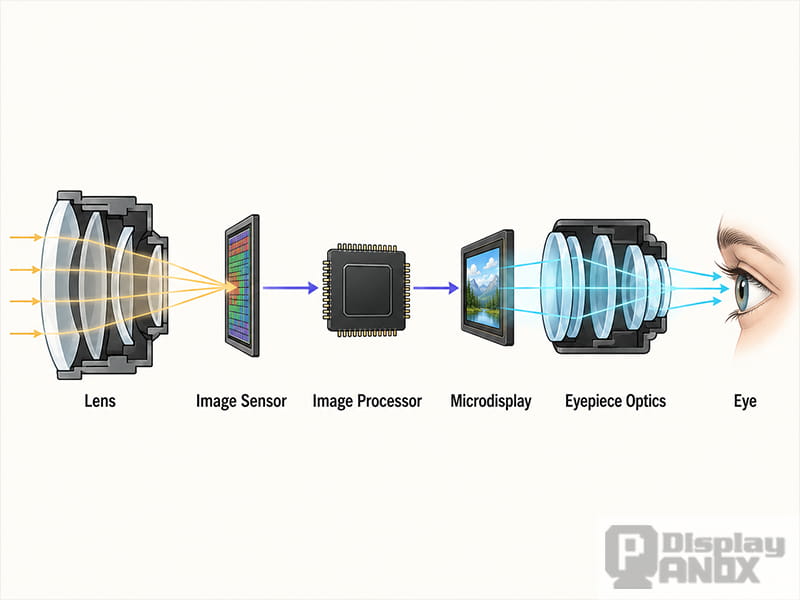
The signal path inside a mirrorless camera can be summarized as:
Lens → Image Sensor → Image Processor → Microdisplay → Eyepiece Optics → Eye
Light first passes through the camera lens and reaches the image sensor. The sensor reads the scene repeatedly as a live video stream. The image processor then handles demosaicing, tone mapping, white balance, noise reduction, overlays, and display formatting. Each processed frame is sent to the miniature display inside the EVF.
The panel itself is too small to view comfortably without optics. A lens group enlarges the display and creates a virtual image that appears at a practical viewing distance. The eyepiece may also include diopter adjustment so the finder information can remain sharp for photographers with different eyesight.
This chain explains why EVF quality cannot be judged by panel resolution alone. Sensor readout speed, processor latency, interface bandwidth, display response, refresh timing, eyepiece design, and software rendering all contribute to the final experience. A fast microdisplay cannot remove delay created earlier in the pipeline, while a high-resolution panel can still look soft behind poor optics.
Viewfinder vs LCD Screen: When Is Each More Useful?
A viewfinder and a rear LCD may show the same sensor feed, yet they serve different shooting situations.
The viewfinder is usually more effective in direct sunlight because the eyecup blocks much of the surrounding light. Pressing the camera against the face also improves stability and makes panning with a moving subject feel more controlled. The enclosed view can reduce visual distractions and help the photographer concentrate on composition.
The rear screen is more practical for low-angle, overhead, tripod, macro, and architectural work, especially when it tilts or rotates. A larger display is easier for reviewing details, navigating touch controls, or allowing several people to see the frame. The choice is therefore mainly ergonomic. Many photographers move between the EVF and LCD throughout the same assignment.
What Specifications Make a Good Electronic Viewfinder?
Camera specifications often reduce an EVF to a “dot” count, but a convincing viewfinder depends on several linked parameters.
Resolution, Pixel Density, and PPD
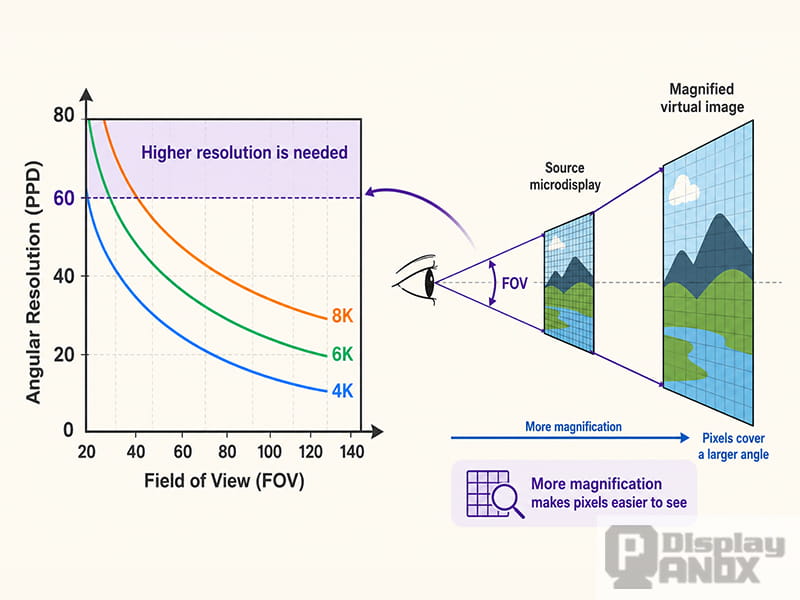
Resolution determines how much spatial detail the panel can reproduce. Pixel density determines how tightly that detail is packed into a sub-inch display. Because eyepiece optics magnify the panel, visible pixel structure can become distracting even when the display looks extremely dense on paper.
Pixels per degree (PPD) is often more useful than pixels per inch for a near-eye system because PPD connects panel resolution to the field of view seen by the eye. A 2025 SID invited paper on OLED microdisplay evolution uses an EVF field of view of about 30 degrees and a human-vision reference of roughly 60 PPD, concluding that UXGA-class resolution or higher is needed to make individual pixels difficult to recognize.
The “million dots” figure in a camera specification also needs careful reading. Many manufacturers count red, green, and blue subpixels as separate dots, so a dot count should not automatically be interpreted as an equal number of full-color pixels.
Refresh Rate, Response Time, and Latency
A higher refresh rate makes camera movement and moving subjects appear smoother. It also reduces the time between display updates, which is valuable for sports, wildlife, and fast panning. Current performance-oriented cameras commonly offer 100 or 120 fps EVF modes; for example, Fujifilm specifies approximately 120 fps for the X-H2S viewfinder.
Refresh rate and latency describe different things. Refresh rate is how often the panel can show a new frame. Latency is the total delay from light reaching the sensor to the corresponding frame reaching the eye. A responsive OLED panel helps, but sensor scan time and image processing must also remain fast.
Magnification, Field of View, and Frame Coverage
Viewfinder magnification describes the apparent size of the finder image under specified lens and focus conditions. A larger image can feel more immersive and makes fine detail easier to inspect, although the full frame must still remain visible without excessive eye movement.
Frame coverage describes how much of the captured image appears in the viewfinder. A 100% coverage specification means the finder is designed to show the entire recorded frame. Field of view describes the angular span of the virtual image and must be balanced with panel resolution: a wider field spreads the same pixels across more degrees of vision.
Eye Point, Diopter Range, and Eyepiece Quality
Eye point—or eye relief—is the distance from the eyepiece at which the complete finder image remains visible. Generous eye relief matters for glasses wearers and for equipment used with protective eyewear. Diopter adjustment corrects the focus of the finder optics, while lens quality influences edge sharpness, distortion, chromatic aberration, and pupil tolerance.
Brightness, Contrast, and Color
The EVF must remain readable across bright outdoor scenes, dim studios, and night work without causing eye fatigue. Contrast and black level influence shadow judgment, while stable color supports a believable preview. Extreme panel luminance alone does not guarantee a better finder: the optical efficiency, eyecup, automatic brightness control, tone mapping, and thermal design determine how much useful light reaches the eye.
Power and Thermal Performance
An EVF operates as part of a continuous imaging chain, so power is consumed by the sensor, processor, interface, panel, and supporting electronics. Higher frame rates and luminance modes can increase that load. Display efficiency, low-power scan modes, activation by an eye sensor, and careful thermal design are therefore important in compact cameras, scopes, and battery-powered instruments.
Why Is Micro OLED Well Suited to Electronic Viewfinders?
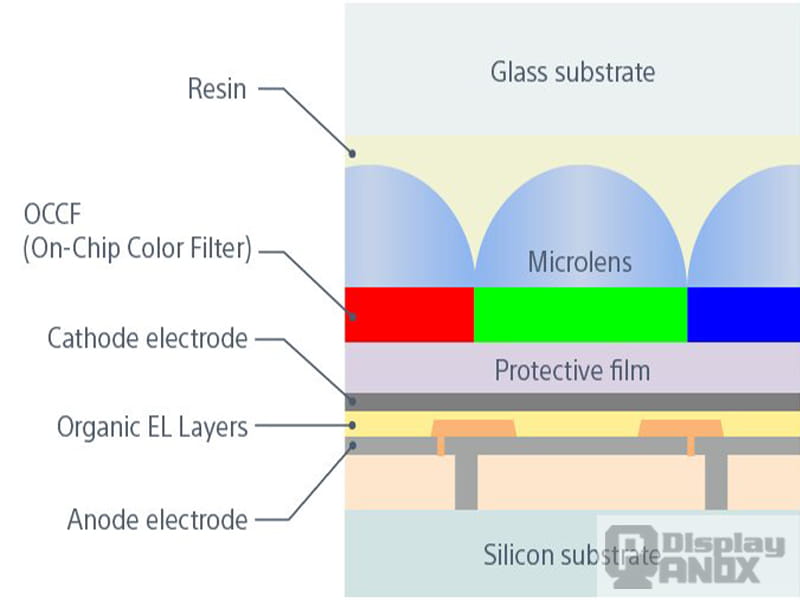
Electronic viewfinders have used both miniature LCD and OLED panels. Micro OLED—also called OLED-on-silicon or OLEDoS—has become especially important in premium near-eye systems.
In a Micro OLED, the OLED emitting layers are built over a CMOS silicon backplane rather than the glass backplane used by many direct-view displays. The silicon circuitry can support very small pixel pitches and integrate driving functions within a compact panel. Sony Semiconductor Solutions describes this combination of an organic light-emitting layer and silicon pixel circuitry as the basis for the small, high-definition displays used in EVFs.
The technology aligns well with viewfinder requirements for several reasons:
-
High pixel density: Full-HD and higher resolutions can fit into panels well below one inch, helping the magnified image appear continuous.
-
Self-emissive contrast: Each pixel produces its own light, allowing deep blacks without the light leakage associated with an LCD backlight.
-
Fast response: OLED pixels can change state quickly, reducing display-side motion smearing and supporting high-refresh operation.
-
Compact optical packaging: The absence of a backlight can reduce display thickness and simplify a small near-eye module.
-
Wide usable viewing angle: Stable image quality across the eyebox helps preserve color and contrast when the eye is not perfectly centered.
Research has demonstrated how far this architecture can be pushed. A 2018 SID distinguished paper reported a 0.5-inch UXGA OLED microdisplay with 6.3 μm pixels, 4032 PPI, high luminance, and support for 120 fps progressive driving. That combination directly addresses the sharpness and motion demands of a magnified EVF.
Micro OLED still involves engineering trade-offs. Very high brightness raises power and lifetime concerns, small pixels make uniformity and optical efficiency more difficult, and silicon-based manufacturing can cost more than conventional display production. A credible EVF design therefore balances resolution, luminance, refresh rate, interface bandwidth, lifetime, optics, and thermal limits instead of maximizing a single specification.
Micro OLED Options for EVF and Near-Eye Development
Panox Display supplies Micro OLED displays in several resolutions and formats for EVFs, compact optical instruments, FPV systems, thermal imaging, AR/VR devices, and other near-eye products. The following modules illustrate how different panel formats can serve different optical designs.
| Micro OLED module | Core specifications | EVF-relevant design value |
|---|---|---|
| 0.39-inch FHD Micro OLED | 1920 × 1080, 5644 PPI, MIPI, 300 or 1500 cd/m² versions | Very compact Full-HD source for space-constrained near-eye optics |
| 0.5-inch UXGA Micro OLED | 1600 × 1200, 4000 PPI, 60–120 Hz, 1000 cd/m², MIPI + I²C | 4:3 format and high refresh rate suited to detailed real-time imaging |
| 1.03-inch 2560 × 2560 Micro OLED | 2560 × 2560 Real RGB, 60–90 Hz, 1800 cd/m², MIPI DSI + I²C | High-resolution square image area for larger EVFs and advanced optical engines |
Panel selection should begin with the required field of view, angular resolution, eyebox, optical magnification, frame rate, image-source timing, and power budget. Interface compatibility matters just as much as display resolution. A module may use MIPI DSI, LVDS, or another high-speed link, while prototypes may also require an HDMI or USB Type-C controller board.
Panox Display can support evaluation with panel documentation, controller-board options, connectors, and integration guidance. For an EVF project, sharing the target optics, available image signal, enclosure size, refresh requirement, operating temperature, and expected volume makes it easier to narrow the product range before hardware design begins.
Where Else Are Electronic Viewfinders Used?
The term EVF is most closely associated with digital cameras, but the same architecture appears wherever a compact screen must be viewed through optics. Professional camcorders use EVFs for focus and exposure monitoring. Electronic binoculars, monoculars, night-vision systems, thermal imagers, medical viewing equipment, industrial microscopes, and drone FPV goggles all convert sensor data into a near-eye image.
These systems may prioritize different specifications. A broadcast camera values low latency and accurate focus rendering. A thermal scope may prioritize low-temperature stability and high contrast. A medical viewer may need color consistency and long operating sessions, while an FPV headset emphasizes response time and motion clarity. The display technology is only one part of the finished viewfinder, but it strongly shapes the size, image quality, and power requirements of the complete optical module.
Conclusion
A viewfinder is the camera’s visual interface for framing, focusing, and following a scene. Optical viewfinders deliver a direct view through mirrors, prisms, or separate optics. Electronic viewfinders turn the sensor feed into a live image on a miniature display, adding exposure preview, focus aids, shooting data, and image playback.
The rise of mirrorless cameras has made EVF performance increasingly important. Resolution, PPD, refresh rate, latency, field of view, eye relief, contrast, optics, and power must work as a system. Micro OLED fits this task particularly well because it combines high pixel density, self-emissive contrast, fast response, and compact silicon-based construction. With the right panel and optical design, an EVF can approach the immediacy of an optical finder while providing far more information about the image being recorded.
Frequently Asked Questions
What does EVF mean on a camera?
EVF means electronic viewfinder. It is a small LCD or OLED display inside the camera eyepiece that shows a live image generated from the camera sensor.
Is “view finder” or “viewfinder” correct?
“Viewfinder” is the standard spelling. “View finder” is widely used as a search phrase and refers to the same camera component.
Is an electronic viewfinder better than an optical viewfinder?
An EVF is better for previewing exposure, white balance, focus aids, histograms, and low-light scenes. An OVF provides a natural view with effectively no electronic lag and uses little power. The better system depends on the subject, camera design, and working style.
Does a viewfinder affect image quality?
The viewfinder does not directly change the data recorded by the camera sensor. It can affect how accurately the image is composed, focused, and exposed because it determines what information is visible before capture.
Why do mirrorless cameras use electronic viewfinders?
Mirrorless cameras do not have the reflex mirror and pentaprism used to create a DSLR’s optical path. The image sensor therefore supplies a live feed to an EVF or rear screen.
Can a camera work without a viewfinder?
Yes. Many compact cameras, action cameras, cinema cameras, and smartphones rely on a rear display or an external monitor. A dedicated viewfinder remains useful for bright light, stable handheld shooting, and tracking moving subjects.
What display technology is used in an EVF?
Modern EVFs generally use miniature LCD or OLED panels. Micro OLED is common in high-density near-eye designs because it can place Full-HD or higher resolution into a very small self-emissive display.
How much EVF resolution is enough?
The answer depends on field of view, eyepiece magnification, panel layout, and viewing optics. For a typical camera EVF with an approximately 30-degree field of view, research indicates that UXGA-class resolution or higher can move the display toward a pixel structure that is difficult for an average eye to distinguish.