







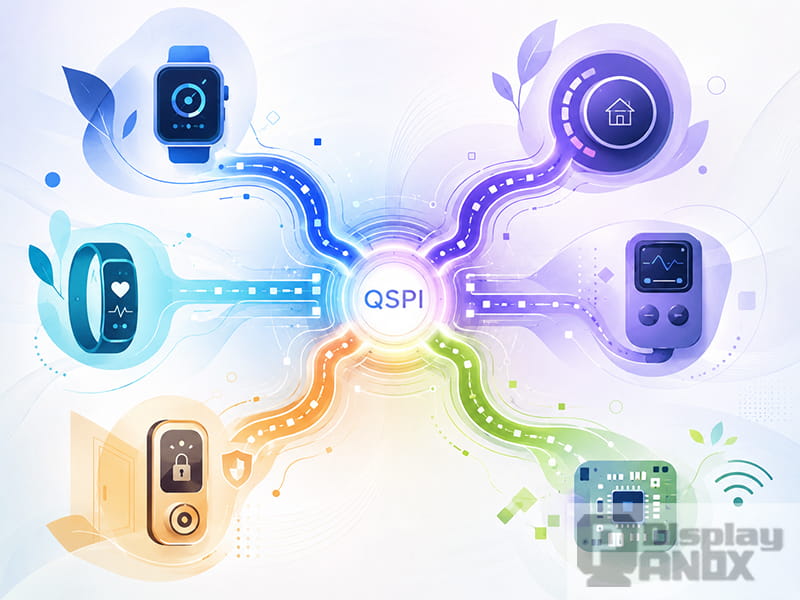
QSPI display panels are most often found in products that need a richer interface than a simple status screen, but still need to stay compact, low-power, and friendly to microcontroller-based hardware. That is why QSPI appears so often around smartwatch-class AMOLED screens, compact touch displays, round OLED modules, and small embedded user interfaces.
In practical product design, the question is rarely “Can QSPI transfer data?” The more useful question is: What kind of product benefits from a four-data-line serial display interface?
A good QSPI application usually has five traits: a small or medium display size, a detailed graphical UI, limited connector space, battery or thermal constraints, and an MCU or compact embedded processor instead of a full phone-class application processor. Panox Display’s QSPI tag page already reflects this pattern, with small AMOLED and OLED modules such as 1.2-inch round OLED, 1.39-inch round OLED, 1.43-inch round AMOLED, 1.47-inch AMOLED, and 2.04-inch AMOLED panels grouped under this interface category.
Why Application Context Matters for QSPI
QSPI is not chosen only because it has four data lines. It is chosen because those four data lines solve a product-level problem.
Small AMOLED panels have moved far beyond basic icons. A smartwatch screen may need animated health rings, notification cards, weather graphics, menus, touch feedback, and smooth transitions. A compact instrument may need waveform-style graphics, warning states, battery information, and live sensor values. A smart home controller may need a visually polished interface in a very small mechanical space.
The display command model is also important. MIPI Display Command Set provides standardized display control commands for functions such as setup, control, brightness, and data supply, and this command-driven thinking is closely related to how many small AMOLED driver ICs are controlled in embedded products. For product teams, that means QSPI can support modern UI behavior without forcing every design into a large, continuous video-display architecture.
1. Smartwatches and Fitness Trackers
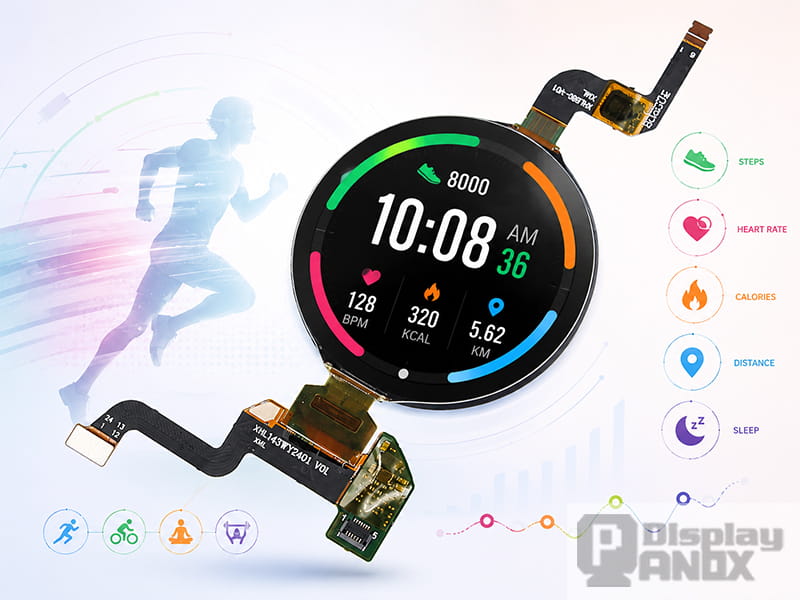
1.43 inch AM-OLED Full Color On-cell PCAP Touch
Smartwatches are the most obvious application for QSPI AMOLED displays. They need a bright, colorful, high-contrast screen in a body that has almost no space to waste. They also need touch input, fast UI response, low standby power, and a display interface that can fit through a narrow FPC.
A round 466 × 466 AMOLED panel is a typical example. It is detailed enough for watch faces, step counters, heart-rate widgets, weather cards, and animated menus, but still small enough that an MCU-based system can be realistic. Waveshare’s ESP32-S3 Touch AMOLED development board, for example, uses a 1.43-inch 466 × 466 AMOLED screen, with the AMOLED display connected through QSPI and the touch screen through I2C. The same board exposes common embedded interfaces and is positioned for automation and IoT development, showing how QSPI AMOLED screens fit real MCU development workflows.
For fitness trackers, the same logic applies in a slimmer format. A narrow AMOLED panel can show steps, heart rate, training zones, sleep data, battery state, notifications, and quick controls. The interface needs to be fast enough for smooth touch response, but the product still needs to preserve battery life. Recent research on wearable AMOLED power design also points out that standby time is a critical product metric for watches and bracelets, and that AMOLED displays are one of the major power-consuming parts in smart wearable products.
2. Wearable Medical and Health Monitoring Devices
QSPI AMOLED panels are also a natural fit for wearable medical and health-monitoring devices. These products often use small screens, but the information they display must be clear at a glance: heart rate, SpO₂, glucose-related indicators, warning icons, battery level, connection state, or device status.
Unlike a decorative consumer display, a medical wearable interface has to remain readable, responsive, and reliable. AMOLED helps with contrast and color emphasis, while QSPI helps the MCU update visual elements without a wide parallel bus or a more complex display subsystem. A dark UI with bright colored warnings can also suit AMOLED’s self-emissive behavior, especially when much of the screen remains black.
Panox Display’s 2.04-inch AMOLED module is a useful reference here. The module has 368 × 448 resolution, 700 cd/m² typical luminance, a CH13613 driver IC, Q-SPI communication, and compatibility with MCU platforms including STM32, GD32F, AVR, Arduino, ARM, and Raspberry Pi. Panox lists wearable devices, smartwatches, medical devices, portable information devices, and electronic locks among its possible applications.
For a health product, that combination matters because the display is large enough to present useful information, yet still compact enough for wrist-worn, handheld, or pocketable equipment.
3. Smart Home Control Panels and Rotary Interfaces
Smart home products often need a display that feels premium without turning the product into a tablet. Thermostats, air-conditioner controls, lighting panels, security keypads, appliance knobs, and room controllers may only need a 1.2-inch to 2-inch screen, but that screen carries much of the user experience.
QSPI is useful here because the host may be a low-power MCU with wireless connectivity. The display needs to show icons, status cards, temperature values, mode selection, and touch or rotary feedback. A QSPI AMOLED can provide a colorful UI while keeping the board compact.
Round panels are especially interesting for rotary interfaces. A circular AMOLED can sit inside a knob-like product and show the current mode, temperature, volume, brightness, timer, or device state. The round format gives designers a more product-like visual language than a standard rectangle. Panox Display’s 1.2-inch round OLED product page describes smartwatch, vehicle, smart home, instrument, industrial device, security, and dynamic information display uses, which overlaps well with compact control interfaces.
4. Portable Instruments and Measurement Tools
Portable instruments need displays that are compact, readable, and power-aware. Examples include environmental meters, handheld test equipment, inspection tools, battery analyzers, compact sensor terminals, and field maintenance devices.
These products usually do not need a phone-size screen. They need a small UI that can show values, units, warning colors, graphs, menu items, and connection state. QSPI is valuable because it gives the product more display bandwidth than classic SPI while avoiding the pin count and routing cost of a wide parallel interface.
This is also where command-mode updates become useful. A measurement interface may update only a number, a bar graph, or a warning region, rather than redrawing a full video stream. Espressif’s LCD documentation describes controller-based LCD panels where the frame buffer is located in the display controller’s internal GRAM, which is the same broad architecture that makes many small controller-based displays practical for MCU products.
For battery-powered tools, the result is simple: the interface can look modern, but the hardware can remain relatively lean.
5. Compact Handheld Devices and Remote Controls
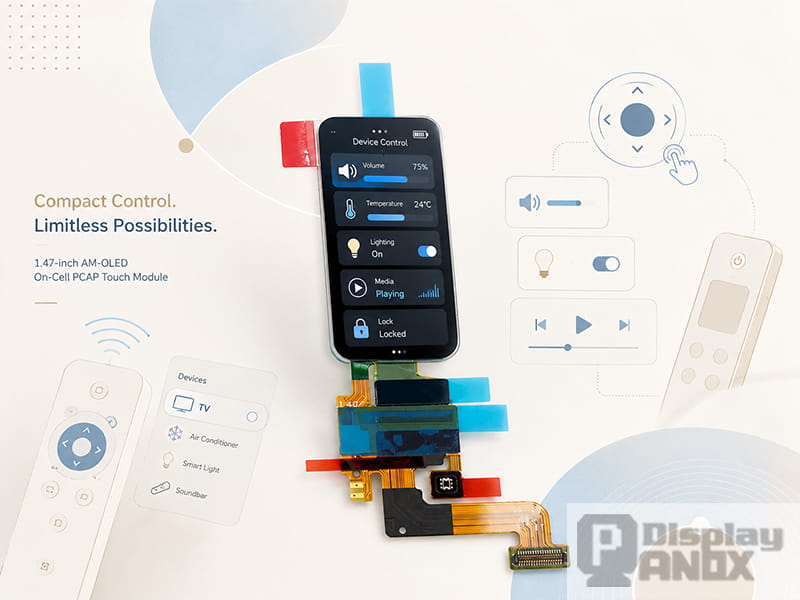
1.47 inch AM-OLED Full Color On-cell PCAP Touch
QSPI AMOLED panels also work well in handheld products that need a richer interface than LEDs or segmented displays. Examples include advanced remote controls, smart camera controllers, portable terminals, handheld ordering devices, audio controllers, and compact communication devices.
The 1.47-inch AMOLED format is a good example of this direction. It is narrow and vertical, which makes it useful for menu lists, status cards, small dashboards, and notification-style UI. Panox Display’s 1.47-inch AM-OLED module has 194 × 368 resolution, integrated on-cell capacitive touch, 400–500 cd/m² luminance, an SH8501B driver IC, and Q-SPI communication.
For remote-style products, the screen may need to show device names, battery level, selected mode, connection status, lock/unlock state, shortcuts, or quick settings. QSPI gives enough bandwidth for these visual elements while keeping the FPC and PCB integration manageable.
6. Industrial HMI and Embedded Control Interfaces
QSPI displays can also appear in industrial control products, especially when the interface is small and the host platform is MCU-based. Examples include compact machine panels, test fixtures, access terminals, embedded controllers, pump interfaces, temperature controllers, and small equipment dashboards.
In these applications, the biggest advantage is not always raw display speed. Often, the real value is that the product can add a better GUI without redesigning the entire electronics platform. Riverdi describes SPI/QSPI display connectivity as a way to use low-power MCUs with standard interfaces and reduce the need for complex graphics rendering on the host side.
For industrial products, this can shorten development time. A small AMOLED or OLED display can replace simple indicators with a more informative UI: status messages, warnings, maintenance reminders, operating modes, and touch-based settings. QSPI gives the designer a path toward a cleaner interface while keeping the control board compact.
7. Security Devices and Electronic Locks
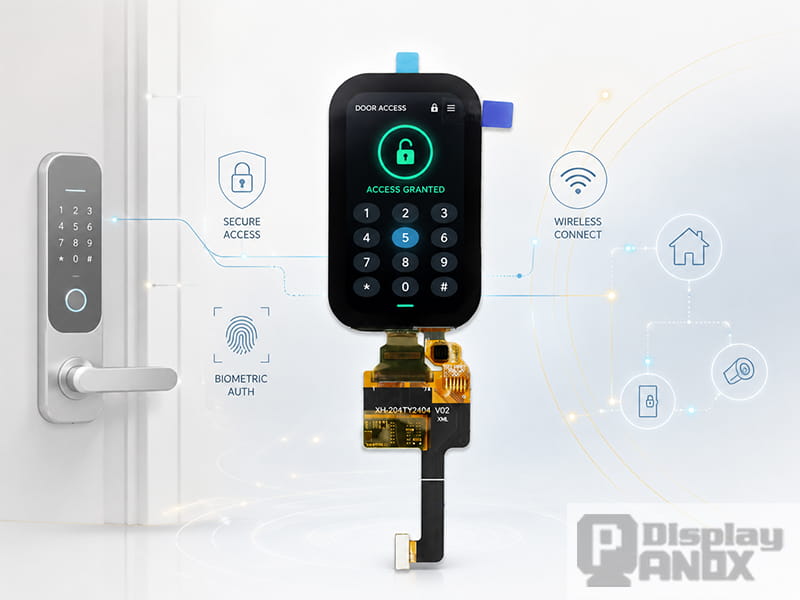
2.04 inch AM-OLED Full Color On-cell PCAP Touch
Security products are another strong application area for QSPI display panels. Smart locks, access controllers, alarm keypads, small verification terminals, and portable authentication devices often need compact screens with high contrast and low standby power.
In these products, the screen may show lock status, user prompts, PIN entry feedback, battery warnings, connection state, or authentication results. The UI does not require a large video pipeline, but it does need fast and clear updates. AMOLED is useful because black backgrounds and bright status colors are easy to read, and QSPI is useful because the host controller can update the display through a compact serial interface.
Panox Display’s 2.04-inch AMOLED product page specifically lists electronic locks among possible application areas, alongside wearable devices, portable information devices, and medical devices. That makes this category a practical fit for QSPI AMOLED modules with touch support.
8. Development Boards, IoT Prototypes and Demo Kits
QSPI AMOLED screens are increasingly common in development boards because they let engineers build polished GUIs on MCU platforms. For early-stage product teams, this matters. A display that already works with ESP32-S3, STM32, Arduino-style workflows, or LVGL can reduce bring-up time and make the prototype feel closer to the final product.
The Waveshare ESP32-S3 Touch AMOLED 1.43 board is a good example. It combines Wi-Fi, Bluetooth, PSRAM, RTC, IMU, a 1.43-inch AMOLED screen, QSPI display communication, I2C touch, and a large number of demos for GUI and IoT development.
For product evaluation, a QSPI AMOLED demo can answer important questions early: Is the screen bright enough? Does the UI feel smooth? Is the MCU powerful enough? Is the touch response acceptable? Can the FPC and connector fit the mechanical design? A good demo kit saves time before the product team commits to PCB layout and enclosure tooling.
Matching QSPI Display Panels to Application Needs
Different QSPI applications do not need the same panel. A smartwatch wants a compact round or square display with high PPI and touch. A handheld remote may prefer a vertical rectangular AMOLED. A smart home knob may need a round panel. A medical or industrial device may care more about brightness, operating temperature, and long-term supply.
| Application | Display requirement | Why QSPI helps | Suitable Panox Display direction |
|---|---|---|---|
| Smartwatch | Round or compact AMOLED, touch, smooth UI | Higher bandwidth than SPI with compact wiring | 1.43-inch round AMOLED, 1.39-inch round OLED |
| Fitness tracker | Slim AMOLED, low power, quick status updates | Efficient command-style updates and small FPC | 1.47-inch AMOLED, 2.04-inch AMOLED |
| Medical wearable | Clear icons, warning colors, outdoor readability | Fast updates without a large display subsystem | 2.04-inch AMOLED |
| Smart home control | Visual control UI, compact mechanical space | MCU-friendly display connection | 1.2-inch round OLED, 1.43-inch round AMOLED |
| Portable instrument | Values, graphs, menus, warning states | Better graphics performance than classic SPI | 1.47-inch AMOLED, 2.04-inch AMOLED |
| Security device | Lock status, prompts, PIN interface | Compact interface and vivid high-contrast UI | 2.04-inch AMOLED |
| IoT prototype | LVGL-style GUI, wireless MCU board | Easier display bring-up on MCU platforms | QSPI AMOLED demo kit or customized board |
Panox Display’s QSPI tag page also notes that display integration often goes beyond the panel itself, including cover glass, touch panel, driving board, connectors, and PCB-related support. For real products, this support is often as important as the interface choice.
Design Considerations for QSPI Display Applications
Before choosing a QSPI display panel, the application should be reviewed from both the UI side and the hardware side.
Display Shape and UI Layout
A round AMOLED works well for watches, knobs, dials, status rings, and glanceable dashboards. A vertical rectangular AMOLED is better for lists, notifications, settings, and compact handheld menus. The shape should be chosen before the UI is finalized, because round and rectangular screens encourage very different information layouts.
Resolution and Frame Update Needs
A static watch face, sensor value, or lock-status screen does not need the same update behavior as a scrolling menu or animated dashboard. QSPI can support smoother UI than classic SPI, but the actual result still depends on MCU performance, rendering method, memory bandwidth, and driver code.
Touch Integration
Many QSPI AMOLED modules use a separate touch interface, usually I2C. That separation is common in compact touch display boards; Waveshare’s ESP32-S3 AMOLED board, for example, uses QSPI for the AMOLED display and I2C for the capacitive touch screen. The product design should reserve the required touch pins and consider touch firmware, cover glass thickness, and waterproofing requirements.
Power Budget
For wearables, display power is part of the whole system budget. AMOLED power depends heavily on brightness, image content, UI color design, refresh behavior, driver settings, and standby strategy. The wearable AMOLED paper mentioned earlier highlights that AMOLED displays are a major power-consuming component in smart wearable products, so interface choice should be considered together with brightness policy, dark UI design, and sleep/wake behavior.
Mechanical Integration
Small QSPI AMOLED panels often use fine-pitch FPCs, board-to-board connectors, on-cell touch structures, or customized cover glass. A panel may look simple in a product photo, then become difficult at the assembly stage if the connector, bending direction, touch tail, or glass outline is ignored. For production projects, the FPC direction and connector position should be reviewed together with the enclosure design.
When QSPI Is Less Suitable
QSPI is strongest in compact graphical interfaces. It is less suitable when the application needs a large high-resolution display, continuous high-frame-rate video, a phone-like app UI, camera preview, or heavy multimedia playback. Those products usually need MIPI DSI, RGB, eDP, HDMI bridge solutions, or another higher-bandwidth architecture.
At the other end, QSPI may also be unnecessary for very simple displays. A low-resolution sensor screen, small monochrome UI, or icon-only status display may work perfectly well with classic SPI or I2C. Choosing QSPI only makes sense when the UI needs the extra bandwidth or when the selected panel already uses that interface.
Panox Display QSPI Solutions for Compact AMOLED Products
Panox Display supplies QSPI-related AMOLED and OLED display panels for wearable devices, smart controls, portable equipment, security products, and other compact embedded applications. The current QSPI category includes round, vertical, and smartwatch-class modules in sizes such as 1.2 inch, 1.39 inch, 1.43 inch, 1.47 inch, and 2.04 inch.
For projects that need faster evaluation, Panox Display can support datasheets, driver IC documentation, connectors, demo kits, controller boards, customized cover glass, and touch panel solutions. The goal is to help engineers move from panel selection to a working prototype with fewer interface and assembly problems.
Conclusion
QSPI display panels are used wherever compact products need a modern visual interface without the complexity of a large display system. Smartwatches, fitness trackers, medical wearables, smart home controllers, portable instruments, remote controls, industrial panels, and security devices all fit this pattern.
The strongest QSPI applications usually share the same design logic: the screen is small, the UI is detailed, the product has limited space, the host is MCU-based, and power consumption matters. In that space, QSPI gives engineers a useful balance between SPI simplicity and higher display bandwidth.
For teams building compact AMOLED products, QSPI is often the interface to evaluate when plain SPI feels too slow and MIPI DSI feels too heavy for the system.
Learn more: Why Is QSPI Used in Small AMOLED Display Panels?
FAQ
What products commonly use QSPI display panels?
QSPI display panels are commonly used in smartwatches, fitness trackers, wearable medical devices, smart home controls, compact handheld instruments, remote controls, security terminals, and MCU-based IoT products.
Are QSPI AMOLED displays suitable for smartwatches?
Yes. Smartwatches are one of the most suitable applications for QSPI AMOLED displays because they need colorful graphics, touch input, compact FPC design, and efficient updates in a small battery-powered product.
Can QSPI display panels be used in medical devices?
Yes. QSPI AMOLED panels can be used in wearable health monitors, compact medical instruments, and portable information devices when the product needs a small, high-contrast color display with MCU-friendly control.
Are QSPI displays only for round screens?
No. QSPI can be used on round, square, and rectangular display modules. Round screens are common in watches and knobs, while rectangular QSPI AMOLED panels are useful for trackers, remotes, handheld devices, and compact dashboards.
Is QSPI enough for video playback?
QSPI can support short animations and rich UI effects at small-display resolutions, but continuous high-resolution video is usually better suited to MIPI DSI, RGB, HDMI bridge, or eDP-style display architectures.
How should I choose a QSPI display panel?
Start with the application: screen shape, resolution, brightness, touch requirement, MCU platform, available pins, memory budget, FPC direction, connector type, and operating environment. Then choose a panel that matches both the visual design and the hardware constraints.