







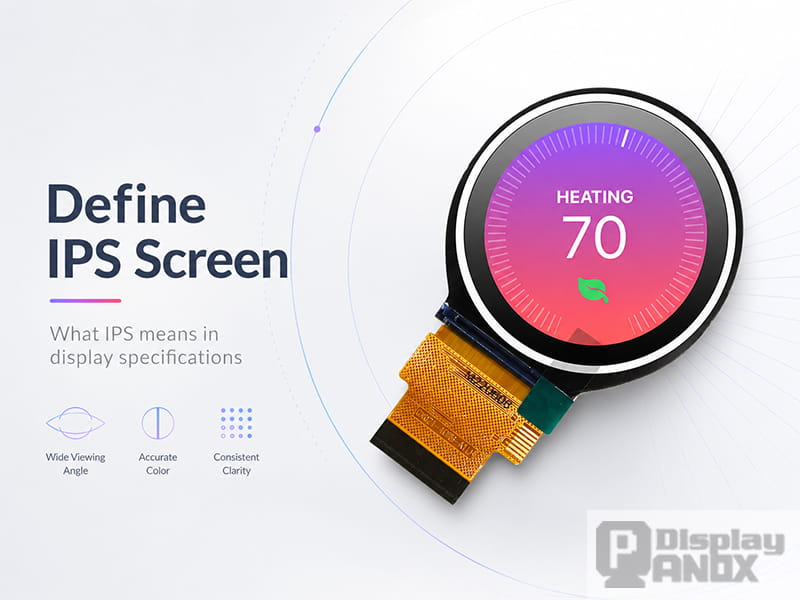
When “IPS” appears in the specifications of a monitor, tablet, industrial panel or LCD module, it identifies the way the liquid crystals inside the screen are arranged and controlled.
The simplest way to define an IPS screen is this: it is a type of LCD designed to keep its image more consistent when viewed from different directions.
IPS stands for In-Plane Switching. In this type of panel, the liquid crystal molecules are arranged parallel to the glass substrates and rotate mainly within the same plane when voltage is applied. This differs from LCD structures in which the crystals tilt more noticeably toward or away from the viewer.
That change in movement may sound small, but it affects how the display looks in everyday use. An IPS screen is less likely to show strong color shifts, washed-out dark areas or inverted tones when the viewer moves away from the center of the panel.
IPS, LCD and TFT Do Not Mean the Same Thing
Display specifications often place terms such as IPS, TFT and LCD beside one another, which can make them look like competing technologies. They actually describe different parts of the display.
LCD, or Liquid Crystal Display, is the general display technology. An LCD uses liquid crystals to control light from a backlight and form an image.
TFT, or Thin-Film Transistor, describes the active matrix used to control individual pixels. Most modern color LCD modules use a TFT structure because it allows pixels to be addressed more precisely.
IPS describes the switching mode of the liquid crystal layer.
For this reason, a product described as an IPS TFT LCD is not combining three unrelated screen types. It is an LCD that uses TFT pixel control and an IPS liquid crystal structure.
This also explains why asking whether IPS is better than TFT can be misleading. A screen can be both IPS and TFT at the same time. A more useful comparison would be between IPS and another LCD mode, such as TN or VA. Panox Display’s existing TFT and IPS guide also treats IPS as a subtype of TFT LCD rather than an alternative to TFT.
What Does IPS Change in Actual Use?
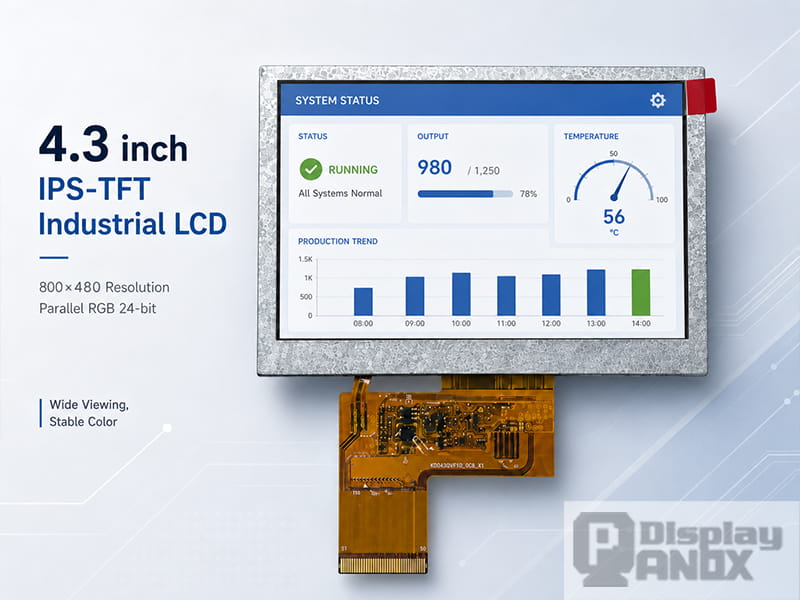
4.3 inch 800x480 IPS-TFT Industrial LCD Display Parallel RGB 24 Bits
The most noticeable difference is viewing stability.
Imagine an industrial control panel installed slightly above eye level. The operator may look at it from below rather than directly from the front. On a display with a narrow preferred viewing direction, dark interface elements may become pale, colors may change, or parts of the image may lose contrast.
An IPS screen reduces these changes. The display does not look exactly identical from every possible angle, but its colors, brightness relationships and grayscale remain more stable across a wider viewing area.
This is useful even when only one person operates the device. Handheld equipment is tilted during use, vehicle screens are viewed from different seats, and wall-mounted controls are seen by people of different heights. A wider usable viewing range makes the interface less dependent on one fixed position.
IPS is also helpful when the screen contains more than simple numbers or text. Icons, charts, warning colors, gradients and photographs are easier to understand when their appearance does not change dramatically with the viewing angle.
What an IPS Label Does Not Tell You
IPS is an important part of an LCD specification, but it does not describe the entire display.
It does not tell you the panel resolution, brightness, contrast ratio, color gamut, refresh rate, response time, interface or operating temperature. It also does not confirm whether the module includes a touch panel or whether it is readable in direct sunlight.
For example, two IPS LCD modules may have the same screen size and resolution but perform very differently. One may use a brighter backlight, while the other may have lower power consumption. One may support MIPI DSI, while the other uses RGB, LVDS or eDP. Their FPC positions, outline dimensions and touch structures may also be completely different.
The IPS label should therefore be read as a description of the viewing characteristics, not as a general quality grade.
This distinction is especially important for outdoor products. IPS can help preserve the image when the viewing direction changes, but sunlight readability depends largely on luminance, surface reflections, optical bonding, cover glass and ambient contrast. A low-brightness IPS panel can still be difficult to see outdoors.
The same applies to color. IPS generally provides better viewing-angle color consistency than more angle-dependent LCD structures, but it does not automatically guarantee a wide color gamut or professionally calibrated color accuracy. The backlight, color filter, driver settings and panel design still influence the final result.
How IPS Compares with Other Display Options
Compared with a typical TN LCD, IPS is usually chosen when viewing-angle stability and consistent graphical content are more important. TN panels can still be suitable for cost-sensitive products or applications designed around a specific viewing direction.
VA LCD panels are often associated with stronger native contrast and darker black levels, although their viewing behavior varies between panel designs. IPS normally offers a more balanced image when the screen is observed from different positions.
OLED uses a completely different structure. Each OLED pixel produces its own light, so black pixels can switch off instead of depending on a continuously illuminated backlight. This allows OLED displays to achieve deeper blacks and higher contrast.
An IPS LCD may still be a better fit when a project needs an established LCD supply chain, a particular standard size, long periods of static content or an interface that is readily available in existing embedded hardware.
The choice is not simply a contest between “better” and “worse.” It depends on what the product needs the screen to do.
When Is an IPS Screen a Good Choice?
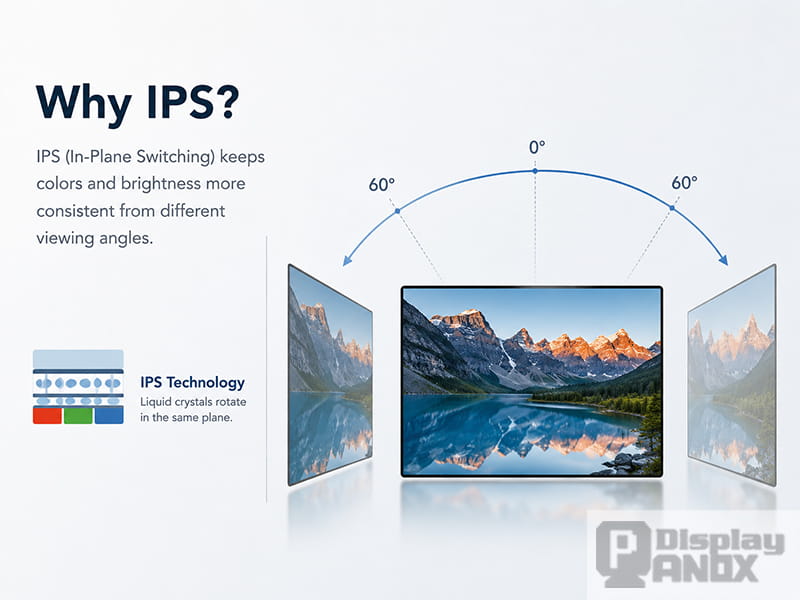
IPS is particularly useful when the display cannot always be viewed straight on.
Industrial HMIs are a clear example. A screen may be mounted on a machine, control cabinet or test station where the operator’s position changes during use. Stable viewing characteristics help keep controls and status information recognizable.
Portable instruments and handheld terminals also benefit because their viewing angle changes whenever the user moves or tilts the device. In smart home panels, IPS allows wall-mounted interfaces to remain clear from different heights and positions.
Vehicle displays, point-of-sale terminals, medical equipment and building control systems present similar requirements. In each case, information may need to be read quickly without the user first adjusting their position to find the best viewing angle.
IPS is less critical when the display is always viewed from one fixed direction and the product has stronger priorities, such as minimum cost, extremely high contrast or a specialized low-power mode.
Choosing an IPS LCD Module
Once IPS has been identified as the suitable panel type, the next step is matching the complete module to the product.
Screen size and resolution are the most visible specifications, but mechanical details are just as important. The active area, outline dimensions, thickness, FPC shape, connector position and mounting structure must fit the enclosure.
The interface must also match the host platform. Small and medium-size IPS LCD modules may use MCU, SPI, RGB, MIPI DSI, LVDS or eDP, depending on their resolution and intended application. A bare panel may need an adapter or controller board before it can connect to a computer or Raspberry Pi.
Brightness should be selected for the real operating environment rather than treated as an isolated number. Indoor equipment, portable outdoor terminals and vehicle systems may require very different backlight designs.
Touch requirements should be confirmed early as well. Adding capacitive touch, custom cover glass or optical bonding can change the module thickness, visible area and mechanical design.
Panox Display provides small and medium-size display panels across categories including TFT-LCD, AMOLED, PMOLED, Memory LCD and Micro OLED. Its product catalogue includes modules with different sizes, resolutions and interfaces for embedded and industrial projects.
For an IPS LCD enquiry, providing the target size, resolution, interface, brightness, outline limits, touch requirements and estimated quantity makes it easier to identify a suitable standard panel or determine whether customization is needed.
What IPS Really Means for a Product
To define an IPS screen accurately, it is an LCD that uses In-Plane Switching to improve image stability across different viewing directions.
Its value is not limited to making a display look attractive. In many products, it makes the interface more dependable. Operators can read information from less-than-perfect positions, portable devices can be tilted without severe image changes, and graphical controls remain visually consistent during use.
IPS does not replace the need to check the rest of the datasheet. Brightness, contrast, interface, resolution, touch structure, temperature range and mechanical dimensions still determine whether a display will work in the finished device.
But when wide, flexible viewing is part of the product requirement, IPS is one of the most practical places to begin.