







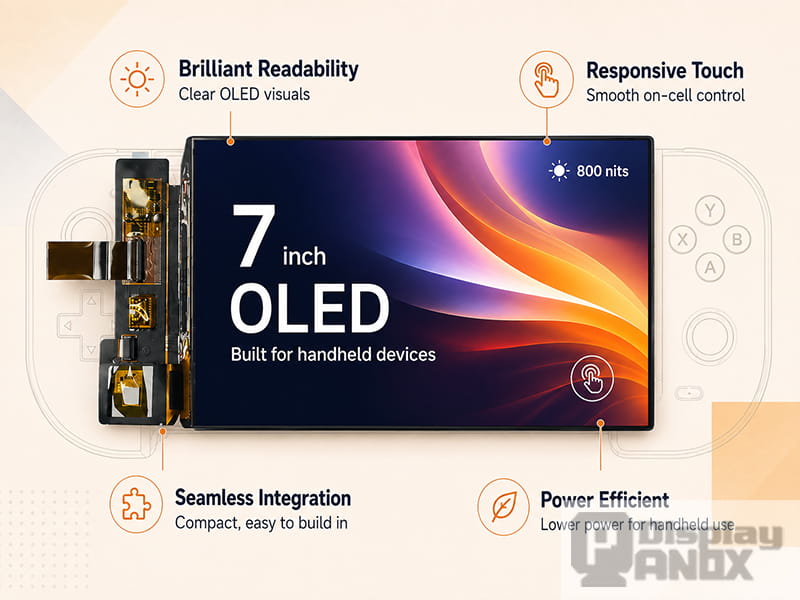
7 inch AMOLED OLED 1920X1080 Mipi
Seven-inch OLED touch screens have become increasingly relevant to handheld game consoles, portable navigation systems, compact control terminals, and other battery-powered devices. The size provides substantially more usable interface space than a smartphone display while remaining small enough for a handheld enclosure.
Demand is also moving beyond basic 60 Hz panels. Premium portable devices now use 7-inch OLED displays with Full HD resolution and refresh rates reaching 120 Hz or 165 Hz. This shift is visible in commercial handheld gaming hardware, where manufacturers are using high-refresh OLED screens as a major product differentiator. AYANEO’s 7-inch 165 Hz OLED handheld, for example, reflects the growing market for smoother, higher-contrast portable displays.
For custom portable hardware, the strongest all-around choice is usually a Full HD AMOLED panel with integrated capacitive touch, high brightness, a thin structure, and a high-speed MIPI interface. Based on these criteria, the Panox Display PO070FMTO is one of the most capable 7-inch OLED touch screen options for high-performance embedded products.
The Short Answer
The best 7-inch OLED touch screen depends on how the final device will be built.
For a production-ready handheld console, portable GPS unit, or compact multimedia terminal, a raw MIPI AMOLED panel offers the thinnest structure and the greatest control over the product’s electronics. The Panox Display 7-inch OLED touch screen combines 1080 × 1920 resolution, 800 cd/m² typical brightness, On-Cell Touch, a four-lane MIPI interface, and a refresh rate of up to 165 Hz.
For a fast prototype based on Raspberry Pi, a mini PC, or a conventional HDMI source, the same type of OLED panel needs a compatible HDMI-to-MIPI or USB Type-C controller board. A raw MIPI panel should not be treated as a plug-and-play HDMI monitor.
For simple control panels with mostly static content, 165 Hz may provide little practical benefit. A lower-refresh OLED or an IPS LCD module can reduce cost and simplify the hardware. Display selection should therefore begin with the application, processor, battery target, and mechanical design rather than screen size alone.
Why OLED Works Well in Portable Devices
OLED pixels generate their own light and do not require a separate backlight. Black pixels can be switched off, producing the deep blacks and high native contrast associated with OLED displays. Removing the backlight also helps reduce the display stack and gives industrial designers more room for batteries, cooling components, speakers, or controls.
These advantages matter at seven inches. A portable display must be large enough for maps, games, video, diagnostic data, or detailed touch controls without making the complete product uncomfortable to hold. Seven inches remains a useful middle ground between a smartphone-sized interface and a larger tablet or portable monitor.
AMOLED is particularly suitable for full-color, high-resolution applications. Its active-matrix backplane controls individual pixels and supports the refresh rates required by modern interactive interfaces. This makes it a more practical choice than PMOLED for a Full HD seven-inch screen.
What Defines a Good 7-Inch OLED Touch Screen?
Full HD Resolution at the Correct Pixel Density
Resolution should be evaluated together with physical size. A 1080 × 1920 image on a seven-inch panel produces approximately 315 pixels per inch. Text, icons, map labels, fine game graphics, and camera images remain sharp at typical handheld viewing distances.
Lower-resolution 7-inch displays, such as 800 × 480 or 1024 × 600 panels, can still work for basic controls. Their pixels become easier to notice in graphic-heavy interfaces, however, and less information fits on the screen without scrolling.
Full HD is therefore a practical target for premium handheld products. It provides visible improvement without moving into a resolution range that adds excessive graphics workload for limited real-world benefit.
Brightness and Outdoor Contrast
Brightness is important for portable equipment because the product may move between dark rooms, vehicles, factories, and outdoor environments. A typical indoor display in the 300–500 nit range can become difficult to read under strong ambient light. An 800-nit OLED provides considerably more luminance headroom.
Luminance alone cannot guarantee sunlight readability. Cover-glass reflectance, internal air gaps, surface coatings, viewing angle, and the displayed colors all affect outdoor contrast. The National Institute of Standards and Technology evaluates daylight readability through display output and reflected ambient light rather than brightness alone.
An outdoor-oriented product should therefore combine a bright panel with optical bonding, a suitable anti-reflective treatment, and a well-designed cover lens. Black backgrounds and high-contrast interface elements can also improve practical readability.
Refresh Rate and Motion Performance
A 60 Hz screen is sufficient for menus, maps, instrumentation, and conventional video. Gaming, rapid scrolling, remote desktop control, and low-latency touch interfaces benefit from 90 Hz, 120 Hz, or higher refresh rates.
A maximum refresh rate of 165 Hz gives a portable gaming product considerable performance headroom. It can make fast motion, camera rotation, animations, and touch-driven scrolling appear smoother. The complete system must still render and transmit frames fast enough to use that capability. A 165 Hz panel connected to a processor producing 60 frames per second will not create 165-frame content by itself.
High refresh rates also increase the display and processor workload. Projects that prioritize runtime should confirm which lower refresh modes are supported by the panel and driver IC rather than assuming that every 165 Hz panel can automatically operate at any desired frequency.
Integrated Capacitive Touch
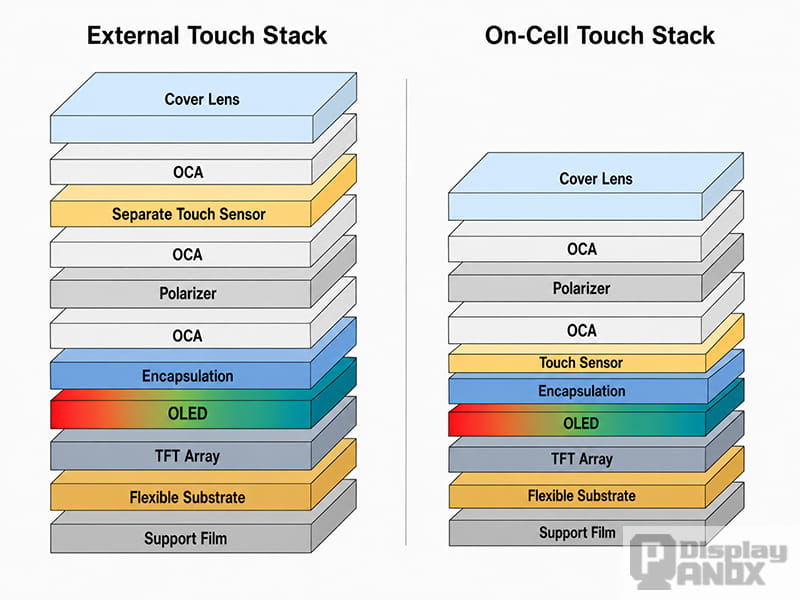
A separate capacitive touch panel adds glass, adhesive, thickness, weight, and additional optical interfaces. On-cell technology places the touch sensor much closer to the display structure, reducing the need for a separate touch-sensor layer.
The Society for Information Display has reported that on-cell integration can improve optical and mechanical performance while producing a significantly thinner module stack. This is especially valuable in handheld electronics, where even a small reduction in display thickness can improve the enclosure design.
On-Cell Touch does not eliminate the protective cover lens. It allows the cover glass to be bonded over an OLED panel that already contains the touch-sensing structure. Touch-controller compatibility, communication interface, firmware, glove operation, wet-touch behavior, and required cover-glass thickness should still be confirmed during development.
Interface Compatibility
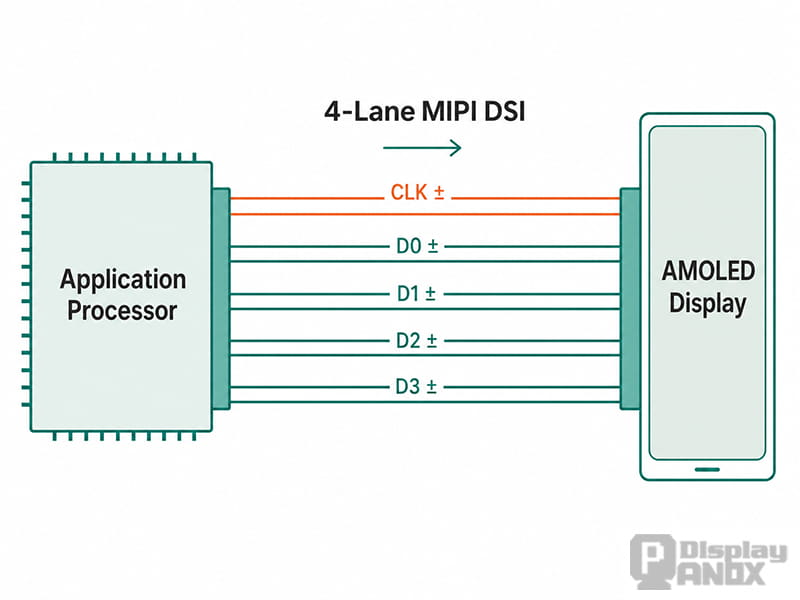
MIPI DSI is widely used between application processors and embedded displays. According to the MIPI Alliance, the interface is designed for high performance, low power, low electromagnetic interference, and reduced pin count. It is common in smartphones, tablets, wearables, automotive displays, and gaming devices.
A four-lane MIPI connection is appropriate for a high-resolution, high-refresh portable display, but “four-lane MIPI” is not a complete compatibility specification. The host processor must support the required D-PHY lane rate, video timing, color format, initialization commands, and any compression mode used by the panel.
The display driver IC, power rails, reset sequence, FPC pinout, and touch interface must also match the mainboard. For processors without native support for the panel, a dedicated HDMI-to-MIPI or Type-C controller board offers a more practical integration path.
Best Overall Option: Panox Display PO070FMTO
The PO070FMTO is designed for portable products that require more than a basic touch interface. Its combination of Full HD resolution, high brightness, On-Cell Touch, and 165 Hz refresh capability makes it especially suitable for handheld gaming systems and other visually demanding devices.
| Specification | Panox Display PO070FMTO |
|---|---|
| Display technology | AMOLED / OLED |
| Screen size | 7 inches |
| Resolution | 1080 × 1920 |
| Pixel density | 315 PPI |
| Aspect ratio | 9:16 |
| Typical brightness | 800 cd/m² |
| Maximum refresh rate | 165 Hz |
| Touch technology | On-Cell Touch |
| Display interface | Four-lane MIPI |
| Driver IC | SH8804B |
| Color depth | 1.07 billion colors, RGB 10-bit |
| Typical contrast ratio | 100,000:1 |
| Active area | 87.1344 × 154.9056 mm |
| Panel outline | 89.13 × 160.91 × 1.1 mm |
| Published operating range | −40°C to 70°C |
These are published panel specifications. Final production decisions should be based on the latest datasheet, interface documentation, engineering samples, and tests performed in the intended enclosure.
High-Refresh Handheld Gaming
The 165 Hz refresh rate is the most distinctive feature for gaming-oriented hardware. It gives manufacturers room to support high-frame-rate Android games, cloud gaming, streaming, emulation, and fluid system animations.
The panel’s 1080 × 1920 native orientation can be rotated to a 1920 × 1080 landscape layout at the system level, making it suitable for a conventional handheld console form. OLED’s pixel-level light control also improves dark scenes, loading screens, and high-contrast game interfaces.
Thin Portable Product Design
At approximately 1.1 mm thick before the final cover-glass and enclosure stack is added, the panel leaves more internal space for other components. The On-Cell Touch structure further avoids the bulk associated with a completely separate touch module.
This is useful in products where the display competes with a large battery, cooling system, controller mechanisms, antennas, and speakers for a limited internal volume.
Premium Visual Interfaces
The combination of Full HD resolution, high contrast, and a specified 10-bit color depth supports detailed graphics and smooth color gradients. Real 10-bit output still requires an end-to-end compatible graphics pipeline, including the processor, MIPI output format, panel configuration, and application content.
The panel is therefore a strong candidate for portable media devices, camera-control terminals, professional imaging tools, premium navigation systems, and interfaces where visual quality contributes directly to the product’s perceived value.
Raw MIPI Panel, OLED Module, or HDMI Touch Screen?
Search results for “7-inch OLED touch screen” often mix several product formats. Some listings are raw AMOLED panels, some include a controller board, and many common 7-inch HDMI touchscreens are actually IPS LCD modules.
| Display format | Best suited to | Main advantage | Main limitation |
|---|---|---|---|
| Raw MIPI AMOLED with On-Cell Touch | Custom production hardware | Thin structure, high performance and direct system integration | Requires compatible processor, firmware and power design |
| AMOLED with HDMI or Type-C controller | Prototypes, demos and low-volume systems | Easier connection to PCs and development boards | Controller adds size, power consumption and cost |
| HDMI IPS LCD touch module | Budget HMIs and Raspberry Pi projects | Broad compatibility and lower entry cost | Lower native contrast and a thicker backlit structure |
| Lower-refresh AMOLED panel | Battery-focused static interfaces | OLED contrast with less emphasis on high-frame-rate operation | Less suitable for premium gaming and fast motion |
For a commercial handheld developed around a custom mainboard, the raw MIPI format usually provides the cleanest final architecture. For a proof of concept, a controller-equipped configuration can shorten development time and reduce the risk of MIPI initialization problems.
Power Consumption Requires a System-Level View
OLED is often described as a low-power technology, but its consumption is content-dependent. Dark interfaces can be efficient because black pixels emit little or no light. Bright white screens, high average picture levels, maximum luminance, and sustained high refresh rates can consume substantially more energy.
Published research on OLED power modeling for mobile devices confirms that power changes with the color distribution of the displayed image and with device-specific display modes. A single typical consumption figure cannot describe every operating condition.
Portable products can manage this behavior through dark interface themes, automatic brightness control, sensible timeout settings, lower refresh rates during static content, and realistic outdoor-brightness policies. Battery and thermal calculations should use worst-case test patterns as well as representative application content.
Engineering Points to Confirm Before Ordering
Display samples should be evaluated with the intended processor and enclosure rather than only on a supplier’s demonstration board. Important checks include the MIPI timing and lane rate, FPC pinout, initialization sequence, power-on and power-off timing, touch-controller protocol, and supported refresh modes.
The optical stack also deserves early attention. Cover-lens material, OCA thickness, printed borders, anti-reflective treatment, mechanical support, and bonding tolerances can change outdoor visibility and touch performance. On-cell touch integration simplifies the stack, but it does not complete the cover-lens design.
Long-term OLED behavior should be considered when an interface contains permanent status bars, navigation buttons, or static instrument graphics. Automatic dimming, screen savers, small element movements, reduced static dwell time, and appropriate brightness limits can reduce uneven pixel aging.
The published operating-temperature range is promising for portable and field applications, but the complete product still requires environmental validation. Touch behavior, adhesive performance, battery output, controller stability, and enclosure materials may have narrower limits than the OLED panel itself.
Which Portable Devices Benefit Most?
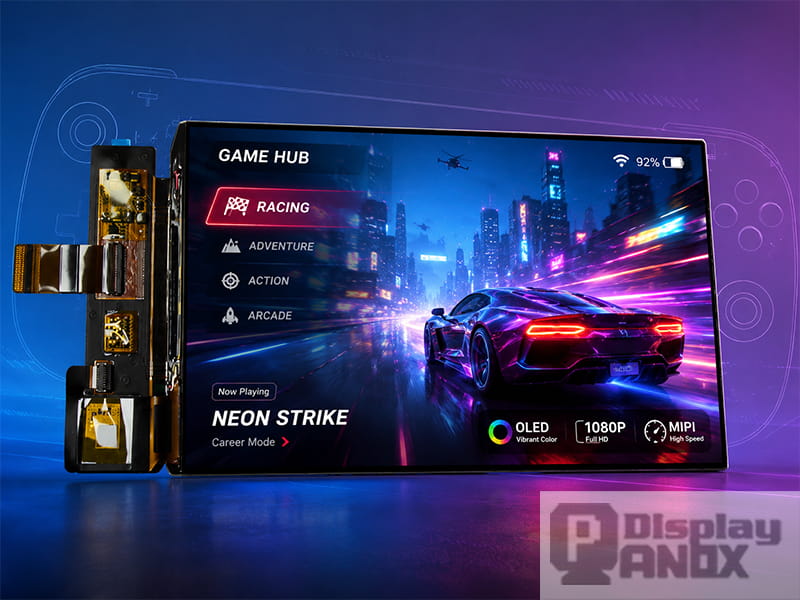
Handheld game consoles are the clearest match. They benefit from Full HD detail, high refresh rates, fast OLED pixel transitions, integrated touch, and high contrast in dark game scenes.
Portable GPS and navigation terminals can use the 800-nit brightness and sharp map rendering, provided that the cover-glass design controls reflections. Touch performance should be tested with the expected gloves, moisture conditions, and mounting structure.
Compact media controllers, camera monitors, and professional imaging terminals benefit from the panel’s color depth and contrast. These applications should include display calibration and an end-to-end evaluation of the image pipeline.
Raspberry Pi and mini-PC projects can also use the panel, although most configurations will require a compatible controller board. A generic Raspberry Pi DSI connector does not guarantee electrical or software compatibility with an arbitrary four-lane MIPI OLED panel.
When Is a 7-Inch OLED the Wrong Choice?
An OLED panel may be unnecessary for a low-cost product that displays only simple buttons or static text. A conventional IPS module can be easier to source, drive, and replace.
Applications that run a fixed interface continuously at high brightness also require careful lifetime evaluation. OLED remains suitable for many such products, but the interface and operating policy must account for differential pixel aging.
A 165 Hz panel can also exceed the needs of a basic industrial HMI. If the processor, application, and battery cannot benefit from the higher refresh rate, a simpler display may be the more economical choice.
Final Recommendation
For custom portable devices that prioritize image quality, thin construction, responsive touch, and high-refresh motion, the Panox Display PO070FMTO is the best overall candidate within the current 7-inch OLED touch screen category.
Its 1080 × 1920 resolution, 315 PPI density, 800-nit typical brightness, On-Cell Touch, four-lane MIPI interface, and maximum 165 Hz refresh rate cover the key requirements of premium handheld hardware. The panel is particularly well suited to gaming consoles, portable navigation products, compact media terminals, and other applications where the display is a central part of the product experience.
Projects using HDMI, USB Type-C, Raspberry Pi, or PC-class video sources should pair the panel with an appropriate controller solution. Panox Display can support both panel-level integration and controller-based evaluation, allowing the same display concept to move from prototype testing toward a customized portable product.
Frequently Asked Questions
Is a 7-inch OLED touch screen better than a 7-inch IPS display?
OLED provides deeper blacks, higher native contrast, a thinner backlight-free structure, and strong motion performance. IPS generally offers a lower initial cost, more controller options, and simpler integration for basic projects. The better choice depends on the product’s visual, power, lifetime, and cost targets.
Is 800 nits enough for outdoor use?
An 800-nit OLED provides good brightness headroom for portable use, but sunlight readability also depends on reflected ambient light. Optical bonding, cover-glass reflectance, anti-reflective treatment, interface colors, and viewing geometry must be considered.
Can the Panox 7-inch OLED connect directly to Raspberry Pi?
Direct connection depends on the Raspberry Pi model, DSI compatibility, panel timing, drivers, and initialization support. A compatible HDMI-to-MIPI controller board is usually the more reliable approach when native panel support has not already been developed.
Does a 165 Hz OLED screen always run at 165 Hz?
The specification describes the maximum supported refresh rate. Actual operation depends on the panel configuration, host output, graphics performance, software, and supported timing modes. Lower refresh modes should be confirmed in the latest technical documentation.
Does On-Cell Touch mean that no cover glass is required?
No. The touch-sensing structure is integrated with the display, but a protective cover lens is still normally bonded above it. The cover glass can be customized for the product’s shape, printed border, thickness, strength, and surface treatment.