







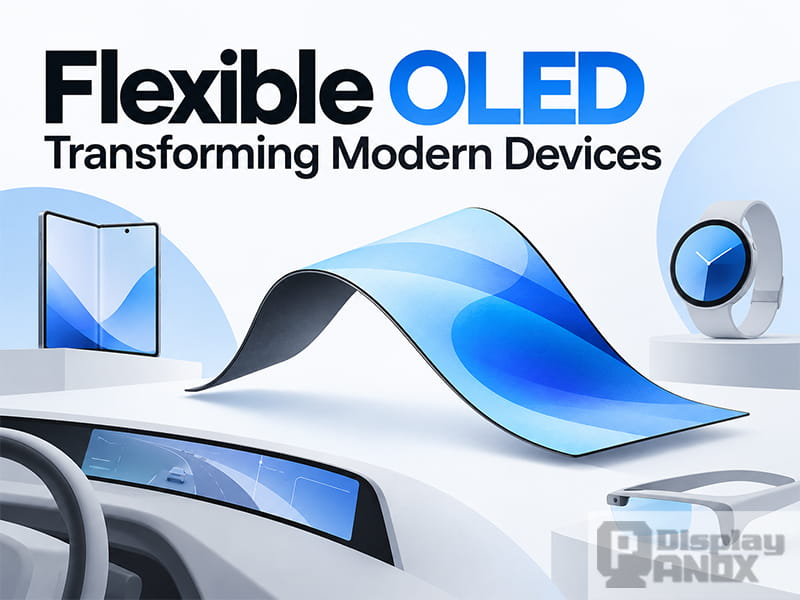
Flexible OLED display technology is changing how electronic devices are designed. By allowing screens to follow curved surfaces, fit into thinner enclosures, and support foldable form factors, flexible OLED displays give product designers options that conventional rigid panels cannot easily provide.
These advantages are particularly valuable in wearable electronics, foldable devices, automotive displays, and compact industrial equipment. However, integrating a flexible OLED involves more than choosing a bendable screen. Mechanical support, bending limitations, driver compatibility, and long-term reliability must all be considered during product development.
Understanding these design factors helps engineers determine where flexible OLED technology provides real value and how to incorporate it into practical, manufacturable products.
What Is Flexible OLED Display Technology?
A flexible OLED (Organic Light-Emitting Diode) display uses a bendable substrate, commonly made from polyimide or other flexible materials, instead of the rigid glass substrate used in conventional OLED panels.
Like other OLED displays, flexible OLED panels use self-emissive pixels that produce light without requiring a separate backlight. Their organic light-emitting layers, driving circuitry, and protective encapsulation are engineered to work within a thin, mechanically flexible structure.
The main difference is the freedom this structure gives product designers. Depending on the panel specifications, a flexible OLED can support a fixed curved installation, a foldable device, or another specialized form factor.
However, a flexible OLED panel is not automatically suitable for repeated folding or rolling. Some panels are intended for static bending, while others are specifically designed and tested for dynamic movement.
For a more detailed explanation of the display structure and operating principles, see What Is a Flexible OLED and How Does It Work?.
How Does Flexible OLED Enable New Device Designs?
The most important advantage of flexible OLED technology is its ability to accommodate product designs that would be difficult to achieve with a conventional rigid display.
1. Curved Displays That Follow Product Surfaces
Traditional rigid displays generally require flat mounting areas. This can limit the shape of the surrounding enclosure, particularly when a device has a curved housing or an irregular installation surface.
Flexible OLED panels can be designed into curved assemblies, allowing the visible display area to follow the contours of the product.
For example, a curved display may be integrated into a vehicle's dashboard, a cylindrical commercial installation, or a compact control panel with a curved front surface.
This can reduce the need to build a separate flat display compartment and provide greater freedom in the overall industrial design.
For fixed-curvature applications, the panel may be bent into its intended position during assembly and remain in that position throughout normal operation. The allowable curvature must still be verified against the panel's mechanical specifications.
2. Thinner and Lighter Device Structures
Flexible OLED technology also supports compact product designs.
Without a conventional LCD backlight assembly and with a thin substrate structure, a flexible OLED panel can contribute to a thinner and lighter display module.
This is useful for products where internal space is limited, including wearable devices, portable electronics, and handheld controllers.
However, the thickness of the bare display panel does not represent the thickness of the complete display assembly. Protective layers, touch sensors, cover materials, adhesives, and mechanical supports must also be considered.
For engineers, the practical advantage comes from optimizing the complete device structure rather than evaluating panel thickness alone.
3. Foldable Products With Larger Usable Screens
Foldable devices demonstrate another important application of flexible OLED technology.
A foldable smartphone, for example, can offer a relatively large viewing area when unfolded while remaining compact during transportation.
This design requires the display to bend repeatedly at a controlled location.
The hinge mechanism, display support structure, protective layers, and bending path must work together to prevent excessive mechanical stress.
A panel designed for a fixed curved installation should not be treated as interchangeable with a panel qualified for repeated folding.
4. Greater Freedom in Display Placement
Flexible OLED technology can also give designers more options when positioning a screen within a product.
Displays may be integrated into curved control surfaces, positioned closer to enclosure edges, or incorporated into products with unconventional proportions.
This flexibility can improve the arrangement of controls and visual information, particularly when the available installation area is narrow or irregular.
The final design must still account for the panel's non-bendable regions, driver IC location, connector position, and mechanical support requirements.
Where Are Flexible OLED Displays Used?
Flexible OLED displays are especially valuable when the physical shape of the screen plays an important role in the product.
Different applications benefit from different aspects of the technology.
Wearable Devices
Smartwatches, fitness devices, and specialized wearable electronics often have limited installation space.
Flexible OLED panels can support curved or lightweight designs that fit more comfortably within compact enclosures.
For these applications, designers must consider the panel outline, module thickness, battery placement, and the routing of the flexible printed circuit (FPC).
A smaller flexible OLED does not necessarily need to bend during normal use. In many wearable designs, the screen remains fixed after assembly.
Foldable Smartphones and Tablets
Foldable mobile devices use flexible OLED technology to combine portability with a larger display area.
The main engineering challenge is maintaining stable display performance through repeated opening and closing.
The fold region must be coordinated with the hinge and protective stack to control mechanical stress.
Display size and resolution are important, but fold-cycle requirements and mechanical compatibility are equally critical.
Automotive Displays
Automotive manufacturers increasingly explore curved displays for instrument clusters, center consoles, and integrated dashboard interfaces.
A flexible OLED panel can help the display follow the intended dashboard geometry, reducing some of the restrictions imposed by flat panels.
Automotive integration requires attention to temperature variation, vibration, operating brightness, long-term image retention, and system reliability.
The chosen module must meet the environmental and functional requirements of the specific vehicle application.
Industrial and Handheld Equipment
Industrial controllers, inspection devices, and portable instruments may benefit from lightweight screens or displays that conform to compact equipment housings.
Flexible OLED technology can be considered when a conventional rectangular display would restrict the enclosure design.
However, mechanical flexibility alone does not establish industrial suitability.
The display must also be evaluated for operating temperature, protective construction, electrical compatibility, and expected service conditions.
Commercial Displays and Product Installations
Curved OLED displays can be integrated into product showcases, retail installations, and specialized digital signage.
They can follow cylindrical, arc-shaped, or other supported surfaces, creating a display area that becomes part of the installation itself.
For these applications, engineers should distinguish between static curved displays and displays intended for continuous rolling or folding.
Long operating hours also require appropriate brightness settings and content management to reduce the risk of OLED image retention and burn-in.
Flexible OLED vs. Rigid OLED: Design Advantages and Limitations
Flexible and rigid OLED displays share the same fundamental self-emissive display technology. Both can deliver high contrast, deep black levels, and fast pixel response.
Their main differences concern the mechanical structure and the products into which they can be integrated.
| Design Factor | Flexible OLED | Rigid OLED |
|---|---|---|
| Substrate structure | Flexible substrate, commonly polyimide | Rigid glass substrate |
| Curved installation | Possible within specified bending limits | Generally requires a flat mounting surface |
| Foldable applications | Possible with specially designed and qualified panels | Not suitable for folding |
| Mechanical integration | Requires careful control of bending and support | Relatively straightforward flat mounting |
| Thickness and weight | Can support thin, lightweight assemblies | Depends on substrate and module construction |
| Mechanical protection | Sensitive to localized stress, creasing, and improper bending | Sensitive to glass breakage and impact |
| Cost considerations | May involve additional materials and integration complexity | Often simpler for conventional flat-screen designs |
A flexible OLED is worth considering when the device requires a curved display surface, a specialized form factor, or significant constraints on installation thickness.
For a conventional flat display with no bending requirements, rigid OLED may provide a simpler and more economical solution.
Similarly, flexible OLED should not automatically be considered more energy-efficient than rigid OLED. Power consumption depends on brightness, display content, driving architecture, and the specifications of the individual panel.
The appropriate choice should be based on the complete product design rather than flexibility alone.
Key Engineering Considerations for Flexible OLED Integration
Successfully integrating a flexible OLED display requires coordination between the display module, mechanical enclosure, electronic hardware, and product assembly process.
The following considerations are particularly important during development.
1. Confirm the Minimum Bending Radius
The bending radius determines how tightly a flexible display can curve without exceeding its specified mechanical limits.
A smaller radius produces a tighter curve and generally increases the mechanical strain experienced by the display structure.
However, there is no universal minimum bending radius applicable to every flexible OLED panel.
The allowable radius depends on factors including:
-
Substrate and encapsulation materials
-
Display thickness and layer structure
-
Protective films and adhesive layers
-
Location and direction of the bending area
-
Whether bending is static or repeated
Before designing a curved enclosure or hinge, engineers should obtain the relevant bending specifications from the display manufacturer.
If the required radius is not documented, it should be confirmed through supplier consultation and appropriate testing.
2. Distinguish Static Bending From Dynamic Folding
This distinction is critical when selecting a flexible OLED display.
Static bending means the panel is curved during installation and remains in a fixed position during normal use.
Typical applications include curved dashboards, cylindrical displays, and fixed curved control surfaces.
Dynamic folding means the display repeatedly changes shape during operation, as in a foldable smartphone or tablet.
Dynamic applications expose the panel to repeated mechanical stress and require additional consideration of fatigue, fold-cycle testing, and hinge design.
A display that performs well when held in a fixed curve may not survive repeated folding.
For this reason, purchasing a panel described only as "flexible" is insufficient when developing a foldable product.
3. Design the Mechanical Support and Protective Structure
A flexible OLED panel requires appropriate mechanical protection during installation and operation.
Although its substrate can bend, other components within the display assembly may be vulnerable to excessive tension, compression, or localized pressure.
Engineers should pay particular attention to:
-
Supporting the panel across the intended curved surface
-
Avoiding sharp edges and concentrated pressure points
-
Keeping rigid components outside designated bending regions
-
Selecting suitable adhesives and protective materials
-
Preventing unnecessary pulling or twisting during assembly
For dynamically foldable devices, the support structure and hinge must guide the display through its intended bending path.
Protective cover materials and touch integration must also be compatible with the required movement.
The bending performance of a bare OLED panel should not be assumed to represent the performance of the fully assembled touchscreen module.
4. Plan the FPC Routing and Driver IC Position
The flexible printed circuit (FPC) connects the display panel to the driving electronics.
Its position and orientation can significantly influence the available space inside the device.
A poorly planned FPC routing path may create excessive stress near the display connection or require additional enclosure space.
During mechanical design, engineers should verify:
-
FPC exit position and available length
-
Connector type and pin arrangement
-
Driver IC and bonding area locations
-
Clearance around the FPC connection
-
Permitted bending or folding of the FPC itself
The display's active area may be flexible while the driver IC and bonding regions remain mechanically restricted.
For compact equipment, these connection details can be just as important as the visible display dimensions.
5. Verify Interface and Controller Compatibility
Most flexible OLED panels used in modern mobile applications communicate through interfaces such as MIPI DSI, while some larger display modules use eDP.
The required interface depends on the specific panel.
Before selecting a module, engineers should confirm:
-
Display resolution and refresh rate
-
Interface type and number of data lanes
-
Required input signals and initialization sequence
-
Power supply voltages and power-up timing
-
Driver IC compatibility
-
Touch panel interface, when applicable
For example, a processor with an HDMI output cannot directly drive a MIPI DSI panel without suitable conversion hardware.
A compatible controller board can help connect the display to a development system, but its supported resolution, timing, firmware, and electrical requirements must match the panel.
Panox Display provides custom OLED/LCD controller boards, including solutions for different video input and display interface requirements.
6. Evaluate Reliability Under Actual Operating Conditions
Flexible OLED reliability depends on both panel construction and the conditions in which the final device operates.
Beyond mechanical bending, engineers should evaluate display performance under the intended operating environment.
Relevant tests may include:
-
Static bend testing at the intended installation radius
-
Repeated folding tests for dynamically operated displays
-
Temperature cycling and humidity exposure
-
Vibration and mechanical stress testing
-
Display brightness and color uniformity checks
-
Touch functionality after mechanical testing
-
Electrical connection and FPC reliability testing
Not every application requires the same test program.
A fixed indoor commercial display, for example, will have different requirements from a portable industrial device or a foldable consumer product.
OLED image retention and burn-in should also be considered in products displaying persistent interface elements or operating for extended periods.
A reliable design begins with clear operating conditions and measurable acceptance criteria.
Flexible OLED Display Modules and Customization Options
Selecting a flexible OLED panel involves more than choosing a screen size.
Resolution, aspect ratio, interface, touch functionality, physical outline, and the intended bending configuration all influence whether a panel can be integrated successfully.
Panox Display supplies a range of flexible OLED display modules for different product requirements.
The following examples illustrate how panel specifications relate to device design.
6.52-Inch Flexible OLED: Long-Strip Display Integration
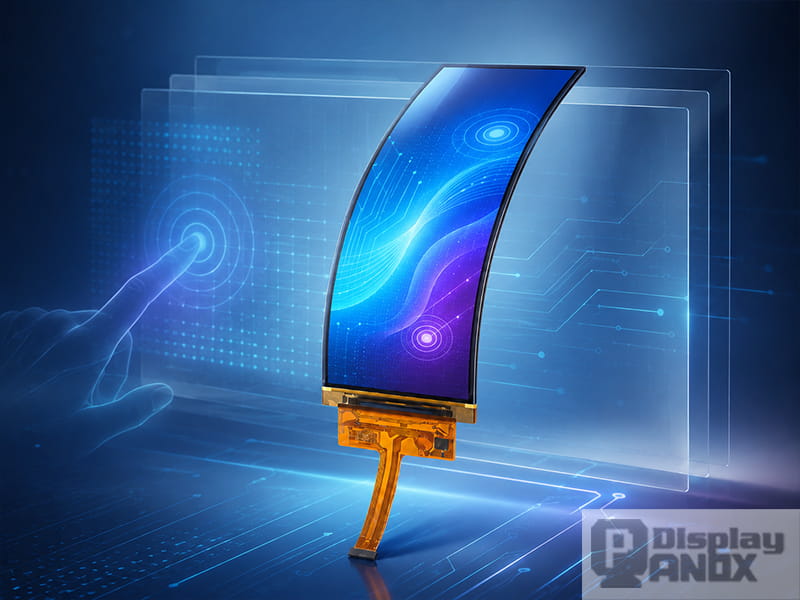
The 6.52-inch flexible OLED module, model PO652F2K, features a 2520 × 840 resolution, a 3:1 aspect ratio, and a MIPI interface.
Its elongated display format provides an option for projects requiring a long, narrow viewing area.
Possible design directions include specialized control interfaces, curved information displays, and compact equipment with unconventional screen proportions.
The product has also been demonstrated with an HDMI controller board, making it relevant for developers evaluating display performance and system integration.
7.8-Inch Flexible OLED: Curved Display Concepts
The 7.8-inch flexible OLED, model RO780FA1920M, provides a 1440 × 1920 resolution and a two-port MIPI interface.
Its larger display area makes it suitable for evaluating curved display concepts, portable devices, and specialized visual installations.
Projects involving cylindrical or curved mounting should confirm the panel's allowable bending radius and installation requirements before enclosure fabrication.
Repeated folding capability should not be assumed without supporting specifications.
8.01-Inch Flexible OLED: Compact Large-Screen Devices
The 8.01-inch flexible OLED, model PF801FM2480C, features a 2480 × 1860 resolution and a MIPI four-lane interface.
This combination of display size and resolution can be considered for compact products requiring a relatively large viewing area.
For foldable or mechanically adjustable devices, developers must separately verify the available bending specifications, touch structure, and permitted operating conditions.
13.3-Inch Flexible OLED: Larger Display Integration
The 13.3-inch flexible OLED module, model POF133F2048E, features a 1536 × 2048 resolution and an eDP interface.
Its larger active display area makes it relevant to portable monitors, tablet-style equipment, and specialized large-format display designs.
Because its interface differs from that of the MIPI-based modules above, controller compatibility and system architecture must be evaluated separately.
What Can Be Customized?
For OEM and industrial development projects, customization may involve the components surrounding the display panel as well as the system used to drive it.
Depending on the selected module and project requirements, available options may include:
-
Controller board design and interface conversion
-
FPC or adapter board configuration
-
Connector and cable selection
-
Touch panel and cover glass integration
-
Firmware and initialization support
-
Module mounting and assembly considerations
It is important to distinguish between customizing a display module and changing the specifications of an existing OLED panel.
A standard panel usually has fixed native characteristics, including its active area, resolution, driver IC, and supported mechanical limits. Changing these characteristics may require a different panel or a new manufacturing program.
For efficient development, customers should provide the intended application, required screen size, interface, bending conditions, available installation space, and expected order quantity as early as possible.
Panox Display can then help evaluate suitable panel options and supporting system components.
Conclusion
Flexible OLED display technology is expanding the possibilities of modern electronic product design by allowing screens to adapt to curved surfaces, compact enclosures, and specialized form factors.
Its greatest value lies in the new product structures it enables. Wearable devices can make better use of limited space, curved interfaces can follow their surrounding housings, and foldable electronics can combine a larger screen with a compact design.
However, successful integration depends on more than the ability to bend a display. Minimum bending radius, static versus dynamic operation, mechanical support, FPC routing, controller compatibility, and reliability testing are essential considerations.
For manufacturers developing products with unconventional display requirements, choosing the appropriate panel and supporting hardware early in the design process can reduce integration risks and simplify product development.
Explore Panox Display's flexible OLED product range or contact our team at [email protected] to discuss display module selection, controller board compatibility, and customization options for your next project.